On Earth Day, April 22, approximately 30 curious townspeople toured energy-conserving elements of the Acton-Boxborough (AB) Boardwalk Campus, learning about the systems that make it possible for this building to consume far less energy than other schools of similar capacity, and thus emit less planet-warming carbon pollution.
The Boardwalk campus, located in West Acton, houses the Douglas Elementary School, the Gates Elementary School, and the Carol Huebner Early Childhood Program (CHECP). The tour began with a chance to mingle and snack in the school’s STEM (science, technology, engineering, and math) lab, followed by a presentation by Energy Manager Kate Crosby. Crosby played a key role in bringing the energy-efficient building into existence and developing curriculum materials to help students in all AB grades learn about energy efficiency and environmental sustainability. Mothers out Front and Energize Acton organized and helped with hosting the event.
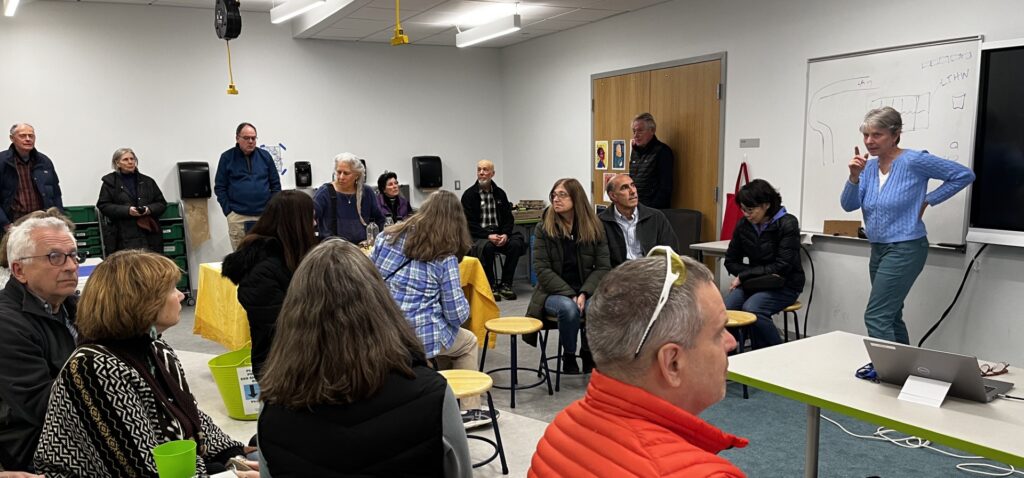
In her introductory talk, Crosby explained that the school was designed in 2019, using a life cycle analysis looking 50 years out in the future. With that long planning horizon, geothermal heating and cooling was found to be more cost effective than fossil fuel options in the long run, although more expensive in the short term. Incentives from the federal Inflation Reduction Act further decreased the cost.
She explained that the school’s geothermal heat pump system includes 65 wells, drilled up to 600 feet deep into the bedrock on the north side of the building. The temperature at that depth stays the same year-round, around 50°F, so it is cooler than air temperature in the summer and warmer in the winter. A mixture of water and antifreeze circulates down then up through closed loop pipes installed in each well, absorbing heat from the earth when the building needs heating, and dumping heat into the earth when the building needs cooling.
In addition to the geothermal system, the building also saves energy by having a tight building envelope, minimizing leaks through which outside air can sneak in and inside air can slip out. When the building was completed, an air-leakage test or “blower test” was performed on the building as a whole. The turnover of air was measured as 0.06 CFM50/sf, matching the Passive House Institute standard for air tightness.
The metric for judging a building’s energy conservation effectiveness is Energy Use Intensity (EUI), measured in kBTU/sf/yr (thousand British Thermal units per square foot of building area per year). According to Crosby, the typical EUI for schools is in the range of 65-75. The Boardwalk Campus was designed to run at 23.1 EUI. The school opened in 2022; after three years of operation, the actual EUI is measured at 20 EUI, even better than expected.
Behind the scenes
After the introductory talk, the tour group squeezed into the “mechanical room,” where the massive pipes, pumps and other hardware for the geothermal system are located. In cold weather, a bank of five pumps pushes near-freezing fluid down into the underground pipes, where it picks up heat from the Earth, and then returns to the mechanical room at a milder temperature. In warm weather, hotter water is pumped into the underground pipes, where it dumps heat into the earth and returns to the mechanical room again at a milder temperature.
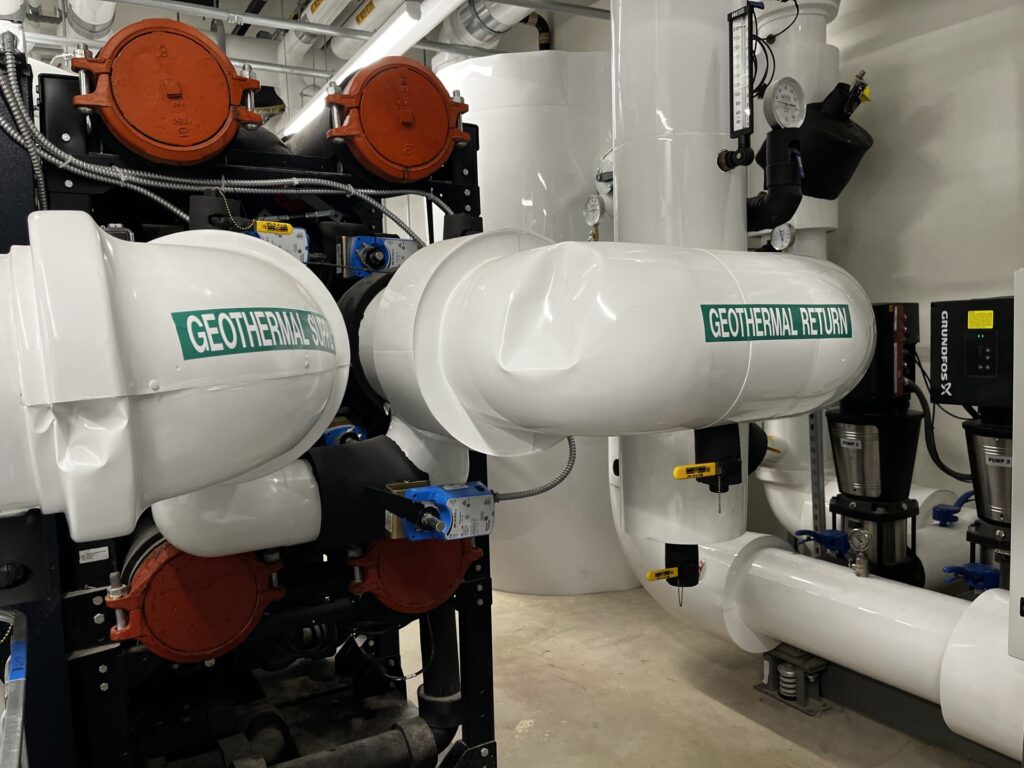
The heart of the mechanical room is an array of large heat pumps, pictured below. Inside each of these there is a closed loop of pipe containing refrigerant, a chemical substance that cycles back and forth between its gaseous and liquid states. As you might remember from science class or experience with SCUBA tanks or a bicycle pump, compressing a gas causes it to get hotter and releasing the pressure causes it to get colder.
Inside the heat pump, an electrically driven compressor and a clever system of valves and pipes manipulate the refrigerant such that when heating is needed, hot refrigerant on the building-facing side of the heat pump can heat up water to circulate through the building, and when cooling is needed, cold refrigerant on the building side of the heat pump can chill water to circulate through the building. Meanwhile, on the earth-facing side of the heat pump, cold refrigerant is chilling or hot refrigerant is heating the geothermal fluid that will be sent down into the earth. (If you find this technology intriguing, the Energize Acton website offers more details plus advice on residential heat pump systems.)
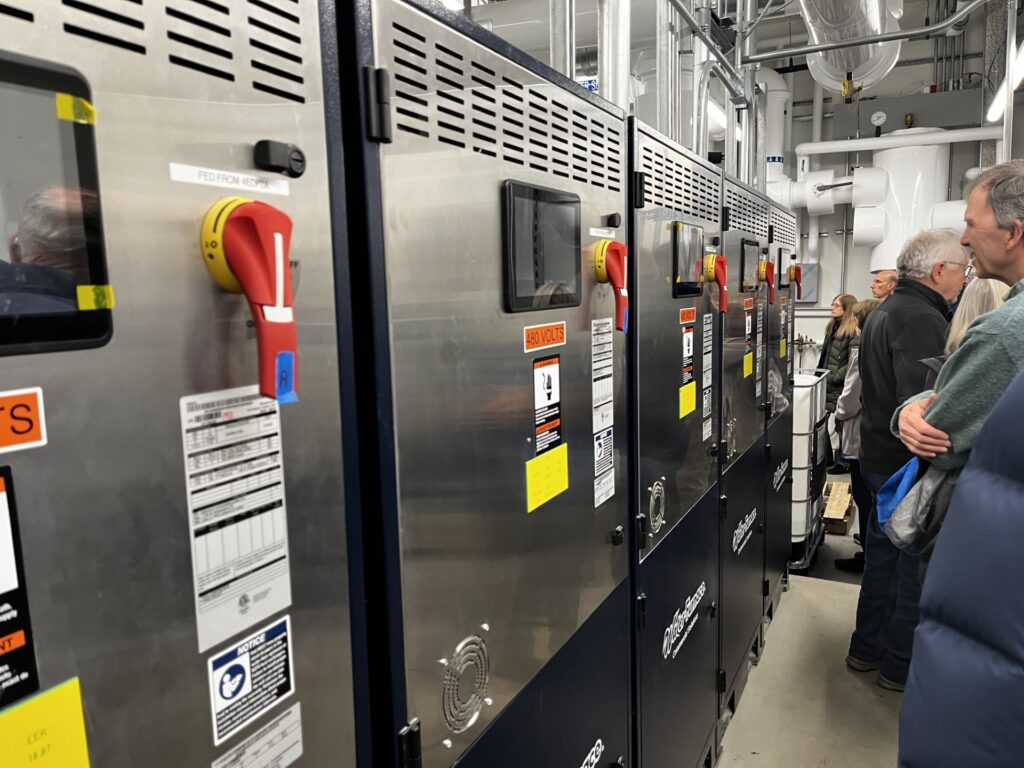
Yet another set of pipes and pumps circulate chilled water or hot water from the mechanical room throughout the building. Chilled and hot water go to two destinations: to the classrooms and other occupied spaces to radiantly cool or warm those spaces, and also to the roof to assist in cooling or warming the air coming into the building.
Our tour group was too large to visit the roof. But had we gone there as our next stop on the tour, we would have seen an array of roof top units with energy recovery wheels (see image in this slideshow). The energy recovery wheels precondition fresh air coming into the building. The duct for the incoming air runs alongside the duct for the outgoing air, and a large rotating wheel slowly turns between them, transferring heat and moisture. In cold weather, the incoming cold dry air gains heat and moisture from the outgoing air. In hot weather, the incoming hot steamy air loses heat and moisture into the outgoing air. In all weather, energy is saved. The pre-conditioned incoming air then passes across heating or cooling coils that bring it up or down to the desired temperature before delivery to the classrooms and other occupied spaces.
The view from the classroom
The group then visited one of the classrooms, where we saw the business end of the two systems of heating and cooling. On the ceiling adjacent to the windows, we saw radiant panels. Behind the visible part of the panels, there are pipes that carry cold or hot water from the mechanical room, to cool or heat the classroom. Along one wall near the floor, we saw vents that deliver fresh air from outside, which had been filtered and heated or cooled up on the roof.
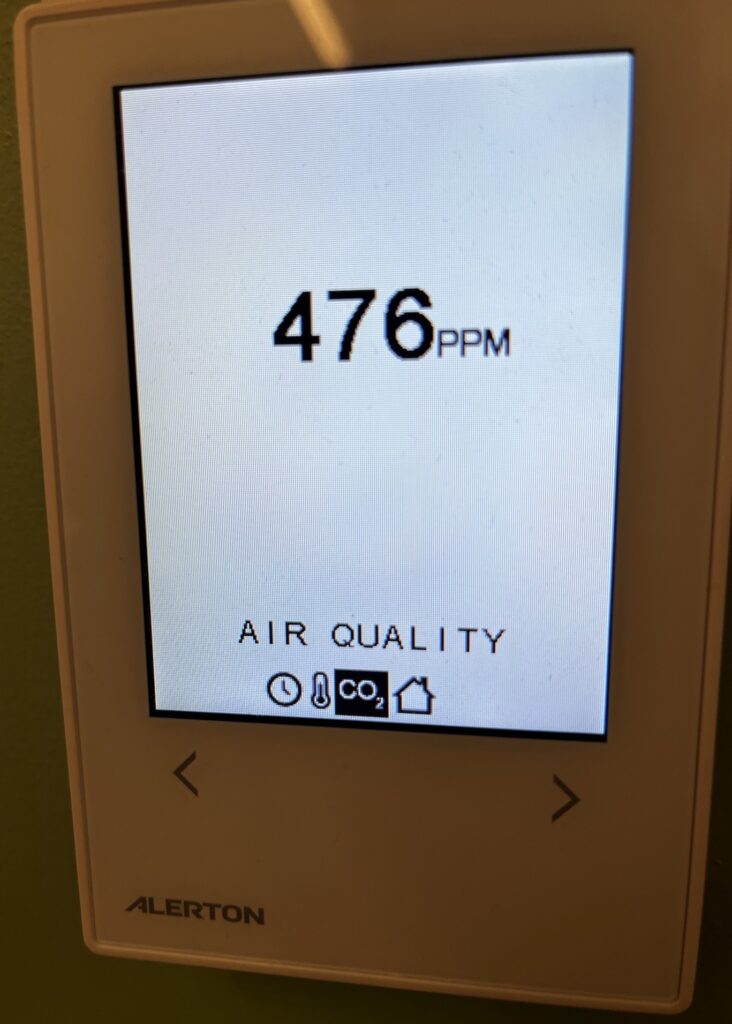
This two-part heating and cooling system saves energy by not bringing in outside air (which needs to be heated or cooled) more often than necessary for air quality. The carbon dioxide level in each classroom is monitored continuously; the tour group watched on a thermostat-like display as the exhalations of our group gradually drove up the carbon dioxide level. Based on these measurements, fresh air is brought in from outside only when required to keep the air quality healthy and the students alert.
Ms. Crosby also explained how the air handling and temperature controls are optimized for the varying needs of each space in the building. In most home heating and air-conditioning (A/C) systems (and in older municipal buildings such as Acton Town Hall), the entire building is either heated, air conditioned, or neither, and the switch over from heating to A/C is made manually. But in the Boardwalk School building, excess heat from rooms on the sunny side of the building can be harvested to heat rooms on the shady side of the building.
Teaching and learning about energy and sustainability
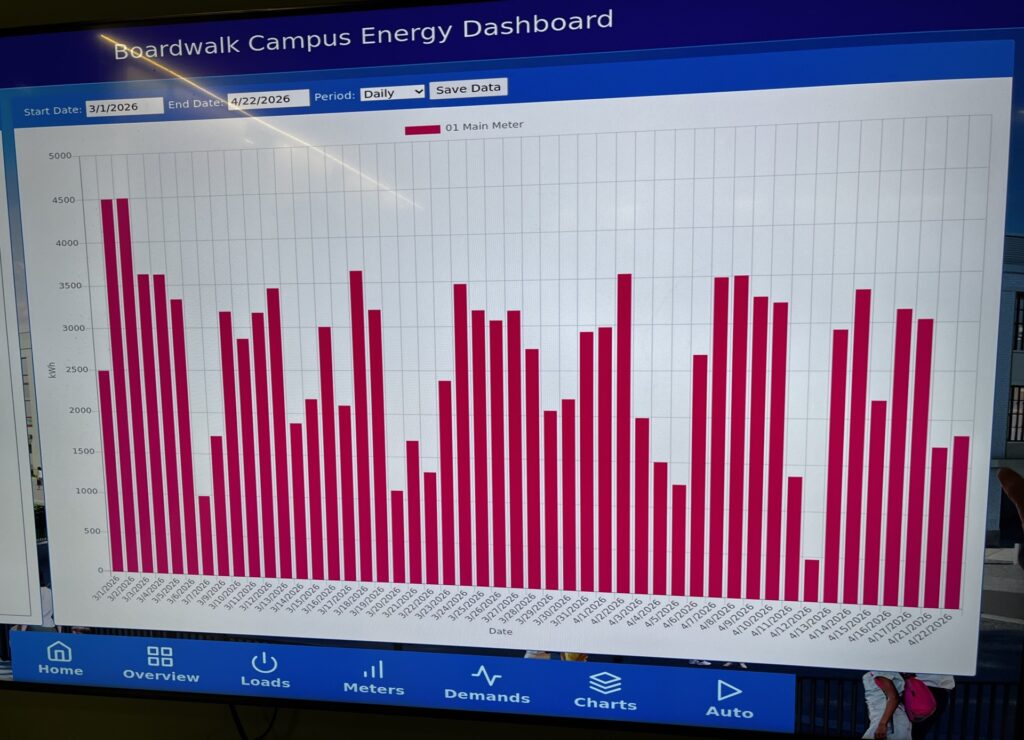
In addition to saving energy, the building itself is also used as a real-life environment for teaching and learning about energy, conservation, and environmental sustainability. Environmental Science students from the high school study the sustainability infrastructure in the Boardwalk school. A large display screen in the main corridor, called the Boardwalk Campus Energy Dashboard, rotates through various data visualizations of real time environmental data.
Still a work in progress
An innovative design is only the first step towards achieving an environmentally sustainable facility. Much additional effort and ingenuity are required to make it all work. Although the tour demonstrated substantial accomplishments around environmental sustainability, two major elements of the original vision have not yet been achieved.
The school design called for solar panels on the roof and above the parking lot, with a large on-site battery energy storage system (BESS) that would store excess energy generated during low-usage times and make it available for use during times of high demand. The BESS component of the project generated significant controversy, with parents and abutters expressing concern about fire risk, noise, and flooding. In the end, the Board of Health denied the necessary Hazardous Materials permit. Ms. Crosby said that the current plan is to put solar panels on the roof of the Boardwalk School building, which will provide approximately one third of the electricity used by the school without the need for a large BESS. She expressed optimism that within five years or so, a viable energy storage system would be available and the campus could achieve its original goal of becoming an energy net-zero facility, consuming only as much energy as produced on site.
Another component of the original design that remains a work in progress concerns water rather than energy. Rainwater and snowmelt from the roof of the building is funneled into an 18,000 gallon underground tank. The intent was that this water would be used for flushing toilets. This system has never worked as designed. In a follow-up phone conversation, Marc Hamel, the school district Facilities Coordinator, explained the problems and prognosis. In retrospect, it turns out that a filter that was supposed to clean the roof water before it entered the subterranean tank was not installed. Thus, the tank accumulated a layer of sludge, and when water was drawn into the system it contained debris that fouled a second filter inside the building and eventually caused a pump to seize up. The filter is now in place, the sludge has been removed, the failed pump has been replaced, and the team is working on a control panel fault. Mr. Hamel expressed confidence that toilets will be flushing with rainwater by the time the new school year begins, saving as much as 70% of the building’s water usage that would otherwise have to come from the public water supply.
Kim Kastens is an associate editor and Board member of the Acton Exchange, and writes on environmental topics.