The clock is ticking. On June 24 at 6:00 p.m., residents will have their first formal opportunity to weigh in on how one of the most frustrating bottlenecks in the region gets fixed. The public comment hearing will be held at Concord Middle School auditorium, 835 Old Marlboro Road in Concord – and, if you drive Route 2, this meeting is worth your time.
Last month, the Acton Exchange reported on the growing momentum to overhaul the Concord Rotary. Since then, I’ve obtained the Massachusetts Department of Transportation (MassDOT) presentation from the May 11 legislative site visit meeting organized by State Representative Simon Cataldo. The slide deck fills in many details; specifically, the design of the four alternatives MassDOT is actively evaluating, their trade-offs, and their price tags.
Here’s what Acton residents need to know.
Why this is everyone’s problem, not just Concord’s
MassDOT’s own data frames the issue clearly: nearly 90% of the 50,000 vehicles that pass through the Concord Rotary each day are through-trips – drivers with no origin or destination in Concord. The rotary is a state right-of-way on Route 2, a regional artery.

Acton Select Board member Dean Charter expressed Acton’s interests plainly: “While the rotary might physically be located in Concord, it is a state right of way that impacts the entire Commonwealth. When the rotary does not work – which is always – overflow traffic fills the streets in Acton and lengthens the commutes for people as far west as Gardner.”
State Senator Jamie Eldridge, who represents multiple communities west of the rotary including Acton, echoed that regional framing: “As the state senator for many communities west of the Concord Rotary, including Acton, I continue to be grateful to MassDOT for taking critical steps to fix the Concord Rotary.”
MassDOT’s purpose statement, drawn from its original environmental filing, is straightforward: grade-separate local and regional traffic movements that currently feed into the rotary, reduce delays, improve safety, improve air quality, and add pedestrian and bicycle accommodations. The trigger for moving now is the closure of the MCI Concord prison, which opens new land opportunities and also raises urgency – the planned redevelopment of the prison site will generate additional traffic that will make an already-broken rotary even worse.
The Four Alternatives
MassDOT and its engineering consultant AECOM have developed four design alternatives, each with distinct engineering logic, costs, and trade-offs. In all cases, acquiring the Gulf gas station parcel at the rotary is required. In addition, Barrett’s Mill Road will no longer feed into a five-way intersection; instead, Barrett’s Mill Road traffic will be diverted into a T-intersection with Great Road a bit farther north.
Alternative 1: Diamond Interchange: $175–$200 million
The most familiar interchange form in Massachusetts, a diamond interchange, would carry Route 2 over or under the local road network, making it free-flowing. It is the most compact of the three grade-separated options. The downsides are higher construction costs driven by bridge work, retaining walls, and earthwork; and ongoing bridge maintenance obligations.
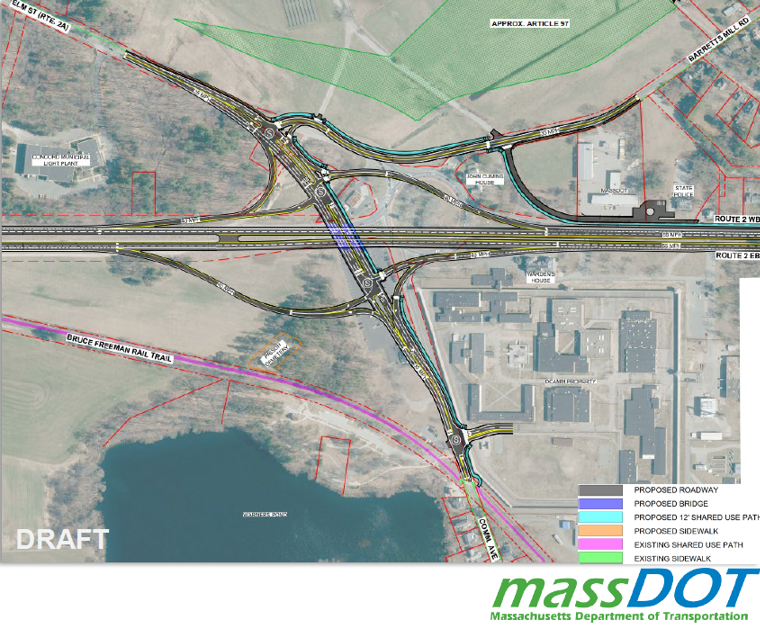
Alternative 2: Partial Cloverleaf Interchange: $165–$180 million
This option also makes Route 2 free-flowing and adds a meaningful safety benefit: loop ramps that eliminate left turns across opposing traffic. On the downside, it has a larger footprint than the diamond interchange and carries similar costs for bridges and earthwork.
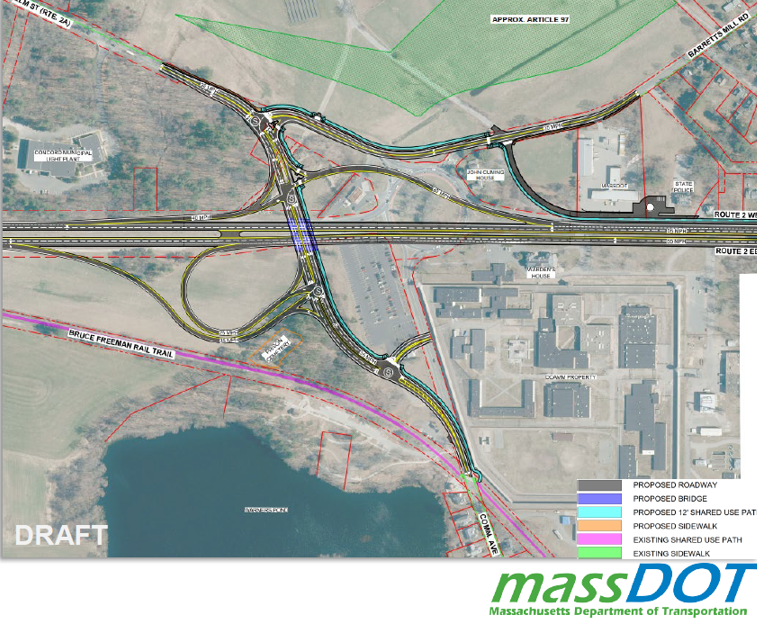
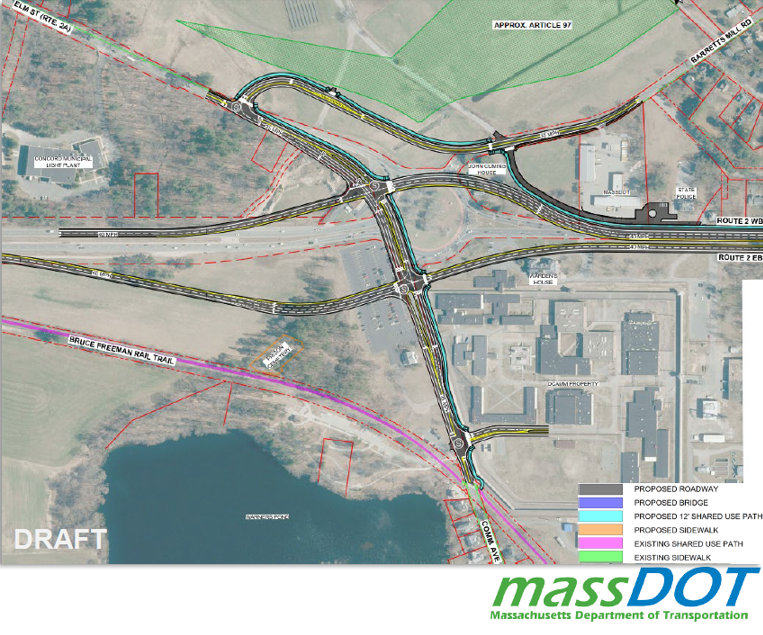
Alternative 3: At-Grade Split Intersection: $90–$110 million
The least expensive option by a wide margin — roughly half the cost of the grade-separated alternatives — this design replaces the rotary with conventional at-grade intersections. It is simpler to build and easier to integrate with adjacent properties. However, Route 2 would not become free-flowing, meaning through traffic would still face traffic signals and conflict points. It also requires removing the historic John Cuming House, a locally significant structure.
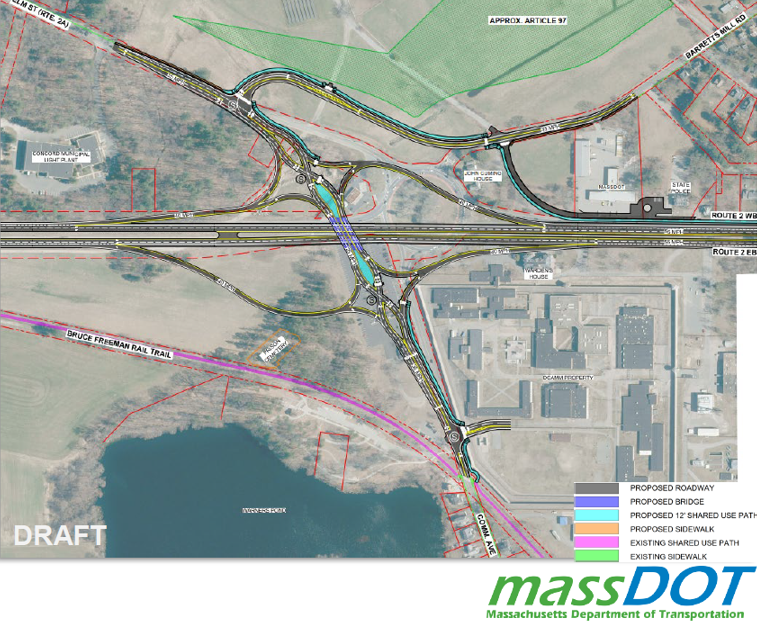
Alternative 4: Diverging Diamond Interchange: $175–$200 million
The diverging diamond is the most technically innovative of the four options. It makes Route 2 free-flowing, reduces conflict points, eliminates left turn conflicts, and allows free-flowing left turns onto freeway ramps – a meaningful operational advantage. The trade-offs mirror the standard diamond: higher bridge and earthwork costs, and bridge maintenance. There is one additional concern unique to this design: the unfamiliar geometry of a diverging diamond, where traffic briefly crosses to the opposite side of the road, can confuse drivers encountering it for the first time.
What the traffic data shows
MassDOT’s travel time analysis compares the four alternatives against a “no build” baseline at three reference locations along Route 2. The pattern is consistent: all four alternatives produce meaningful travel time reductions relative to doing nothing, and the three grade-separated options (Alternatives 1,2,4) generally outperform the at-grade split on throughput, particularly during the afternoon peak hour, when the no-build condition shows travel times ballooning well past six minutes for certain corridor segments. The grade-separated options cut those times roughly in half.
The (draft) crash data from 2020 to 2024 adds a safety dimension to the efficiency argument. The rotary and its immediate approaches recorded 329 crashes over that five-year period, including three suspected serious injuries, 48 suspected minor injuries, and 20 possible injuries. The remainder were property-damage incidents. A grade-separated design eliminates the core conflict points that generate many of these crashes.
What comes next – and when
MassDOT’s design schedule is ambitious but still years away from construction. A public information meeting is planned for July 2026. MassDOT expects to identify a preferred alternative in fall 2026, begin 25% design in spring 2027, and complete the 25% design public hearing process by winter 2028–2029. The project is targeted for construction advertisement in fiscal year 2030.

This timeline makes the June 24 hearing particularly consequential. It is the opportunity to shape which alternative MassDOT advances before engineers invest heavily in detailed design. Once a preferred alternative is selected in the fall, the design becomes much harder to alter.
Representative Cataldo, who organized the May 11 legislative meeting that produced the presentation materials, signaled he intends to move decisively: “Our community is ready for change at the rotary. I’m grateful to MassDOT for scheduling a public comment opportunity so quickly, and I look forward to promptly deciding on a plan.”
Senator Eldridge urged the Concord Select Board specifically to take action: “With the upcoming hearing in Concord on June 24, I urge the Concord Select Board to send a letter to MassDOT expressing the town’s support for this major state road project.”
Representative Danillo Sena, who also represents communities west of the rotary, welcomed the progress: “A replacement of the Concord Rotary has been long overdue. I am grateful for the efforts that all advocates have made to now make it a priority. All four proposed plans will reduce the average traffic time, which is an important issue for my constituents west of the rotary. I am excited to see a plan progress.”
A note on who gets a voice
One undercurrent worth naming: the hearing is in Concord, and the rotary is in Concord, but the impact of this intersection radiates well beyond Concord’s town line. Acton Select Board member Charter made the governance point directly, saying that while Concord residents have important input, a single town should not hold veto power over a project that affects commuters across the region.
That’s the case for Acton residents to show up on June 24. The outcome of this process will shape Route 2 for many years. The meeting is open to the public, and public comments submitted at hearings like this become part of the official project record that MassDOT and federal reviewers must consider.
The details
What: Public comment hearing on Concord Rotary redesign alternatives.
When: Tuesday, June 24, 6:00 p.m.
Where: Concord Middle School auditorium, 835 Old Marlboro Road, Concord. Mass DoT’s announcement does not mention an option for remote participation, but does offer reasonable accommodation or language assistance with advance notice.
Greg Jarboe is the Acton Exchange beat reporter for the Council on Aging and also writes on various topics of community interest.