Drivers passing Acton Town Hall, Littleton Common, or along Great Road in Acton or Parker Street in Maynard may have noticed a striking and increasingly familiar sight: a line of silent demonstrators holding stark black signs with bold, white, all-caps lettering.
The group calls itself the “Signs of Fascism Brigade,” a small but persistent local activist organization that has been staging roadside demonstrations across the region since last November.
Each protest unfolds to drivers like a visual sequence. A lone sign introduces the theme: “SIGNS OF FASCISM.” Several yards ahead, another reads, “REPLACING SCIENCE WITH IDEOLOGY,” followed by the refrain repeated on every placard: “THIS IS FASCISM.” Farther along, additional signs appear — “USING THE MILITARY ON CIVILIANS”. Then, “IGNORING DUE PROCESS”. Each sign is presented in identical style and spacing, and the entire procession stretches for several hundred feet.
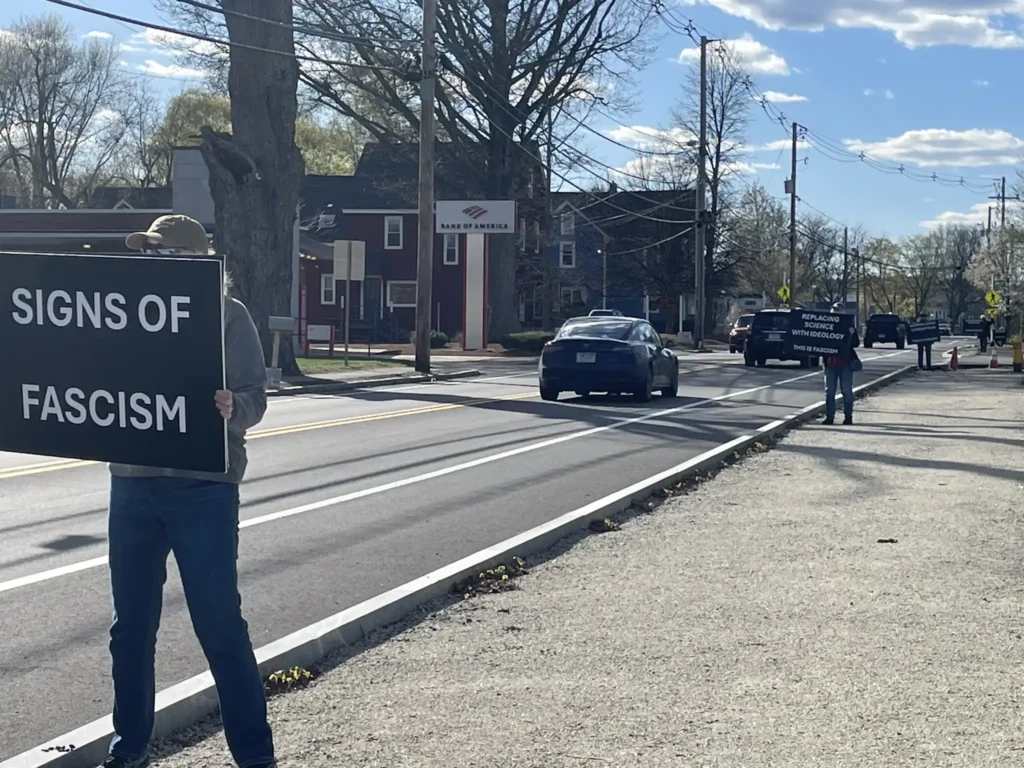
The effect, as drivers move past, is deliberate. Rather than chanting or engaging directly, participants rely on what they describe as “silent visual protests,” allowing the message to emerge one sign at a time.
“It’s meant to be experienced in motion,” said one participant. “People read it as they drive, in a sequence.”
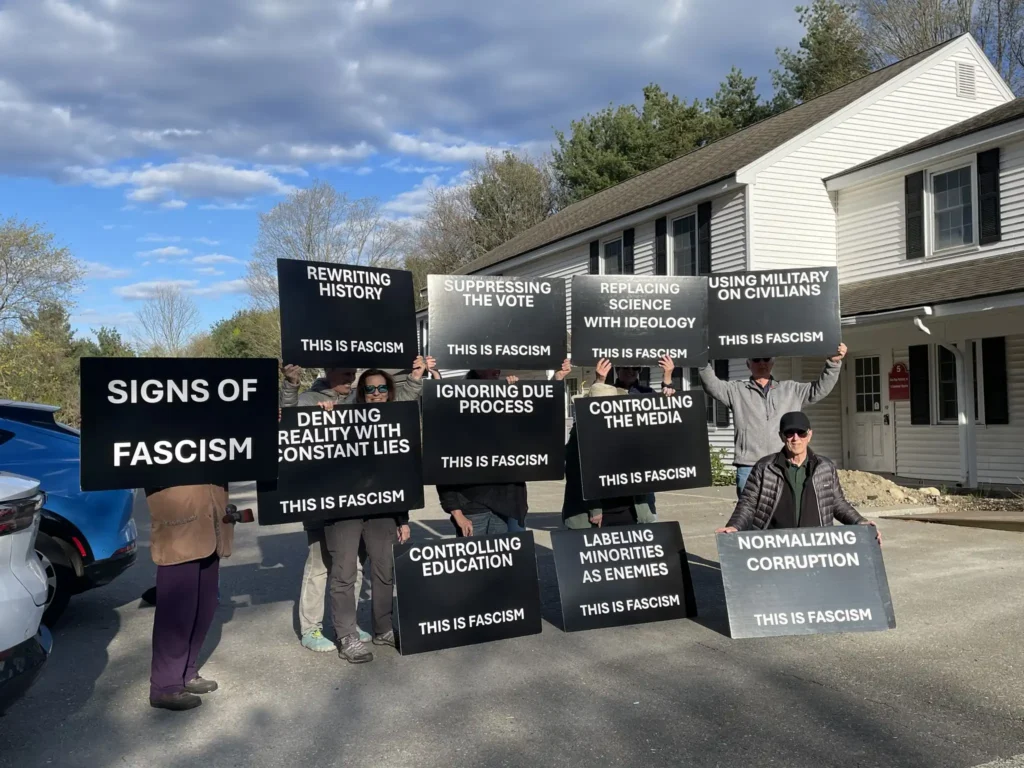
The local brigade began modestly, with three retired professionals who recruited friends and acquaintances. Participation has since expanded through personal networks and support from the local Indivisible chapter. Though the group typically numbers only a dozen at any given event, organizers say they have held 15 demonstrations with a rotating cast since November, including several staged in front of high snow banks on freshly cleared sidewalks. Most participants have chosen to remain anonymous, further highlighting the erosion of public trust.
Similar demonstrations using the same format have appeared in other parts of the country, including Ohio, California, and Arizona, suggesting a broader, loosely connected movement.
For some participants, the decision to join evolved over time. One early member recalled initial skepticism: “In October, I saw the words ‘signs of fascism,’ and I thought it was too much. But here we are in April, and now I’m totally on board.”
One organizer said the group’s message has only become more urgent in recent months. “When we started, we asked ourselves if we were being alarmist”. But now, “Less than six months later, we feel there are clear examples of everything we’re pointing to.”
The demonstrations have drawn a range of reactions from passersby. Many drivers slow down, and honk in enthusiastic support, while others choose to focus on the road ahead. For participants, the mixed response is part of the experience.
“When I see cars go by and younger people don’t even look up,” said Jodi, one of the organizers, “I wonder if they understand what’s happening.”
Participants cite a range of concerns motivating their involvement, including distrust of current government institutions and fears about the erosion of democratic norms. “We’re not immune,” one demonstrator said. “There’s no guarantee with democracy.” Another pointed to what she described as growing corruption and the weakening of scientific agencies such as the Environmental Protection Agency and the Centers for Disease Control and Prevention.
Despite the gravity of their concerns, many participants frame their efforts in modest terms. “I can’t change major events,” one said, “but if I change one person’s mind, it’s worth it.”
Others are less optimistic about the long-term outlook for institutions. “It won’t be rebuilt in my lifetime,” said one participant.
Still, some members find encouragement in the act of participation itself. One naturalized U.S. citizen, born in Germany, emphasized what she sees as a uniquely American strength: “Grassroots organizations here are amazing. So many people volunteer. You don’t see that everywhere else.”
For now, the Signs of Fascism Brigade remains a small but visible presence along local roadways — silently holding signs, one after another, as traffic passes by.
Jamie Jacobs retired in 2025 after teaching Physics at Fitchburg High School for eleven years. Before that he was a serial technology entrepreneur and founder of five companies with a focus on 3-D medical imaging.