If you’ve ever sat in a line of traffic crawling toward the Concord Rotary on Route 2, you’ve probably wondered: does anyone in state government actually know this is happening? On Monday morning, the answer was yes — and they showed up in force.
State Representative Simon Cataldo of Concord convened a remarkable day of engagement on Monday. It began at the rotary itself, where Secretary Eng, Undersecretary Gulliver, Massachusetts Division of Capital Asset Maintenance and Management (DCAMM) Commissioner Adam Baacke, Concord Town Manager Kerry Lafleur, Acton Town Manager John Mangiaratti, Rep. James Arciero, Rep. Michael Kushmerek, and Senator John Cronin conducted an on-site inspection of the intersection, essentially standing in the shadow of the problem they are trying to solve.
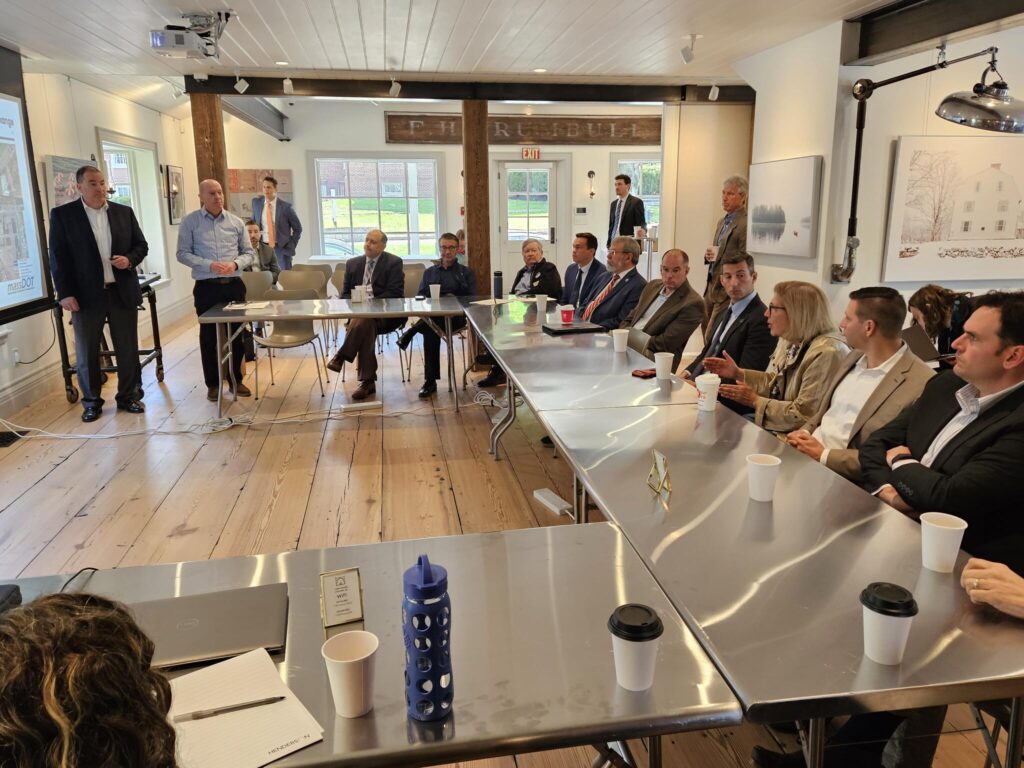
From there, the group moved to the 1780 House on Monument Street in Concord, where the stakeholder meeting expanded to include a broader legislative delegation and planning consultants. In all, more than two dozen people gathered to address two intertwined issues that will shape the future of the region for decades: the long-overdue redesign of the Concord rotary and the redevelopment of the adjacent MCI Concord prison site.
For Acton residents who commute toward Boston on Route 2 every day, this meeting matters enormously. Here’s what you need to know.
The rotary: Four options, a tight budget, and a long road ahead
Jonathan Gulliver, Undersecretary of Transportation and MassDOT’s (Department of Transportation) Highway Administrator, presented the current status of the Route 2 Concord rotary redesign project.
The rotary sits at the intersection of Route 2, Concord Turnpike (Route 2A/119), Barretts Mill Road, and Commonwealth Avenue. It carries roughly 50,000 vehicles per day and, by MassDOT’s own assessment, operates at Level of Service F — the lowest possible grade — during peak hours. The rotary and the nearby Elm Street/Route 2 intersection are classified as high-crash clusters. In plain terms: it is a dangerous, dysfunctional bottleneck.
MassDOT has developed four design concepts for the site:
- Concept 1: Diamond Interchange. Route 2 flows freely. Commonwealth Avenue is elevated above Route 2 in a grade separation. A relatively straightforward configuration.
- Concept 2: Partial Cloverleaf Interchange. Route 2 flows freely, and loop ramps eliminate the need for left-turn movements across opposing traffic. According to MassDOT, this concept maximizes usable land for future development of the MCI Concord site and is the most feasible option if right-turn-in/right-turn-out access to the development from Route 2 is required.
- Concept 3: At-Grade Split Intersection. The least expensive and least complex option, but also the least effective. Route 2 would not flow freely, and MassDOT projects that even after construction, this intersection would still rate at Level D or F during peak hours. In other words, it would be an expensive way to not solve the problem.
- Concept 4: Diverging Diamond Interchange. Route 2 flows freely, and the design reduces conflict points by eliminating left-turn disputes. The trade-off is that this concept has the largest physical footprint of the four.
Estimated construction costs range from $110 million to $200 million, depending on which concept is selected.
Acton Select Board member Dean Charter, who attended the meeting, summarized the choice bluntly: “The traffic signal option [Option 3: at-grade split intersection] would provide no traffic improvement. The other three all provide substantial improvement. The three practical options all would alleviate cut-through traffic in the residential areas of Acton and Concord.”
As for timing: Charter noted that under the best-case scenario, the project will not go out to bid until 2031. Public outreach meetings are expected to begin this spring or summer, with the goal of coalescing around a preferred concept by fall or winter 2026. After that, the project moves into Preliminary Environmental Filings, a lengthy process before a shovel can touch the ground.
The state officials who walked the site and then sat through the presentations were direct about what they saw and what they intend to do about it.
Secretary Eng framed the project as a matter of giving commuters their time back: “MassDOT is committed to delivering a safe transportation system that best serves the needs of today’s traveling public. We look forward to continuing these conversations and working together to advance solutions that strengthen connectivity, improve reliability, and support the communities along the Route 2 corridor.”
Undersecretary Gulliver pointed to the on-site inspection as a turning point in how the project gets communicated: “Yesterday’s visit to the Route 2 rotary was a valuable opportunity to share MassDOT’s vision for improving this critical connection with our legislative partners. We will continue to advance this project in coordination with the community and elected leaders to ensure the redesign reduces congestion, improves safety, and provides a reliable travel experience for Concord and the surrounding communities.”
DCAMM Commissioner Baacke, whose agency oversees the MCI Concord property, underscored that the two projects, the rotary fix and the prison redevelopment, are a rare chance to solve two regional problems at once: “DCAMM appreciates the leadership that Representative Cataldo and his legislative colleagues have displayed in championing this tremendous opportunity to leverage the closure of the MCI-Concord facility, and through state and municipal collaboration simultaneously address a long-standing transportation challenge and foster the production of much needed housing on surplus state property.”
Rep. Cataldo himself was unambiguous about the engineering conclusion: “The data based on MassDOT’s comprehensive research is clear: an above-grade solution is the only way to meaningfully improve congestion and safety, and to finally create non-vehicle-dependent connectivity in Concord across Route 2. Today’s meeting marks an important step forward in bringing key stakeholders to the table to move this project from planning to action.”
Acton’s stake in the outcome
The Concord Rotary is not just Concord’s problem. For the thousands of Acton residents who use Route 2 daily, the rotary is an everyday source of delay, stress and, sometimes, hardship.
State Representative Dan Sena of Acton spoke directly about what is at stake for his constituents: “An unreliable route means an unreliable schedule. Arriving late to work or appointments can suddenly throw people into missed school pickups, missed doctor’s appointments, and job insecurity. The four design plans at the meeting for Concord Rotary’s redevelopment would all reduce average commute times.”
Acton Town Manager John Mangiaratti was cautiously optimistic: “I am thankful for the efforts of Rep. Cataldo for bringing this impressive group of stakeholders together. It appears that there is momentum to resolve this regional and statewide transportation problem. It was interesting to hear from participants how the rotary is not just a road safety issue but also a significant economic and quality of life issue as well. Several concepts to replace the rotary were presented, and the above-grade crossing concepts had the greatest potential to improve safety and efficiency.”
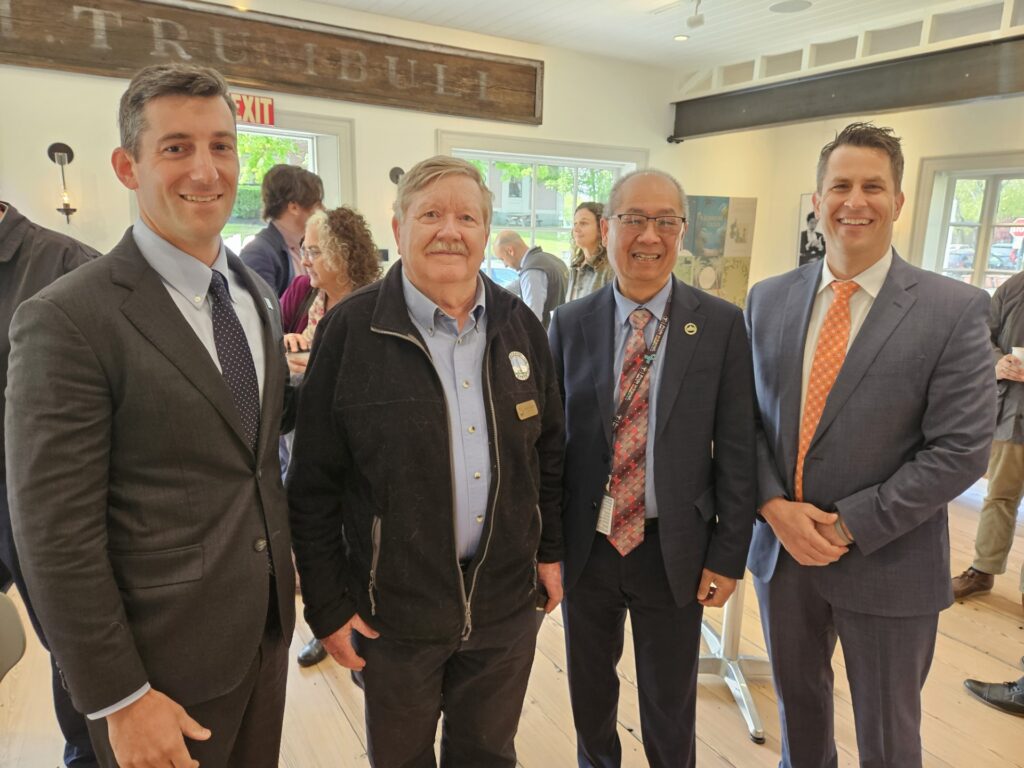
State Senator Jamie Eldridge of Marlborough, whose district encompasses many communities west of the rotary, issued a pointed call to action: “For decades, the Concord Rotary has created major safety concerns and daily congestion challenges for residents and commuters traveling [from] west of Concord and throughout the region. Today’s meeting sends a clear signal that the ‘rubber is hitting the road’ on finally advancing towards a solution. I urge continued support for placing this project on the TIP and advancing a solution for the thousands of residents who rely on this route every day.” The Transportation Improvement Program (TIP) is the state’s mechanism for committing federal and state transportation funding – getting on it is a critical step toward actual construction.
The prison next door: A 54-acre opportunity
Directly adjacent to the rotary sits MCI Concord, a medium-security state prison whose future is now being actively planned. The redevelopment of this site – roughly 54 potentially developable acres in West Concord – was the second major topic of Monday’s meeting.
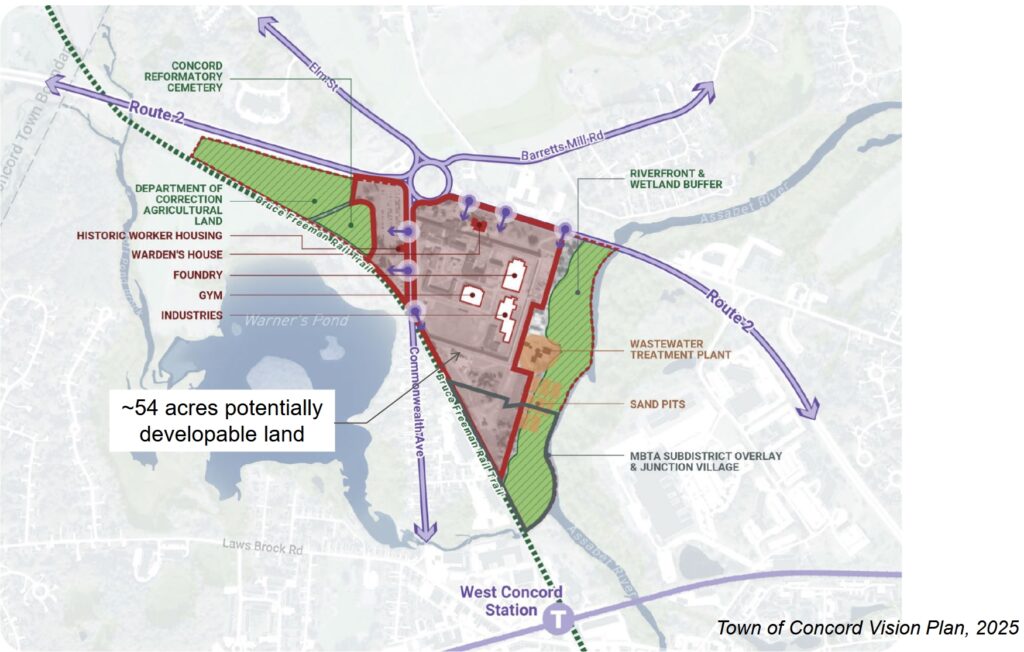
Chris Dempsey of Speck Dempsey, part of the Stantec consultant team hired by the Town of Concord to lead the MCI Master Plan process, presented the vision for what could replace the prison. The planning process officially kicked off on May 5, 2026, and is on an ambitious timeline to produce a Master Plan and draft zoning by the end of this year.
The process is organized around five guiding principles for the site:
- A green habitat corridor along the Assabet River, designed to be climate-resilient and sustainable.
- A uniquely Concord destination that reflects the town’s history, character, and quality of life.
- A walkable neighborhood – a place to live and thrive.
- An economic engine for Boston’s MetroWest region.
- A net positive contributor to Concord’s fiscal health, livability, and traffic.
What does that look like on the ground? The planning team has been studying the existing West Concord neighborhood and examining how a new development can feel like a genuine extension of the community, not a bolted-on subdivision. Key questions include where to locate streets, how to connect the site to existing neighborhoods and transit, and how to protect the environmental character of the Assabet River corridor.
The schedule is structured and fast-moving. This summer, the team will host a design charrette during the week of June 8, review comparable municipal sites, and begin a fiscal impact analysis. By this fall, a draft framework plan will be presented in September, with draft zoning to follow in October. A final master plan document is targeted for December, setting up a Special Town Meeting vote on zoning in the winter of 2026/27.
A Request for Proposals (RFP) for developers is anticipated by mid-2027
The rotary and the MCI site are deeply linked. The choice of rotary design concept will directly affect how the MCI site can be developed – specifically what kinds of road access from Route 2 are possible. The Partial Cloverleaf (Concept 2), for example, was specifically noted by MassDOT as the option that best preserves development options for the site. Planning for one without the other was a recipe for conflict, which is why Monday’s meeting brought both sets of decision-makers into the same room.
What happens next
The meeting did not produce a decision, nor was it meant to. But it produced something arguably more valuable: a shared sense of urgency among people who have the authority to act.
For Acton residents, the relevant next steps are:
- Watch the TIP process. Senator Eldridge’s call to place the rotary project on the Transportation Improvement Program is a key ask. If Secretary Eng responds, that would signal a real financial commitment from the state.
- Follow the public outreach meetings. MassDOT expects to begin public engagement on the four design concepts this spring or summer. That’s the community’s opportunity to weigh in on which concept gets chosen.
- Track the MCI Master Plan timeline. The design charrette in June and the September framework plan presentation will be key moments when the public can engage with what West Concord might look like in a decade.
- Watch the Concord Select Board. Senator Eldridge specifically asked the Concord Select Board to write a letter of support for the rotary project. Their response will be a signal of how united the region is in pushing this forward.
After decades of frustration, Monday’s events, from the on-site inspection at the rotary to the stakeholder meeting at the 1780 House, were the kind of day that, at minimum, makes inaction harder to sustain. Secretary Eng and senior MassDOT staff didn’t just hear about the problem in a conference room; they stood at the intersection. The legislative delegation and municipal leaders from Acton and Concord all acknowledged the same problem in the same room. The next question is whether that acknowledgment translates into funding, a preferred design concept, and eventually — somewhere around 2031 on the optimistic end — actual construction.
For the thousands of Acton residents who lose hours every year to the rotary, the answer cannot come soon enough.
Greg Jarboe is on the Acton Finance Committee and is the senior center beat reporter. However, the topics he writes on are various.