For decades, the Route 2 rotary in Concord has been the traffic jam every Acton commuter complains about but nobody controls. On Wednesday, June 24, 2026, at 6:00 p.m., the agency that does control it held a public comment meeting at the Concord Middle School to lay out four ways it might finally get fixed — and to hear, in person, what residents think of them.
The Massachusetts Department of Transportation Highway Division hosted the session on “Improvements & Upgrades to Concord Rotary,” MassDOT Project File No. 602091, covering the rotary itself and the adjacent Elm Street/Baker Avenue intersection. The meeting was supposed to be recorded in full through the Minuteman Media Network; in practice, technical difficulties meant only the first minute and a half made it onto video. That makes the accounts of residents who were actually in the room, a couple of whom spoke to the Acton Exchange only on condition that their names not be used, more important than usual in understanding what happened.
Why now
This planning didn’t come out of nowhere. As the Acton Exchange reported in May, momentum had already been building: State Representative Simon Cataldo convened a day of engagement that brought Secretary of Transportation Phil Eng, MassDOT Highway Administrator Jonathan Gulliver, DCAMM Commissioner Adam Baacke, and town managers from both Concord and Acton out to inspect the rotary in person, followed by a legislative meeting at the 1780 House. That meeting, and a follow-up preview piece the Acton Exchange published ahead of the June 24 hearing, first laid out the four design alternatives MassDOT eventually brought to the public.
The timeline MassDOT presented on June 24 traces the project further back: a February 2008 notice to proceed for a combined Concord Rotary and Bruce Freeman Rail Trail study, a completed Route 2 Corridor Study in June 2024, and critically, the June 2024 closure of MCI-Concord, which opened up the adjacent prison site for redevelopment and added new urgency to fixing the interchange those future residents and businesses would depend on. Design workshops began in the summer of 2025 and continued into this year’s meeting.
Four options, one goal
MassDOT and its design consultant, AECOM, presented four concepts for reworking the intersection of Route 2, Route 2A, Commonwealth Avenue, and Barretts Mill Road. Three are grade-separated interchanges, the state’s preferred direction, and one that keeps traffic at a single level.
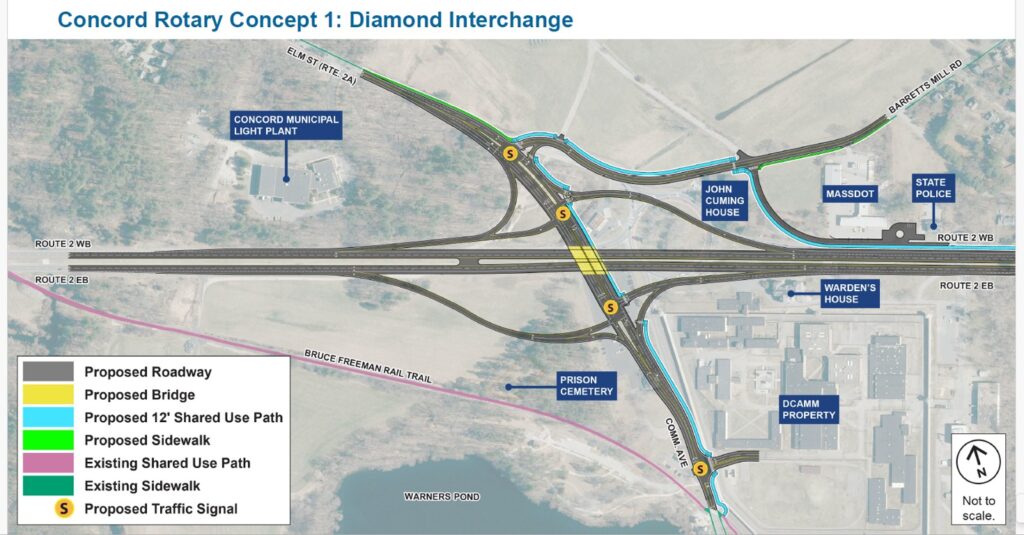

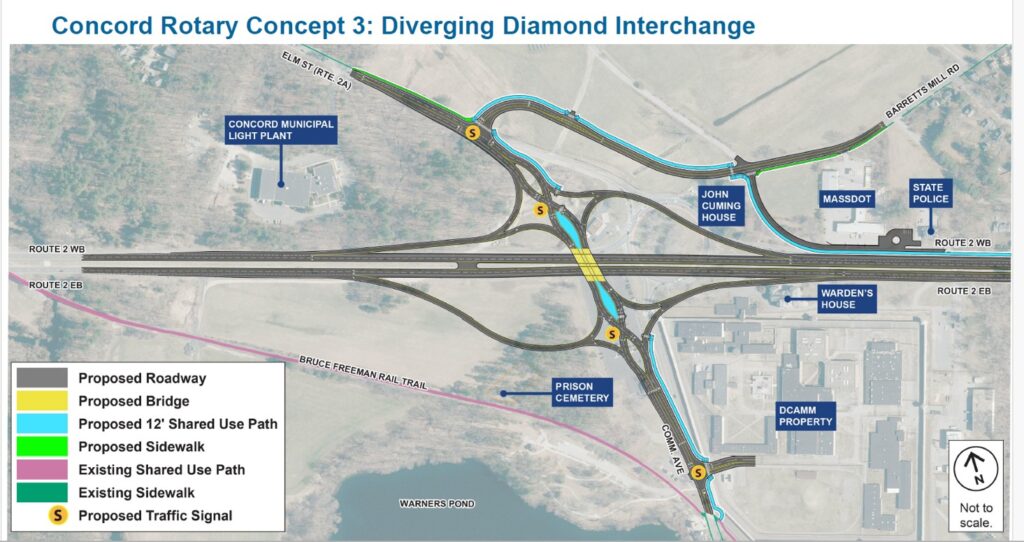
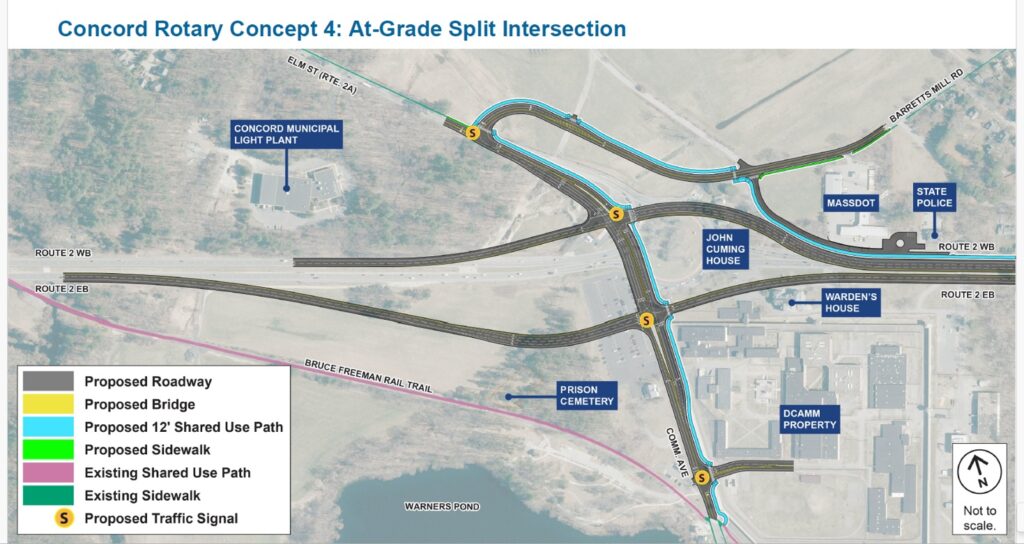
All four alternatives share two features regardless of which one is ultimately chosen: full replacement of the Route 2 bridge over the Assabet River, and changes to the Elm Street/Baker Avenue intersection. The new Assabet River bridge will be longer and wider than the current structure, with greater clearance above the water and improved access for people using the river itself. In addition, all alternatives include a shared use path (in cyan) to help improve access across the rotary area for walkers and cyclists.
What this could mean for Acton’s economy
Not everyone at the hearing was focused solely on travel time and safety. Patricia Costa, Acton’s Economic Development Director, attended the June 24 meeting and shared a broader perspective with the Acton Exchange on what the rotary’s redesign could mean beyond traffic counts. “While each design concept differs in its details, they all advance the same broader objectives of improving safety, enhancing connectivity, and leveraging opportunities,” Costa said. In her view, all four proposed concepts should improve connectivity across Route 2, reducing the barriers that currently limit movement between the two sides of the highway – and better integration between the communities on either side, she argued, will strengthen the economic relationship between Acton and Concord, increasing the positive influence each town’s economy has on the other. By effectively connecting Great Road in Acton with Commonwealth Avenue in Concord, Costa said the project “will create new opportunities for shoppers, encourage cross-community activity, and strengthen economic synergies on a regional scale.”
Costa also tied the rotary project directly to the future of the adjacent MCI Concord site, noting that because the selected design will determine the future use of that parcel, its impacts need to be analyzed not just from a transit perspective but in terms of what redevelopment of the site will mean for the surrounding area. An increase in housing units from that redevelopment, she said, will generate additional demand that has the potential to attract new businesses, while more efficient inbound and outbound transit connections will make the area more attractive for investment.
More broadly, Costa argued that a project of this scale will draw attention well beyond its own footprint. “We can expect a project of this magnitude to serve as a catalyst for additional private investment, making surrounding properties more attractive to developers, including parcels in both towns that are not immediately served by Route 2,” she said, predicting that “the project’s economic benefits are likely to extend well beyond the immediate project area.”
Yes, there are bike and pedestrian accommodations
Acton Exchange editor Kim Kastens flagged that none of the four concept maps presented at the May meeting included pedestrian or bicycle infrastructure. But at the June meeting it was there, in the legend that appears on all four concept diagrams: a cyan line marked “Proposed 12′ Shared Use Path,” a green line for “Proposed Sidewalk,” and separate markings for existing shared-use paths and sidewalks, plus yellow circles marking proposed traffic signals.
How good that connection actually is, though, depends heavily on which concept gets chosen, and that’s where an Acton resident’s firsthand account is more useful than the slides themselves. Nathan Wolf, who attended the June 24 meeting and uses the Bruce Freeman Rail Trail regularly, walked through each concept from a cyclist’s perspective and came away with a clear ranking. He counted roughly 11 crosswalks a rider would need to cross to get from the Acton side of the rail trail to Barretts Mill Road under Concept 1, compared with about 9 crosswalks under Concept 2, 10 under Concept 3, and 8 under Concept 4 – but he considers Concept 4’s crossings disqualifying anyway, since they include an at-grade crossing of both Route 2 travel directions. “This option does not carry nearly the same magnitude of driving time improvements as the grade-separated options,” he said of Concept 4, “and would also require the relocation of the John Cuming house.”
Wolf’s preference lands on Concept 2, the partial cloverleaf, largely because it’s the only one of the three interchange options that doesn’t require cyclists to cross a Route 2 entrance ramp directly, a conflict point he considers a serious safety risk, particularly from drivers turning right on red without expecting to see a cyclist. He weighs that against Concept 2’s biggest downside: its cloverleaf loops sit closer to the Bruce Freeman Rail Trail than the other options, which he expects would increase noise and air pollution on the trail itself. Concept 3, the diverging diamond, drew his sharpest criticism on the bike side. He described crossings that would require cyclists to move from the side of the road to a median and back, a maneuver MassDOT did not otherwise elaborate on, on top of what he estimated was the largest paved footprint of any of the four concepts.
Notably, the shared-use path system wasn’t enough for everyone in the room. According to a second Acton resident who attended the hearing but asked not to be named in this story, the biggest concern voiced by Concord residents specifically wasn’t the shared path at all – it was the absence of a true grade-separated pedestrian bridge over Route 2 at the Elm Street intersection and near the Assabet River crossing. As that resident put it, none of the four plans includes a pedestrian overpass at either location; people on foot or bike would still cross Route 2’s ramps at signalized, at-grade crossings rather than going over the highway entirely. This resident’s own suggestion, not something MassDOT proposed, was that the state agency overseeing the separate MCI Concord redevelopment could fund such a bridge, since the new housing planned for that site would generate the pedestrian demand that the bridge is meant to serve.
What residents said
The room’s feedback focused less on which of the three grade-separated concepts was best and more on how MassDOT ran the process. Wolf’s account of the evening, echoed by other attendees, centered on frustration that MassDOT presented four fully-formed concepts without any accompanying estimates of cost, right-of-way impacts, or projected local traffic effects in West Concord and along the Acton line – even though reducing local cut-through traffic is one of the project’s stated goals. “People were generally unhappy at being presented with what seemed to be four set-in-stone options without any specific information with which to provide informed opinions,” Wolf said, adding that he thought MassDOT “could have handled this situation better,” even allowing that this was an early-stage meeting.
A recurring theme in the public comment, in Wolf’s telling, was induced demand: several attendees pushed back on MassDOT for not accounting for additional traffic that new road capacity and the hundreds of housing units planned for the adjacent MCI Concord site would eventually generate. Wolf noted that despite an hours-long meeting about decongesting Route 2, MassDOT did not directly address improvements to the parallel Fitchburg Line commuter rail service, which he and others in attendance argued is the only long-term way to move large numbers of commuters off the road entirely. That sentiment wasn’t limited to one attendee: a comment calling for upgrading commuter rail service to run every thirty minutes drew applause from the room, according to a second Acton resident who was also present, a sign that some residents would rather see transit investment than a wider road.
Attendees also pushed on alternatives MassDOT had already considered and rejected. One proposal, keeping Commonwealth Avenue at street level and routing Route 2 beneath it in a trench, was ruled out by MassDOT because of the area’s high water table. Another, preserving the current Assabet River bridge deck as a below-grade crossing for cyclists, was rejected over flood risk to the structure. Wolf also raised the idea of a stand-alone bicycle bridge over Route 2 near the MCI Concord site; MassDOT called it out of scope for this project, while indicating openness to it being pursued separately as part of the prison site’s redevelopment.
By Wolf’s account, attendees were broadly unified in preferring some grade-separated design over the at-grade option, without a strong consensus on which of the three interchange concepts was best, and were notably unhappy with the proposed Baker Avenue intersection changes, even though MassDOT correctly noted that a fuller redesign there falls outside this project’s scope. He also described widespread skepticism, which he shares, that the project will ultimately be built as proposed, on schedule, and within budget, given the area’s long history of similar proposals that stalled.
Behind the reluctance to speak on the record
A couple of people who attended the June 24 hearing were willing to share detailed impressions with the Acton Exchange but declined to be named. Part of that caution traces to a tension that surfaced during the meeting itself: at least one Concord resident reportedly criticized the consultant team for focusing too heavily on improving traffic for people who don’t live in Concord, prompting the consultant to explain at length how the four concepts were shaped as much by the MCI Concord redevelopment as by the traffic needs of Acton and other towns to the west.
There’s also a longer backstory. Roughly ten years ago, an earlier effort to redesign the Concord Rotary reportedly stalled when Concord’s Select Board voted against it, concerned that construction would disrupt life for town residents. This time around, Concord’s Select Board has not taken a public position on the current redesign options – even as it remains deeply involved in shaping the separate MCI Concord redevelopment plans next door.
One attendee’s account: no vote, no clear preference, and a “fatal flaw” standard.
One Acton resident who attended the hearing but asked not to be named came away with the impression that, for MassDOT, the hearing largely satisfied a procedural requirement. The questions and comments from the audience were overwhelmingly of the “have you considered this?” or the “what about that problem farther down Route 2?” variety, rather than residents expressing a clear preference among the four concepts. This resident asked MassDOT directly, as the final question of the evening, what criteria the project team would use to choose which concept to advance to 25% design, given that no clear public preference had emerged. The answer: there will be no vote and no survey. Instead, the team indicated it would be looking for whether anyone identifies a “fatal flaw” in one of the designs that hadn’t already been considered, – an outcome this resident considers unlikely.
A second attendee’s account: money, deadlines, and a request for pedestrian bridges.
A second Acton resident who also asked not to be named offered additional detail that didn’t appear in the written meeting materials. Asked when construction would start, whether funding was secured, how long construction would take, and how MassDOT planned to manage the traffic disruption during construction, the resident says MassDOT does not yet have the money for the project but is hoping to be placed on the state’s project funding list, likely a reference to MassDOT’s Transportation Improvement Program, though placement on that list is itself no guarantee of a specific funding date. Despite that funding uncertainty, this resident says MassDOT representatives verbally floated a construction start around 2030 and a finish around 2035, alongside a cost estimate in the hundreds of millions of dollars.
This resident also described how the diamond-style interchange concept would work in practice: Route 2 itself would run beneath an overpass carrying local traffic from Barretts Mill Road and Route 2A, with signals controlling access to Route 2 eastbound at the ramp terminals, an improvement over the sole at-grade concept, in this resident’s view, but one they doubt would fully resolve backups on Route 2A. They credited MassDOT for apparent sensitivity to the area’s historic and environmental resources – preserving the John Cuming House, the prison cemetery, area wetlands, and the Bruce Freeman Rail Trail – while noting the agency seemed more interested in constructive suggestions than in general complaints. Asked why any of this should matter to Acton residents specifically, this resident’s answer was straightforward: whichever concept MassDOT eventually advances will shape both the timeline and the true breadth of choices, including modest ones, like pedestrian bridges, that would otherwise need to be championed by whichever entity is redeveloping the neighboring MCI Concord site.
What happens next
MassDOT’s own published timeline runs through 25% design, not full construction:
- Summer 2026 — Public comment period (open now).
- Fall 2026 — MassDOT defines its recommended concept.
- Spring 2027 — 25% design process begins for that concept.
- Winter 2028/2029 — 25% Design Public Hearing.
- Spring 2030 — Final design complete; project advertised for construction.
Notably, that published timeline stops at “advertised for construction” in spring 2030. It does not include the construction start date of roughly 2030 and finish date of roughly 2035 that MassDOT representatives are said to have offered verbally at the hearing, nor the cost estimate in the hundreds of millions of dollars also reportedly discussed verbally – both of which residents should treat as preliminary until MassDOT confirms them in writing, especially given the agency’s own acknowledgment that project funding has not yet been secured.
How to weigh in
Residents can submit comments by email to MassDOTMajorProjects@dot.state.ma.us, or by mail to Carrie Lavallee, P.E., Chief Engineer, MassDOT, 10 Park Plaza, Boston, MA 02116, Attention: Major Projects, Project File No. 602091. Meeting materials are posted on MassDOT’s Highway Division events page, and the project can be tracked directly through MassDOT’s Project Information System under Project 602091. Given that this month’s meeting recording largely failed, written comment may be the most reliable way to make sure a concern actually reaches the project record.
State Representative Simon Cataldo said, “I’m grateful to everyone who came out and shared their thoughts at the June 24th public comment meeting. I’d encourage anyone with feedback to submit written comments. This project will shape Route 2 for the next generation, so impacted residents should make their voices heard.”
Given how many Acton commuters pass through this interchange every day, and how long this rebuild will take once a concept is chosen, this summer’s comment period may be the easiest leverage Acton residents get over a project happening just across the town line.
Greg Jarboe is a member of the Acton Finance Committee, and a volunteer writer for the Acton Exchange.