At a joint meeting of the Acton Water District (AWD) Board of Commissioners (the Board) and the AWD Finance Committee (the FinCom) on February 9, the FinCom declined to make a recommendation on the proposed FY27 AWD budget, citing concerns about its disproportionate impact of costs on low-volume water users. Despite this unusual lack of FinCom endorsement, the Board unanimously approved the $8.9 million budget, which includes a 34.2% increase in the annual debt service fee.
The lack of agreement centers on how the district should allocate settlement funds received and expected from lawsuits against the manufacturers of PFAS (per- and polyfluoroalkyl substances), a suite of dangerous chemicals found in public water supplies in Acton and elsewhere. The AWD is coming down the home stretch on its ambitious, multiyear effort to treat all of its water for PFAS. But the costs have been high in stress as well as dollars. The current dispute has exposed questions about rate fairness and sparked broader discussions about water district governance.
The backstory
The Acton Water District is a separate municipal entity from the Town of Acton government, with its own separate charter from the Commonwealth of Massachusetts. The Board is analogous to the Town’s Select Board, the FinCom is analogous to the Town FinCom, and the District Annual Meeting is analogous to Acton’s Annual Town Meeting.
AWD bills comprise three parts: a service fee, steady at $15 per water-taking unit; a debt fee, which is the same for every water-taker and has risen in recent years as the costs of water treatment have accrued; and a usage fee, which depends on amount of water used. To incentivize conservation, the usage fee is progressive, meaning larger volume users pay more per cubic foot, and it is higher in summer than winter. There are also discounts or rebates available for certain categories of low-income and hardship. When the debt fee was introduced in 2013, it was a small fraction of any customer’s total bill. But as debt accumulated to pay for treatment plants, the debt fee became a more burdensome fraction of the bill, especially for low-volume customers.
How the costs of providing safe, legal drinking water should be allocated across the various rate-payers has been the subject of much discussion and some tension between AWD FinCom and Board for years. At the Nov. 21, 2021 Board meeting (minutes) the FinCom recommended that the debt service fee be converted to a per cubic foot fee. The Board did not accept the FinCom’s recommendation, arguing that the fixed debt fee ensured a reliable income to pay the debt service, even as water volume sold fluctuated from year to year. After extensive discussion, the Board agreed to engage “a consultant to help figure out debt fee structure.”
No such consultant was engaged, and the issue re-emerged a year later. At the Dec. 22, 2022 Board meeting (minutes), FinCom member Ron Parenti presented to the Board members a different proposal to restructure AWD rates and fees. Again, there was extensive discussion, which ended with Board Chair Steve Stuntz saying, “We appreciate all the work of the Finance Committee, but the Board is not going to move forward with any changes to the debt service or the rate structure.”
The budget debate has been playing out against the backdrop of the AWD’s massive investment in PFAS treatment infrastructure — an expense that was neither anticipated nor desired, but has become unavoidable as the district responds to contamination from per- and polyfluoroalkyl substances. The district has borrowed nearly $19 million for PFAS-related projects across three treatment facilities: $1 million borrowed for the North Acton plant, $10.35 million for Central Acton, and $7.57 million for South Acton. The AWD succeeded in obtaining favorable loans through the Massachusetts Drinking Water State Revolving Fund, with zero percent interest, no requirement for repayment until construction is complete, and approximately $2.7 million in principal forgiveness. However, the remaining debt still needs to be repaid, driving increases in debt service fees.
The current controversy emerges
In 2020, AWD joined many other public water suppliers in litigation against PFAS manufacturers, seeking partial compensation for contamination the District did not cause. Major settlements have been reached: $10.3 billion from 3M (approved March 2024), $1.185 billion from DuPont, Chemours, and Corteva (approved February 2024), and additional agreements with Tyco Fire Products ($750 million) and BASF Corporation ($316.5 million) awaiting court approval.
AWD received its first settlement payment in May 2025, of approximately $2 million. Payments from the various settlements are expected to continue through 2036.
The district formed a PFAS working group to determine how to use these funds. The working group recommendations were discussed at length at the Board meeting of December 8 (minutes). The working group recommended “using a portion of the funds currently in hand to supplement the upcoming FY27 budget for PFAS-related costs, such as the lease payments for the North Acton PFAS treatment system and media replacement. The balance of settlement funds would be invested, with the intent that each year, the District would review ongoing PFAS needs and determine how much of the invested funds should be drawn down to support operating or capital expenses.” This is similar to the Grace fund established after earlier W.R. Grace litigation. It was reported that FinCom had seen the recommendations at a December 5 meeting (minutes not yet available), and had voted to support the PFAS working group recommendations, with two votes in favor and Bill Guthlein abstaining. The Board voted unanimously to accept the PFAS working group recommendations.
Staff and Board members worked to develop and refine a FY27 budget in alignment with the PFAS working group recommendations, with drafts provided at meetings throughout December and January. At a joint meeting of the Board and FinCom on January 12 (minutes), Mostoller explained that the budget would include an increase in the FY27 debt fee to reflect “the transition from construction financing, which previously carried no cost, to permanent financing.” There would be no increase in the volumetric rates, made possible by covering some operational expenses from the PFAS settlement funds.
FinCom met on January 21 (minutes). FinCom member John Petersen presented an analysis showing a consequence of the decision to use settlement funds to support operating expenses but not debt costs: the draft budget would cause the water bill for low-usage customers to increase by 20%, while high-usage customers would experience a 9% increase, placing a larger burden on low-usage customers. The other FinCom members agreed that the budget could be revised to better balance the use of PFAS settlement funds between operating expenses and debt service. The committee agreed that Chair Ron Parenti should request another joint meeting of the Board and FinCom to discuss several topics, including the debt fee.
That requested joint meeting was scheduled for January 26, but was then canceled. In a testy email exchange (made public in the Feb 4 FinCom meeting packet), Board Chair Stuntz wrote to FinCom Chair Parenti “… there are no substantive issues for the Board to address … Please give us the courtesy to believe that we are capable of making good decisions. It seems that the debt fee keeps being questioned, and the Board continues to provide a clear answer…”
Parenti then resigned his position as AWD FinCom Chair.
FinCom met again on February 4. Minutes are not yet available, but an Acton Exchange reporter was at the meeting. The meeting began by electing Bill Guthlein to replace Parenti as FinCom Chair. FinCom member John Petersen reflected on Parenti’s contributions: “People in this room know, but not everybody realizes, how important volunteers are to the operation of the water district. Ron has done just a fantastic job in lots of ways.”
Petersen then presented a detailed version of his analysis showing that the proposed FY27 budget would hit different customers very differently. Under the draft budget, low-volume users — those consuming about half the average — would see their bills increase by 20.2%, from $531 to $638 annually. Average users would face a 14.3% increase, from $747 to $854 annually. Meanwhile, high-volume users would see a 9.1% increase, from $1,180 to $1,287 annually.
District Manager Matthew Mostoller expressed concern about continuing to revisit the issue. “I’ve had this conversation multiple times now,” he said. “I don’t think there’s a lot of value in continuing to pursue it.” Nonetheless, the remaining two members of the FinCom, Guthlein and Petersen, agreed to once again request a joint meeting with the Board to discuss the issue.
“I Made a Mistake”
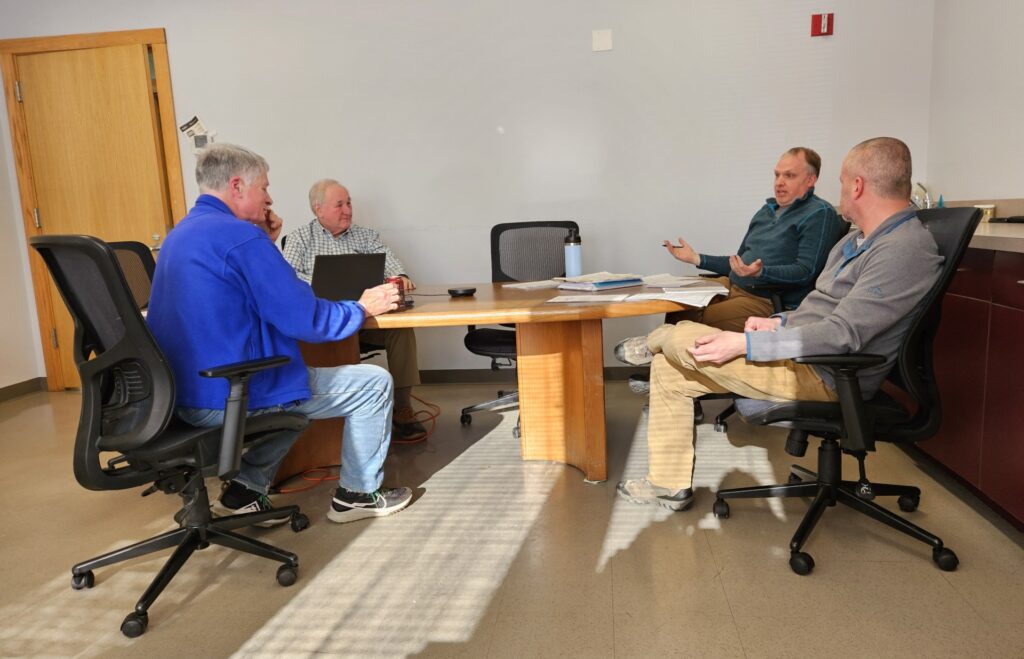
That joint meeting took place on February 9. Minutes are not yet available, but the Acton Exchange had a reporter at the meeting and was provided with a transcript of the zoom call. Whereas the 2021 and 2022 FinCom/Board disagreements had centered on how to fairly apportion the pain of rising PFAS costs, the 2026 disagreement centers on how to fairly apportion the benefits from the PFAS lawsuit settlements.
Petersen opened the debt fee discussion with a striking admission. In a prepared statement made available to the Acton Exchange, he acknowledged that he had made an error in initially supporting the budget approach.
“I made a mistake when I reviewed and recommended the DRAFT AWD FY27 budget,” Petersen told the group. “I considered the budget only from the perspective of the District, not its customers.”
He explained that while the revenue requirement is the same regardless of how PFAS funds are applied, the impact on customer bills varies significantly. The current approach, he argued, provides one policy for regular charges —– a mix of usage and fixed fees – but a different policy for ratepayer relief through PFAS funds, which goes entirely to usage-related costs.
“The draft budget, which essentially provides one policy for charges – a mix of usage and fixed fees – and a different policy for rate payer relief through the use of PFAS funds – usage only – is inconsistent and should be revised,” Petersen stated.
His recommendation: apply PFAS settlement funds “in the same way the District charges for water as a mixture of usage and fixed fees,” which would mean splitting the funds between operational and debt service costs, then increasing water usage rates modestly to maintain the same total revenue.
The Commissioners and Staff Respond
The commissioners indicated they had not been persuaded to change their earlier decision about how to allocate the settlement funds. District staff defended the approach on both technical and practical grounds. Deputy District Manager Corey Godfrey noted at the earlier FinCom meeting on February 4 that water utilities typically try to recover fixed costs through fixed fees, and that conservation incentives may have limited additional impact in a community like Acton where water use is already quite low.
At the February 9 meeting, Stuntz made the point that, “Part of bonding is getting the kind of bond rating we have, which is predicated on a known source of funding to pay for those. That’s why bond agents were particularly pleased to see that the debt fee was not dependent on usage volumes, but on a fixed fee to the users.”
An Unprecedented Vote
The Board then moved to approve the budget at the in-progress (February 9) meeting rather than waiting for additional information about insurance costs and free cash status. However, it was pointed out that proper procedure requires the FinCom to first make its recommendation.
Petersen then moved that the Finance Committee “not recommend the FY27 budget as presented because it changes the fixed and usage percentages for low and high volume users.” Guthlein said, “Well, I will not second that motion. So, we have a kind of a deadlock. No recommendation on the budget from the Finance Committee.”
The Board then voted unanimously to approve the FY27 budget.
Looking Ahead to Annual Meeting
The FY27 budget will now proceed to the Annual District Meeting, where voters will have the final say. That meeting is scheduled for March 18, 2026, at 6:00 p.m. at the Town of Acton Public Safety Facility, 371 Main St. To vote at the AWD Annual District meeting, you must be a registered voter in the Town of Acton; you do not need to be an AWD customer.
The fundamental questions raised by this debate are likely to persist: How should the water district balance the need for reliable revenue in order to service debt, with the goal of equitable rate structures? What role should conservation incentives play in a community where water use is already relatively low? And, in the future, how should the District allocate settlement funds that continue to arrive years after the capital expenses were incurred?
For now, the Board has made their decision. But with the annual meeting just weeks away, Acton residents will have the opportunity to weigh in on whether the approved budget strikes the right balance.
The Good News: PFAS-free drinking water coming soon
The good news is that after long years of escalating costs, tough decisions large and small, engineering challenges, negotiations with neighboring towns and state regulators, juggling of water sources –– and now this controversy about how to distribute costs and benefits –– the prospect of nearly PFAS-free water is finally upon us. At the Feb. 9 Board meeting, Mostoller announced that the conditioning of filtration medium at both the South Acton and Central Acton Water Treatment plants is now complete, and the temporary interconnect that had been bringing in purchased water from Concord is being disassembled. All that remains on the to-do list is to complete water quality testing at Central Acton and pass inspection of both plants by the Massachusetts Department of Environmental Protection.
Water from the North Acton Water Treatment Plant has been treated for PFAS since June 2024, and PFAS levels in that water have usually been below the laboratory detection limit. With completion of the South Acton and Central Acton PFAS systems, all of the water going into the AWD distribution system is expected to have similarly low levels of PFAS. Few public water suppliers in Massachusetts have reached the milestone of successfully treating all of their water for PFAS.
Disclosure: Ron Parenti, prominent in this article, is an occasional writer for the Acton Exchange.
Greg Jarboe is a member of the Town of Acton Finance Committee, which is completely separate from the AWD Finance Committee. He writes frequently for the Acton Exchange on varied topics of community interest. He was the editor of The Acton Minuteman in 1977, and was a member of the Acton Select Board in 1980, when W.R. Grace and the EPA entered into a Consent Decree regarding cleanup of the W.R. Grace site in Acton.
Kim Kastens is a member of the Acton Exchange Board and an associate editor. She is also the Chair of the Green Acton Water Committee, and has previously published on the Green Acton website both a backgrounder and an opinion piece about charging for water. At the 2023 AWD Annual District Meeting, she was the advocate for a Citizen’s petition warrant article requesting that the AWD commission an external expert study of options for structuring future water rates. Living in the far northeast corner of Acton, she is not a customer of the Acton Water District.
Editor’s Note: The Acton Water District Finance Committee (FinCom) is seeking a new member to fill the vacancy created by Ron Parenti’s resignation. Interested residents can contact District Moderator William Mullin or District Manager Matthew Mostoller for more information about the FinCom position.