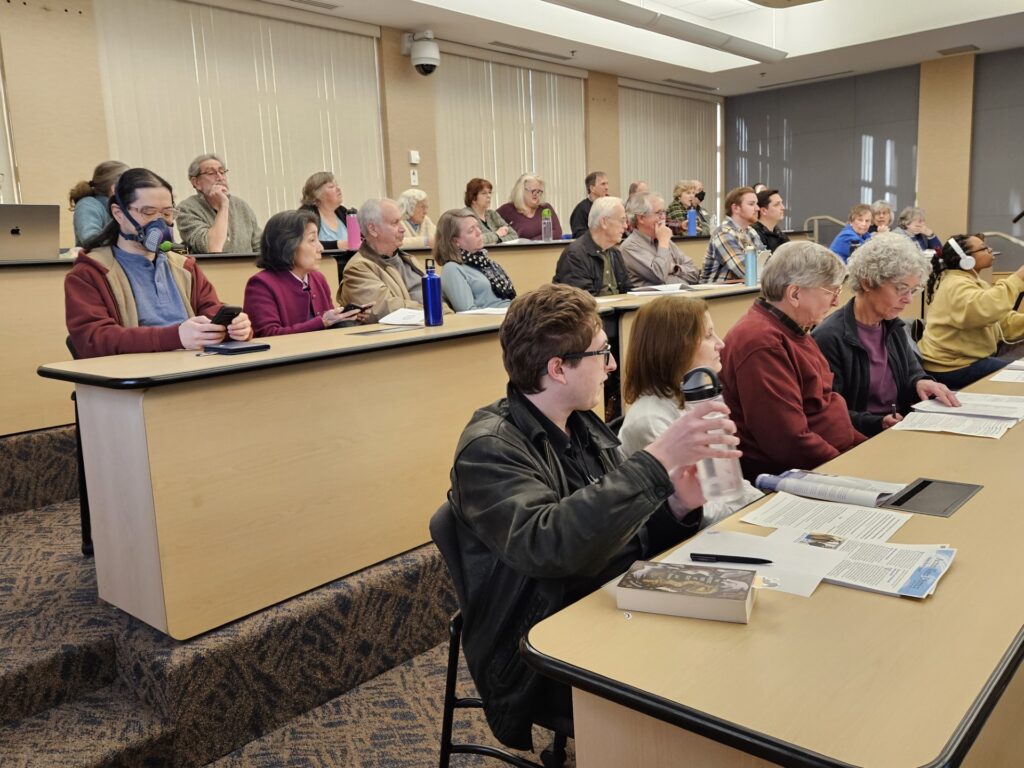
Voters packed the meeting room at the Public Safety Facility on March 18 for the Annual District Meeting for the Water Supply District of Acton (AWD, “District”). After praise for long-serving AWD official Ron Parenti and the recent completion of PFAS treatment facilities, the meeting took up an abbreviated version of the published warrant. Nine of the 18 articles passed unanimously. Eight articles were passed over, as expected. Article 4, the fiscal year (FY) 2027 budget, evoked extended discussion, including a proposed amendment that was not allowed to go forward to a vote. Voters voted against Budget Article 4: 21 in favor, 25 opposed. Later in the meeting, AWD Commissioner Barry Rosen moved a reconsideration of Article 4. Voters rejected the motion to reconsider: 19 in favor, 22 opposed.
The meeting began with a slide presentation about the District’s accomplishments for the year, an overview of the FY27 budget, and trends in District revenues and expenses. John Petersen delivered the presentation on behalf of the AWD Finance Committee (FinCom). FinCom was shorthanded at this meeting, as Ron Parenti had recently resigned, and Chair Bill Guthlein was out of the country.
The accomplishments for the year included acquiring the property at 549 Main St, constructing bedrock wells on that property, and completing the installation of PFAS treatment facilities at the South Acton and Central Acton Water Treatment Plants. PFAS (per- and polyfluoroalkyl substances) are a class of manufactured chemicals that have been widely used in industry and consumer products, and have been associated with adverse health outcomes if ingested. The capital expenses for all of these projects were approved by voters at the 2023 District Annual Meeting. The presentation noted that “these major capital projects were completed in record time.”
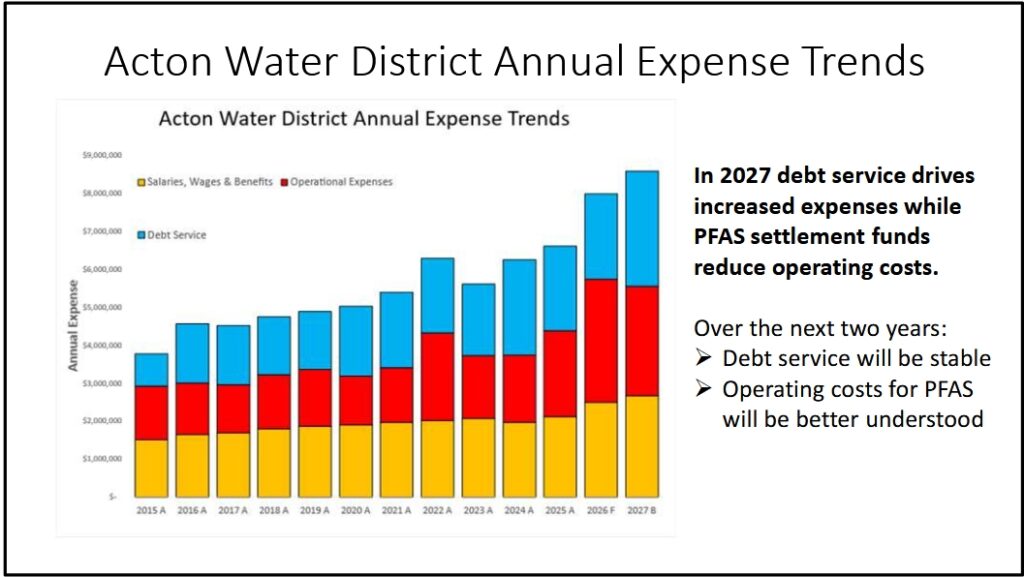
The presentation then delved into revenues, expenses, and billing, to provide context for the articles to follow. Total revenue for FY27 is forecast as $8.9 million and total expenses as $8.6 million. Details of the budget are on page 4 of the AWD Annual Report. As explained on the AWD website, the water bills paid by AWD customers comprise a volume charge that scales with the amount of water taken and a fixed fee that is the same for all water-taking units. The fixed fee comprises a $15 service charge plus a debt service fee; debt fee is $63.50 per quarter in FY26, and proposed to increase to $85.25 per quarter in the budget presented at this meeting. The graph below shows how operational charges (funded from the volume charge portion of users’ bills) and the debt service (funded from the fixed part of users’ bills) have changed over time.
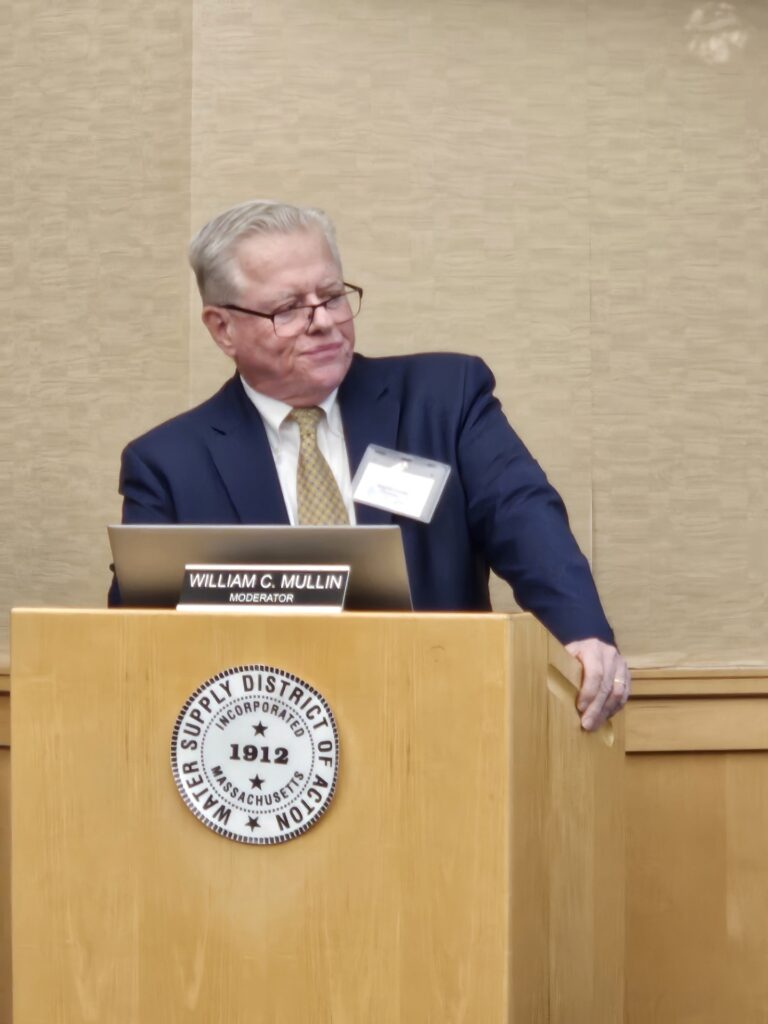
Moderator Bill Mullin then opened discussion of the warrant articles. Routine articles 1 through 3 passed with minimal discussion and unanimous votes, to fix salaries of officials, accept reports, and authorize bonding if necessary.
Then came Article 4: “to raise and appropriate the sum of $8,580,431, for the fiscal year budget, as printed in the annual report, to defray the usual expenses of the District.” Commissioner Erika Amir-Lin, presenting the article, stated that this budget “covers the costs of sustaining the 365 days per year functioning of the district … associated with meeting our regulatory, legal and customer service responsibilities.” The Commissioners recommended this article but the AWD FinCom went on the record as making no recommendation. A previous Acton Exchange article provides some background on the disagreement between the Commissioners and FinCom, which has been going on for some years and centers on how the increasing costs of PFAS treatment and the newly-arriving benefits from the PFAS lawsuit settlement should be apportioned across different tiers of water-takers and different components of customers’ bills.
Extensive discussion followed. Voters asked for clarification of how increasing costs were being split between fixed fee and volume fee, why the FinCom had no recommendation on the budget, why the net surplus revenue is expected to be so high (a quarter of the whole budget), whether the District has a policy on how much free cash needs to be retained, how can it be that last year we had no free cash and this year we have a considerable amount of free cash when the cost of everything is going up, whether the District works from a 10-year capital plan, and how the PFAS settlement funds interact with the proposed budget.
One long-time Acton voter said that she had never before voted for a budget on which the free-cash certification had not been received, and moved (twice) that we adjourn this session and resume when the free-cash has been certified. Those motions were ruled out of order (not following meeting rules). The entire discussion, marked by a high level of engagement on the part of the voters, can be viewed on ActonTV.
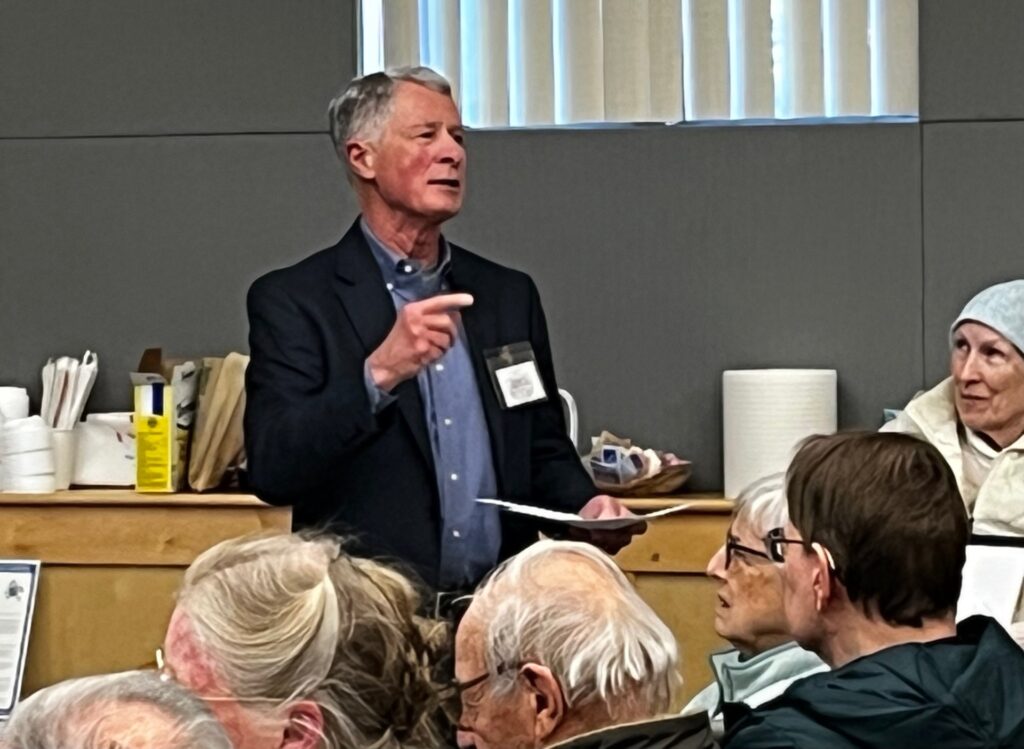
At this point, FinCom member John Petersen stepped out from behind the officials’ table, and proposed an amendment to the budget article, speaking as an individual. Petersen’s amendment would add to the existing text of the article the following: “… and for the fiscal year 2027, that the District will consider the non-binding recommendation of the Annual Meeting to the Commissioners, to increase water usage rates by 11% and to apportion the additional revenue from such increase equally among all service units as a reduction in the debt service fee included in the water bills.”
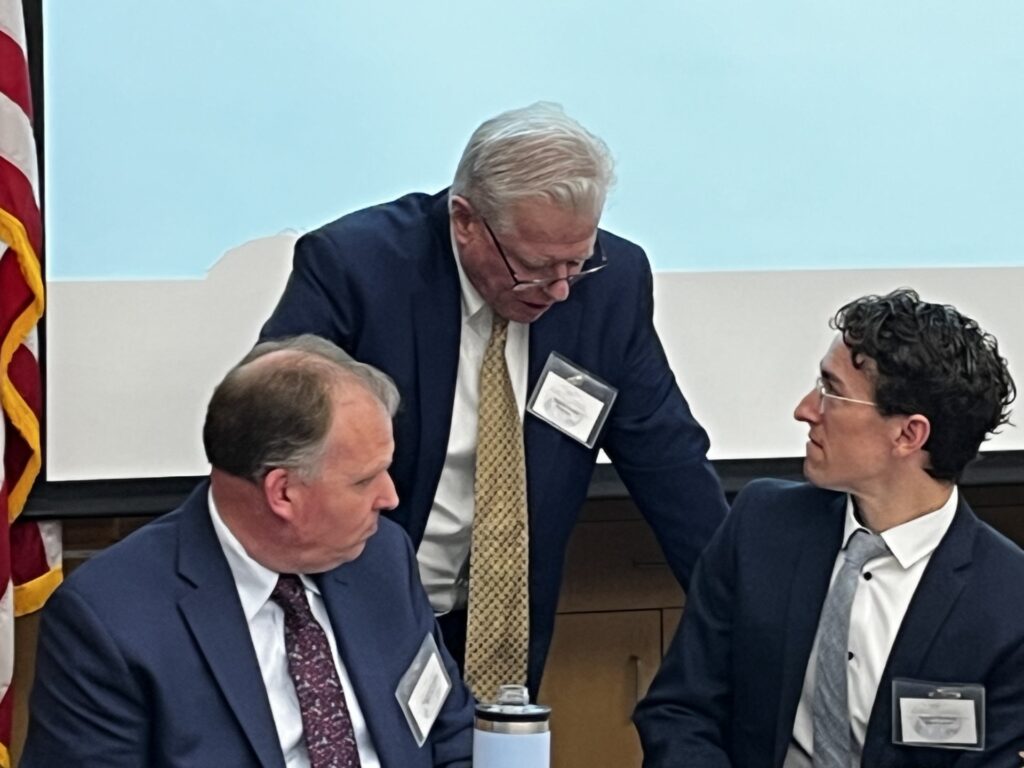
Additional questions from voters were followed by consultation among the moderator, district counsel, and district manager. Addressing the voters, District Counsel Spencer Holland reviewed history going back to the 1912 Special Act of the Massachusetts Legislature, which established the Acton Water District and vested the Water Commissioners with the authority to establish water rates and to use the income from water usage to cover the operating expenses. “It now comes to the moderator,” Attorney Holland continued, “who has the desirable and highly paid job of determining whether a motion to amend is within the scope of the warrant article.” (The moderator receives $50 per meeting.) After explaining his reasoning and the research he had done on the topic, Moderator Mullin concluded, “I do not believe that the amendment is in the scope of the article…. I state it to be unacceptable.”
Further questions from voters followed, touching on the dollar difference between the proposed budget and Mr. Petersen’s proposal, and on the philosophical reason behind the Commissioners rate setting. Then, Mr. Petersen, still speaking as an individual, said, “Now I’m going to ask you to vote ‘no’ on Article 4. And the reason … is that I do think that the Commissioners made a choice … The choice was … how should we take those PFAS litigation funds and apply those to our expenses so that they have an impact on users. That’s not constrained by anything previously….We never had this money before. So it’s a free choice on the part of the Commissioners. The choice made by the Commissioners to say we’re going to take all of that money and we’re going to let it flow into the budget in a way that impacts [variable] usage [charge] but does not impact the [fixed] debt [service].”
A vote was then held on the main motion, Article 4, to approve the budget. A voice vote was inconclusive. A show of hands vote yielded 21 votes in favor of the budget and 25 votes opposed. Article 4 failed.
The meeting then moved on to Articles 5 and 6, which deal with the revolving funds that the District maintains to receive incoming funds from fees and then pay for related expenses. Article 5 handles the mitigation fees that the District charges when a parcel has a newly-established water usage or an increase in water usage by more than 200 gallons per month. Article 6 handles the new water meter installations. Both revolving funds were proposed to be capped at $100,000, and both votes passed unanimously.
Articles 7-14 were “passed over,” in other words not brought to a vote. As explained previously in the Acton Exchange, these articles deal with transfers from surplus cash, also known as surplus revenue. Because the District has not yet received its free cash certification from the Massachusetts Department of Revenue, these articles will have to be taken up at Special District Meeting, before the end of the fiscal year on June 30.
After the successful vote to pass over articles 7-14, Commissioner Barry Rosen made a motion to reconsider Article 4, the FY27 budget.
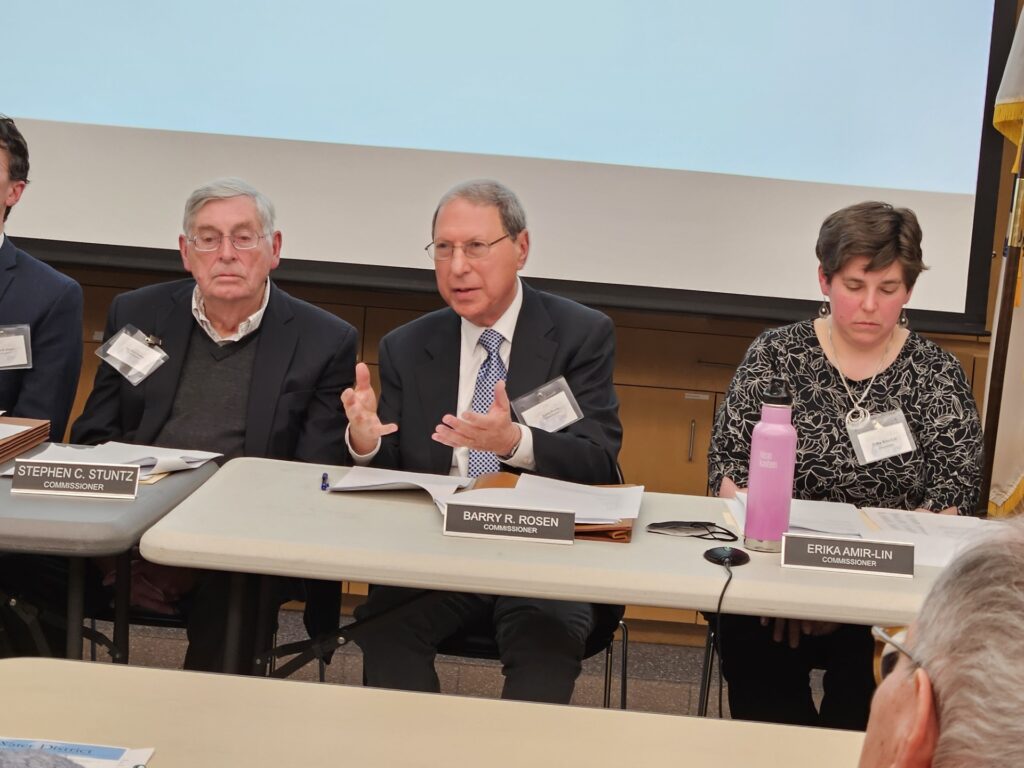
The moderator, town counsel, and district manager consulted on the process for reconsideration, while the commissioners caucused on their position on this new motion. Although a knowledgeable voter pointed out that Acton Town Meeting requires a supermajority to move forward a reconsideration of a completed vote, District Counsel could find no requirement for a supermajority at an AWD Annual Meeting, and so the moderator proceeded to take a simple majority vote. The vote to reconsider failed with 19 in favor and 22 opposed.
The final business of the evening was to consider a package of articles dealing with funds received and expected to be received from lawsuit settlements against manufacturers of PFAS. Article 15 established a special revenue fund to be known as the “PFAS Settlement Fund,” to receive settlement funds. Initial payouts totaling $2.3 million have been received, and additional settlement funds are expected in future years. Article 16 authorized the District to transfer $330,000 from the PFAS fund towards lease payments on the North Acton Water Treatment Plant. Article 17 authorized the transfer of $150,000 from the PFAS fund for PFAS Media Replacement. This activity was vividly described by Commissioner Stuntz as “trucks full of GAC [granular activated carbon] come in, and they pump the old stuff out and pump in the new.” Article 18 authorized transfer of $150,000 from the PFAS fund to reimburse the FY26 general fund for the costs of purchasing water from Littleton and Concord while the PFAS treatment systems at the South Acton and Central Acton treatment plants were completed and certified. Articles 15-18 all passed unanimously.
After the meeting adjourned, several District officials were invited by the Acton Exchange to provide comments on the meeting. Mr. Petersen and Mr. Mostoller replied by email the next day. Mr. Petersen wrote: “Unfortunately, there was no good way for the voters to express their concerns with inequitable treatment of ratepayers in the Acton Water District budget (Article 4). I look forward to reviewing the budget with the commissioners and developing a budget that will find more general support in the community.”
Mr. Mostoller wrote: “I am grateful for the renewed interest in the business of the Acton Water District. It is unfortunate that the proposed budget for FY27 was defeated with no concerns articulated with the proposed expenses. This action unnecessarily jeopardizes our ability to provide continued water service beyond June 30th. I invite the voters who turned down the budget to attend Board meetings where they may engage directly on the issue of our rates and fees which are the purview of the Board of Water Commissioners. Annual Meeting is not the venue to engage in this work, and I look forward to an affirmative vote on the budget at an upcoming Special District Meeting. This will enable the dedicated staff and officials of the District to perform our essential community service.” The Board of Water Commissioners meet on Monday evenings by zoom, with schedules, meeting packets, and minutes posted here; the next meeting is scheduled for March 23.
Looking forward, the budget article (#4) and the surplus revenue articles (#7-14) will be taken up at a Special District Meeting to be held later in the year, after the free cash certification is received from the Massachusetts Department of Revenue. A budget must be approved before the end of the fiscal year, June 30, or the District will not be able to continue to operate, according to District Manager Matt Mostoller and District Counsel Spencer Holland. The evolution of the budget might be influenced by the outcome of town elections on April 28, in which John Petersen is challenging incumbent Steven Stuntz for a seat on the AWD Board of Commissioners.
Video of the entire Annual District Meeting can be viewed on ActonTV.
Kim Kastens is a member of the Acton Exchange Board and an associate editor. She is also the chair of the Green Acton Water Committee, and has previously published on the Green Acton website both a backgrounder and an opinion piece about charging for water. At the 2023 AWD Annual District Meeting, she was the advocate for a Citizen’s petition warrant article requesting that the AWD commission an external expert study of options for structuring future water rates. Living in the far northeast corner of Acton, she is not a customer of the Acton Water District.
Correction, March 22, 2026: The original version described two separate votes on Article 4, the budget. In fact the second vote was a vote on a motion to reconsider Article 4, not a re-vote on the original article. The original vote on Article 4 failed, with 21 in favor and 25 opposed. The vote on the motion to reconsider also failed, with 19 in favor and 22 opposed, so that the original vote defeating Article 4 stood.