For most of us, the Declaration of Independence exists in two familiar images: the elegant, faded parchment behind glass at the National Archives and John Trumbull’s grand painting of the founders gathered in Independence Hall. Both, it turns out, are a little misleading. And on Thursday, June 25, that myth busting was exactly where historian Emily Sneff began her talk at the Acton Memorial Library, the final program in the town’s Acton 250 lecture series and the opening event for the newly formed Acton Historical Alliance.
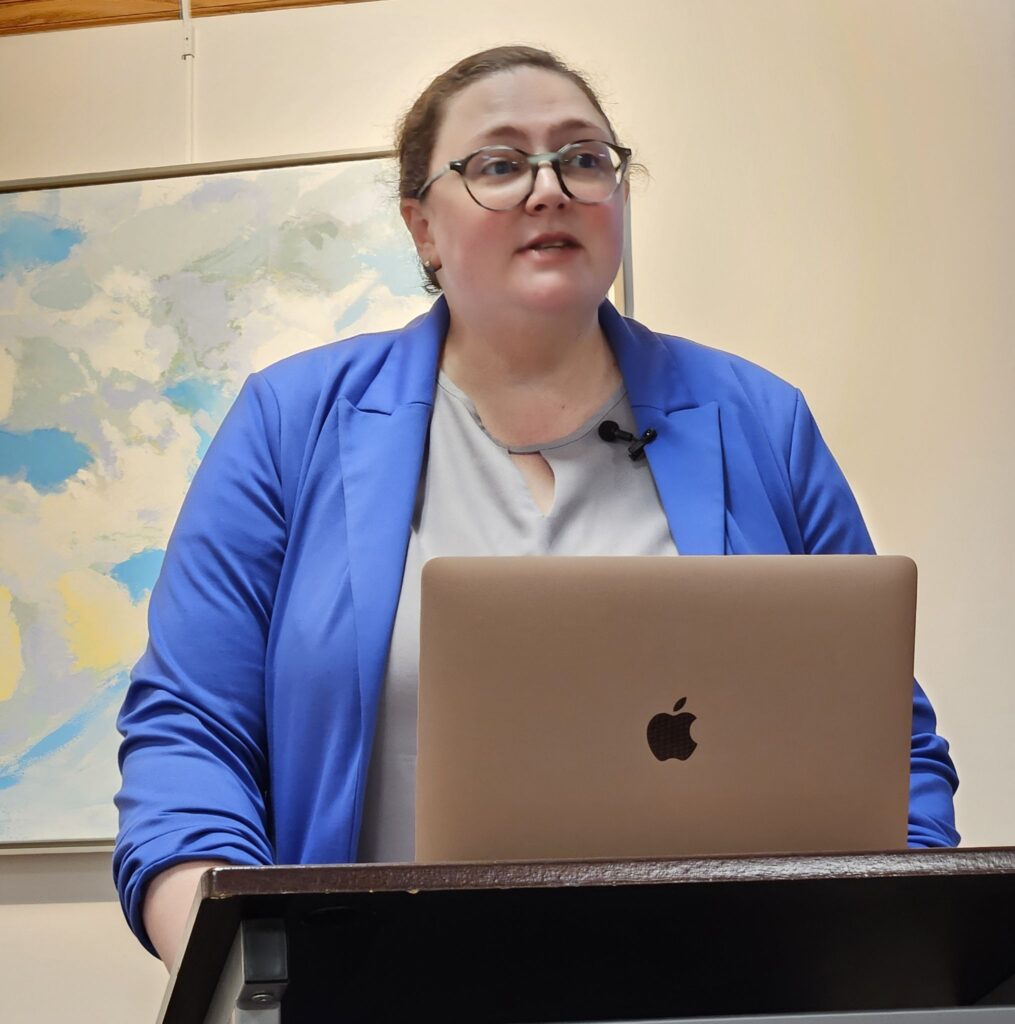
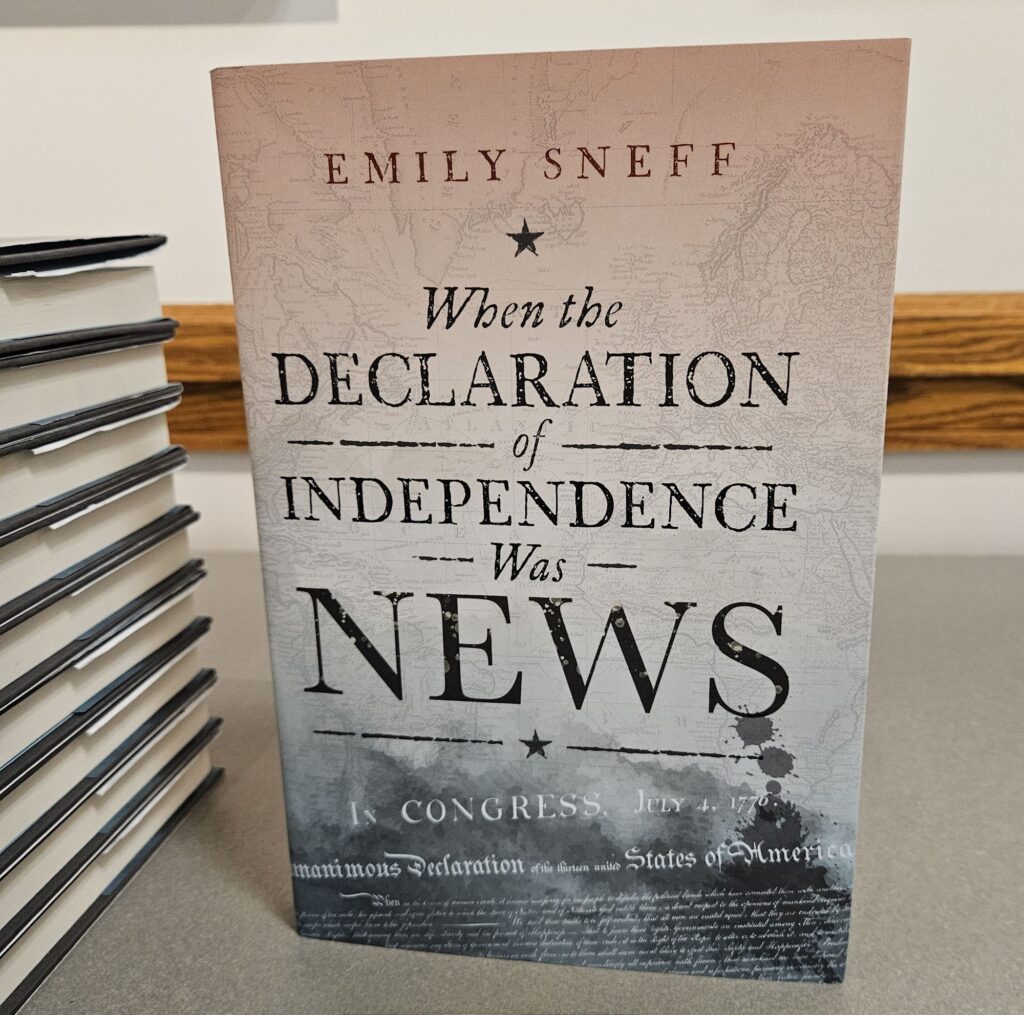
Sneff, who holds degrees from William & Mary and has worked on Declaration research at Harvard, traveled from Philadelphia to speak about her new book, “When the Declaration of Independence Was News” (Oxford University Press). Library trustee Pam Lynn, who introduced her, noted that Sneff had been on the road promoting the book since it was released in mid-April, with recent stops in Michigan, Virginia, and Pennsylvania before arriving in Acton.
Two famous images, two corrections
Sneff opened with Trumbull’s painting, which depicts the drafting committee presenting its work to Congress. The scene is often assumed to show the signing of the Declaration, but it actually shows June 28, 1776, when the committee submitted its draft, days before independence was even debated. Several men in the painting, Sneff pointed out, could not possibly have been in the room. Virginia’s Richard Henry Lee and George Wythe had already left Philadelphia to help write their home colony’s constitution, and Maryland’s Charles Carroll was not elected to Congress until July 4. Trumbull, working decades later, painted an amalgam of delegates rather than a snapshot of one specific day.
The famous parchment has its own problem: the version we all picture, crisp black script on cream paper, is not the 1776 original. It is an 1823 engraving commissioned by Secretary of State John Quincy Adams, made by handwriting expert William Stone from an original that had already begun to fade. The actual signed parchment in the National Archives today is largely illegible.
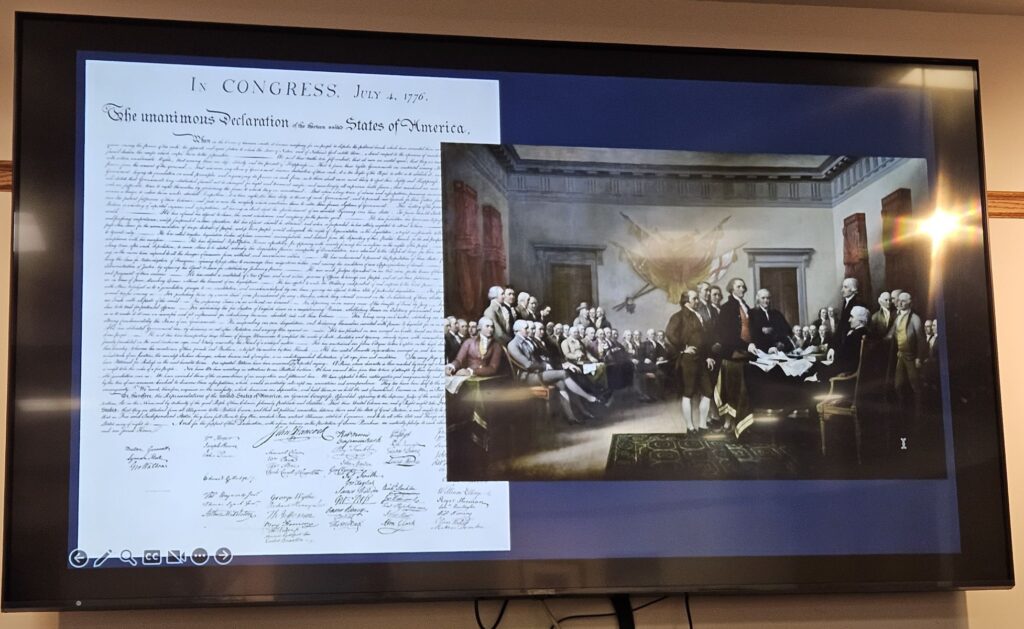
Even the date at the top of the parchment is deceptive. July 4 was the day Congress approved the text and began circulating it as news, not the day it was signed. The engrossed parchment did not exist yet. The first signatures were not added until August 2, and the 56 signers were never in the same room at the same time. Charles Carroll, in fact, signed a document he had no part in debating or voting on. As for the story that John Hancock signed his name large enough for King George to read without his spectacles, Sneff dismantled that one too: the Declaration was never sent to the king at all. Congress considered him its subject, not its audience, and it reached him only indirectly, through British communication channels.
A nine-month story, not a one-day event
The heart of Sneff’s book, and her talk, is the nine months after July 4, when the Declaration was simply news, before anyone knew how the story would end. She traces that story from a May 15, 1776, congressional resolution urging the colonies to form new governments (with a fiery preamble by John Adams blaming King George directly, which caused Maryland’s delegation to briefly walk out) through the fall and winter, closing in January 1777 with a printing in Baltimore that marked the document’s shift from breaking news to archival treasure.
One detail Sneff returned to more than once: how slowly, and how unevenly, the news actually traveled. Word reached Massachusetts in a week and a half to two weeks. It took roughly a month to reach the southernmost states by land, and about five weeks to cross the Atlantic to London. A soldier stationed at Fort Ticonderoga recorded that the Declaration “made a little buzz but was soon forgotten about,” a reminder that for people fighting a war, a political announcement from Philadelphia was just one more piece of news in a difficult season.
New England threads
Several of Sneff’s best stories touch directly on this region. George Washington received his copy from John Hancock on the morning of July 9 and had it read aloud to the assembled Continental Army in New York that evening. That same night, New Yorkers pulled down a gilded statue of King George III, an act of unauthorized enthusiasm that irritated Washington, who worried it made his army look disorderly at the exact moment it needed to be taken seriously.
In Massachusetts, Sneff highlighted the Boston Gazette, which was actually being printed in Watertown at the time because publisher Benjamin Edes had evacuated Boston ahead of the British. And in Watertown itself, in the middle of a hastily arranged treaty meeting, the Declaration arrived and was translated into French, then into Algonquian languages, for Wabanaki chiefs meeting with Massachusetts officials. One chief, Ambrose Bear, is recorded as responding, “We like it.” Sneff noted this exchange, which happened two weeks after July 4, may be the first formal acknowledgment of American independence by any outside party, delivered not by France or Spain, but by Native nations on this side of the Atlantic.
Sneff also told the story of a broadside now held at Brown University’s John Carter Brown Library, printed by a partnership of Boston printers on Queen Street. On its back is a note added later by a soldier named Daniel Gould, who wrote that he bought the copy “when the Declaration of Independence was first celebrated in Boston in the year 1776 when I was a soldier in the American Army.” Sneff’s research traced Gould to Topsfield; he had marched to Lexington and Concord in April 1775, later served as a bodyguard for Major General Artemas Ward in smallpox-quarantined Boston, and eventually became a minister in Maine. It is, she said, the only known copy of the Declaration signed by a soldier who left his own story on the back.
Censorship, spin, and the first reports from abroad
The Declaration reached London by British mail ship in early August 1776, and Sneff described how it was printed there both in full and in censored form, with London printers quietly deleting references to King George as a “tyrant.” Some newspapers skipped the list of grievances entirely, replacing it with a note telling readers the colonists were simply repeating old complaints. Fabricated stories about American leaders circulated in the same papers, including one claiming a despondent John Hancock had been talked into declaring independence against his better judgment. Sneff noted that there wassome frustration on behalf of Benjamin Franklin and his fellow diplomats that Congress had no coordinated effort to counter this coverage; the Declaration essentially traveled through Europe as mediated by the London press, not by any American messaging effort.
Women, German printers, and enslaved people reading between the lines
Sneff’s research surfaces figures often left out of the standard account. Baltimore printer Mary Katherine Goddard, who was also the town’s postmaster, produced the January 1777 printing that first listed all the signers by name, an act of some personal risk given that independence was still far from secure. Philadelphia’s German-speaking population, including printer Charles Cist, had the Declaration translated into German within days of July 4. And in the audience questions that followed her talk, Sneff addressed how enslaved and otherwise disenfranchised people encountered the document, noting that petitions for freedom, including cases here in Massachusetts such as Elizabeth Freeman’s, drew directly on the rights language of the Declaration, evidence that its ideas spread by ear as well as by page, reaching people who could not read it themselves through public readings ordered in every Massachusetts parish.
Why it still resonates
Asked why the Declaration was necessary at all, given that fighting had already been underway for 15 months, Sneff said Congress was formalizing on paper a separation many colonists already felt, especially Anglican ministers, who had spent months uneasy about praying for a king they now considered an enemy. She also pushed back gently on the modern instinct to see the present moment as uniquely chaotic, noting that anyone who thinks 2026 is unusually turbulent should spend some time in 1775 and 1776.
Sneff closed by describing her own path to the subject: a medievalist in college who came to the Declaration relatively late, through museum work rather than a childhood fascination, and who has now spent a decade studying little else. For an Acton audience that has spent the better part of three years marking its own 250th anniversary events, her larger point landed clearly. The Declaration was not a single tidy moment. It was a document that traveled slowly, imperfectly, and unevenly, shaped along the way by printers, translators, soldiers, diplomats and ordinary people, in Acton’s own region as much as in Philadelphia or London, deciding what to make of the news that a new country now existed.
Copies of “When the Declaration of Independence Was News” are available through Oxford University Press, and Sneff is scheduled to continue speaking at events around the country through the 250th anniversary year.
Greg Jarboe is vice chair of the Acton Finance Committee and a contributing writer for The Acton Exchange.