On May 4, the Acton Water District (AWD) announced that the installation of the equipment needed to remove PFAS (Per- and Polyfluoroalkyl Substances) from Acton’s drinking water is nearing completion, and that PFAS levels from all three of the District’s operating treatment plants have been reduced to non-detectable levels. District Manager Matthew Mostoller also announced that the restriction on outdoor water use has been reduced from level 4 (no outdoor water use) to level 3 (one day per week outdoor water use).
This milestone marks the end of a six-year effort to comply with an MCL (Maximum Contaminant Level) for PFAS established by the MassDEP in 2020. Those regulations require that water providers in Massachusetts reduce the levels of PFAS in drinking water to 20 ppt (parts-per-trillion), and notify customers if that limit is exceeded. This limit may be further reduced if a 4 ppt requirement proposed by the Environmental Protection Agency (EPA) is ultimately enforced; however, water quality tests have verified that the filtration equipment installed by the Water District will also be in compliance with that proposed standard.
Where does the PFAS in Acton’s water come from?
No centralized source of PFAS has been found in Acton. Trace amounts of PFAS have been detected in the soil and bodies of water throughout the world for two reasons. First, commercial products containing these compounds have been manufactured for almost 50 years. There are thousands of PFAS variants that have been widely used because of their unique chemical properties, such as the ability to repel oil and resist heat. These synthetic molecules have been utilized in the manufacture of everyday products, such as non-stick frying pans, and fire-retardant furniture.
The second reason that PFAS compounds have permeated the environment is that they break down very slowly, which is the reason that they are called the “forever chemicals”. This property is beneficial when the goal is to build a reliable product, but it also results in detrimental environmental consequences that have only recently been fully recognized. PFAS is everywhere because the items containing these materials have been purchased, used, and disposed of throughout the world. Fortunately, the companies that created these chemicals have been successfully sued, and settlements in excess of $10B are being negotiated.
Why did it take six years to complete the installation of PFAS treatment?
Prior to 2020, drinking water limits on regulated contaminants were specified in units of parts-per-million (ppm) or parts-per-billion (ppb). A part per trillion is an incredibly small number — roughly equivalent to the ratio between one millimeter and three times the distance between the earth and the moon. In Massachusetts, the limit on PFAS in public drinking water supply is 20 ppt for the sum of the concentrations of six PFAS variants; this measure is called PFAS6.
The technology required to purify municipal water supplies to this level is still poorly understood, and for PFAS remediation only a few approaches have been proven to be effective. These include granular activated charcoal (GAC) filtration, ion exchange, and reverse osmosis. Which of these would work best for high-volume treatment was an unresolved question when the PFAS regulations were enacted, and accurate cost factors for equipment installation and long-term maintenance were unavailable.
The Acton Water District chose to proceed cautiously in its selection of a remediation approach, and in 2020 the District Manager initiated a series of tests of GAC treatment of output water from the North Acton Water Treatment Plant (NAWTP). Following those successful tests, voters were asked in 2022 to approve $1 million to begin the design and construction of an addition to that facility for PFAS treatment. Since the long-term effectiveness of GAC for PFAS removal was still somewhat in question, the Water District elected to install equipment leased from Veolia Water Technologies. The construction of that facility began in December of 2023, and it became operational in June 2024. As shown in the graph below, the concentration of PFAS in the output water from the NAWTP immediately plummeted from greater than 15 ppt to non-detectable.
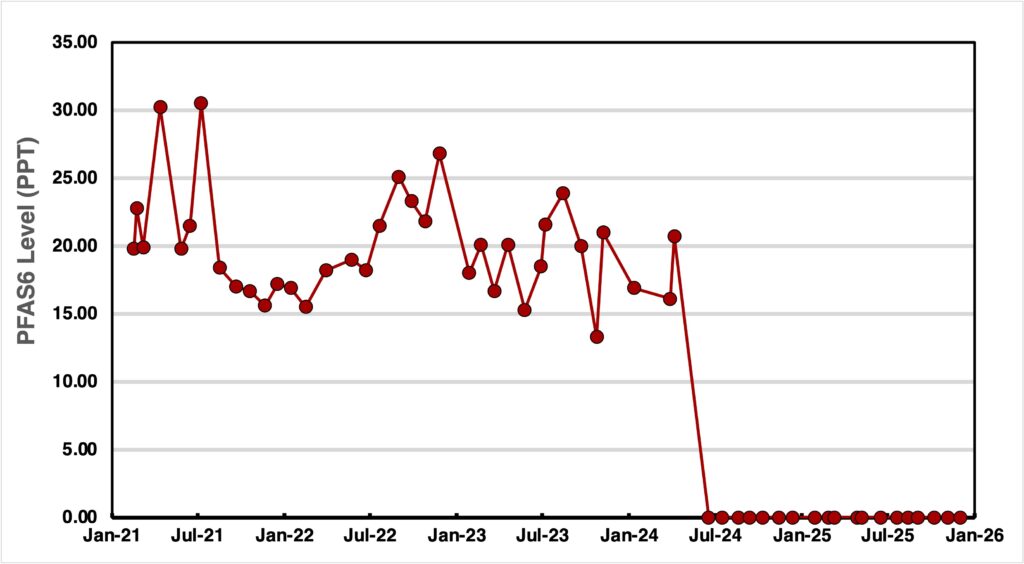
Prior to the installation of similar treatment at the South Acton Water Treatment Plant (SAWTP) and the Center Acton Water Treatment Plant (CAWTP), the Water District experimented with alternative methods to reduce PFAS levels such as blending water sources, limiting withdrawal rates, and rotating well operation. Those efforts were effective as a temporary measure, but resulted in a reduction in the District’s supply capacity and were operationally difficult to manage. Unfortunately, this reduction in capacity necessitated the imposition of strict outdoor water use restrictions.
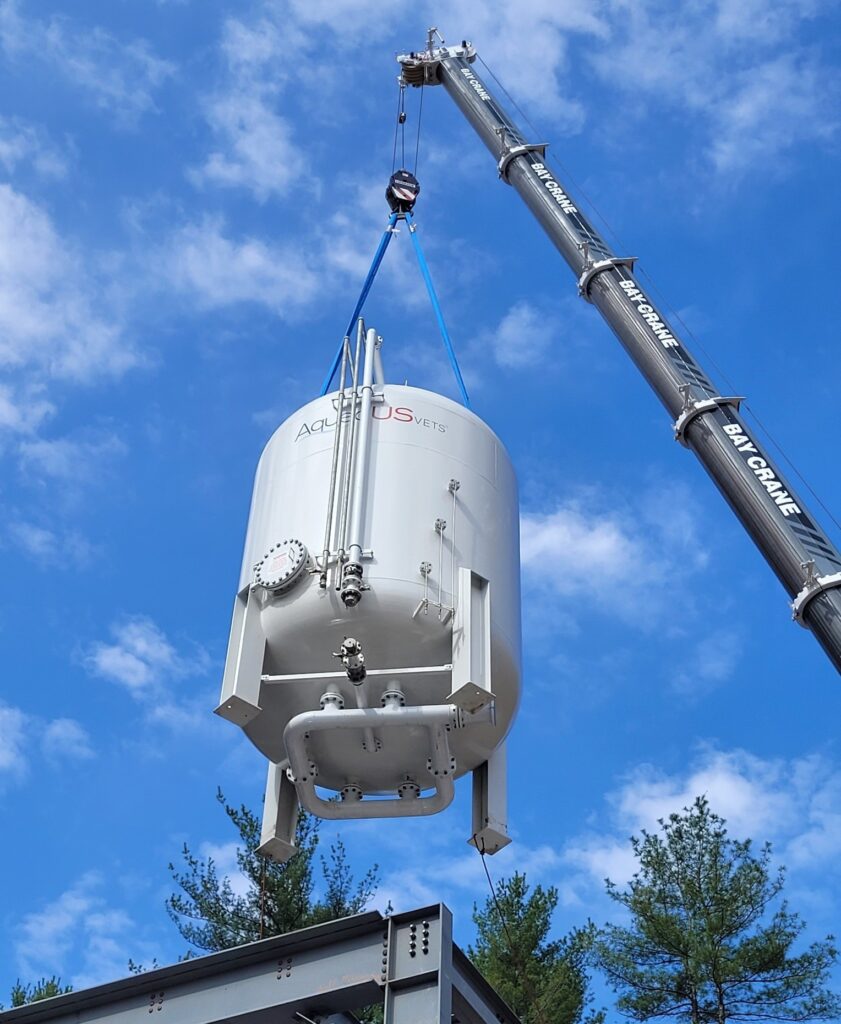
Planning for the design and installation of the South Acton and Center Acton treatment plants began in 2024 when it became clear that the approach used at the North Acton plant had been successful. Since the output volume, water chemistry, and particulate concentrations at each plant is different, treatment had to be carefully tailored to accommodate local conditions. The recent PFAS retrofit at the South Acton plant is the District’s largest installation, and incorporates six AqueoUS Vets tanks that are each 18 feet tall and 12 feet in diameter. Each contains 30,000 pounds of GAC.

How much has the PFAS treatment equipment cost, and who is paying for these upgrades?
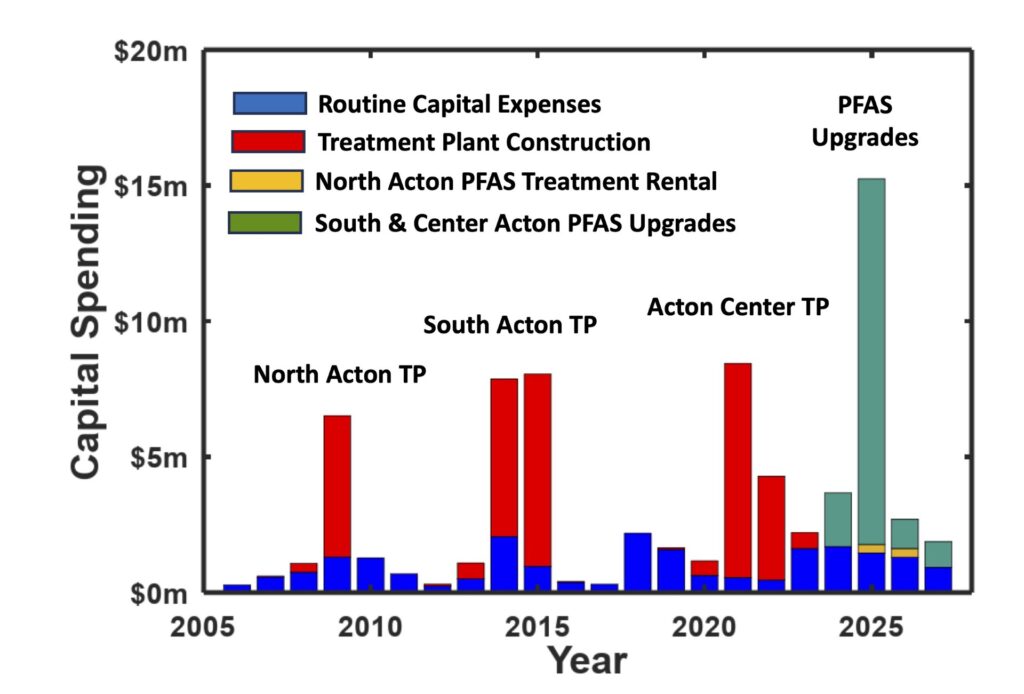
Compliance with all of the existing state and federal water quality regulations is technically challenging and very expensive. The Water District’s treatment plants were designed to remove other contaminants and meet older regulations, before PFAS regulations came into effect. As the chart below shows, approximately $38 million was spent to build those three facilities. The retrofits needed to add PFAS filtration have added another $20 million to the total bill for the treatment infrastructure. Most of these costs have been financed through long-term loans. Fortunately the District was able to obtain state loans with favorable conditions such as zero percent interest and principal forgiveness of $2.4 million.
As to the question of who is paying for PFAS removal, that responsibility rests largely on the shoulders of Acton’s water users. The Water District has received some money and expects to receive more from litigation settlements with 3M, DuPont, and several other PFAS manufacturers; but the total amount is expected to be less than $5 million. Most of the money needed for plant construction is being paid by debt service fees assessed to the Water District’s customers, who are currently being billed $83 per quarter for that charge. The cost of long-term maintenance for PFAS treatment will also be reflected in future water bills, but at this point in time the rate of media replacement is still unknown. For the current 20 ppt contaminant limit, it is estimated that the media in multiple GAC tanks may need to be replaced about once a year, which will add about $1 million to the District’s annual operating budget. The media replacement rate and associated costs will further increase if the EPA’s proposed 4 ppt regulation is enacted.
Does the Water District anticipate a need for additional treatment plant modifications?
The Water District has made investments to address the immediate PFAS removal needs. Long-term solutions in North Acton need to be evaluated, as do upgrades in West Acton, where a variety of water quantity and quality challenges remain unaddressed. History suggests that the number of regulations for drinking water is likely to increase with time, and that the limits on allowable contaminant concentrations could become more restrictive. New concerns about health risks emerge over time, and this year the term “microplastics” has been discussed frequently in the press. Recently, regulators have also expressed concern about elevated pharmaceutical levels in water sources. It may only be a matter of time before regulations on these products are announced, and water providers may find it necessary to add additional treatment stages to comply.
In the long term, local treatment in small towns like Acton may become technically and financially unsustainable. For this reason, the Acton Water District has joined eight neighboring towns in an investigation of a connection to the system operated by the Massachusetts Water Resources Authority (MWRA). That project, if it moves forward, is expected to take at least a decade to complete, and the cost of an MWRA expansion to MetroWest towns is expected to be in excess of $1 billion. Until this happens, the Acton Water District will need to do whatever is necessary to satisfy all of the applicable water quality regulations and meet the community demand for water.
Dr. Parenti is a member of the Town of Acton Water Resource Committee and the Acton Water District Finance Committee. Technical information about the construction and operation of the PFAS treatment equipment was provided by the Manager of the Acton Water District Matthew Mostoller, and the Deputy District Manager Corey Godfrey.