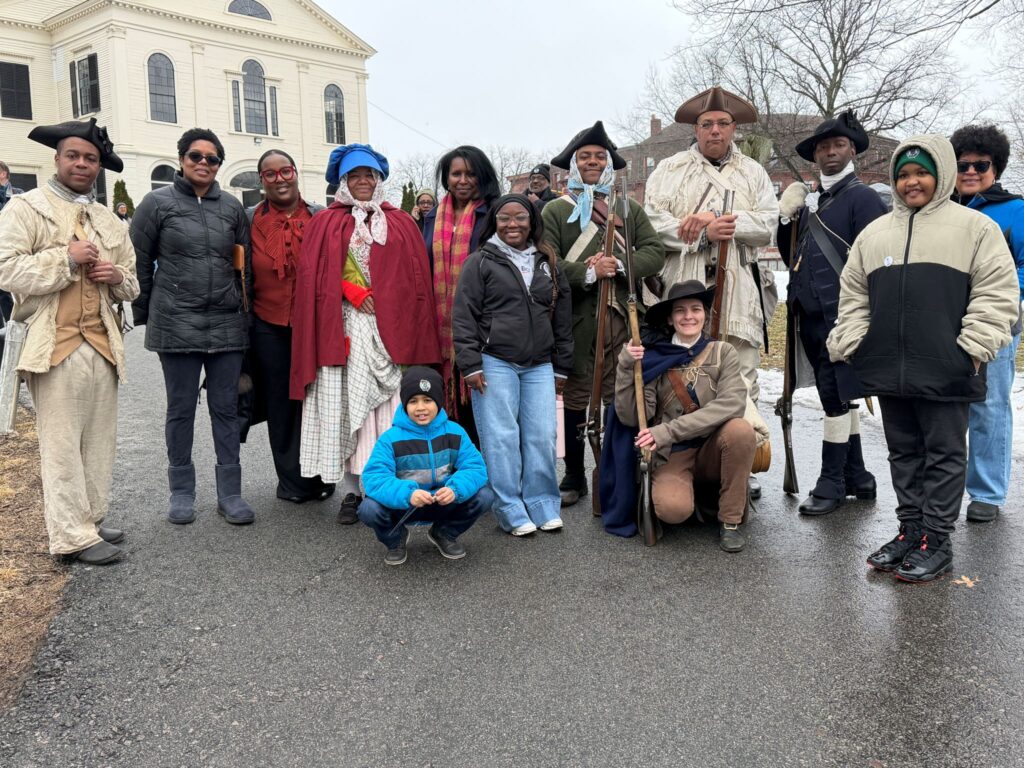
On Saturday, March 7, Boston Mayor Michelle Wu’s office hosted “The 250th Anniversary of Henry Knox and Roxbury’s Legacy of Liberty.” Acton area re-enactors and musicians participated.
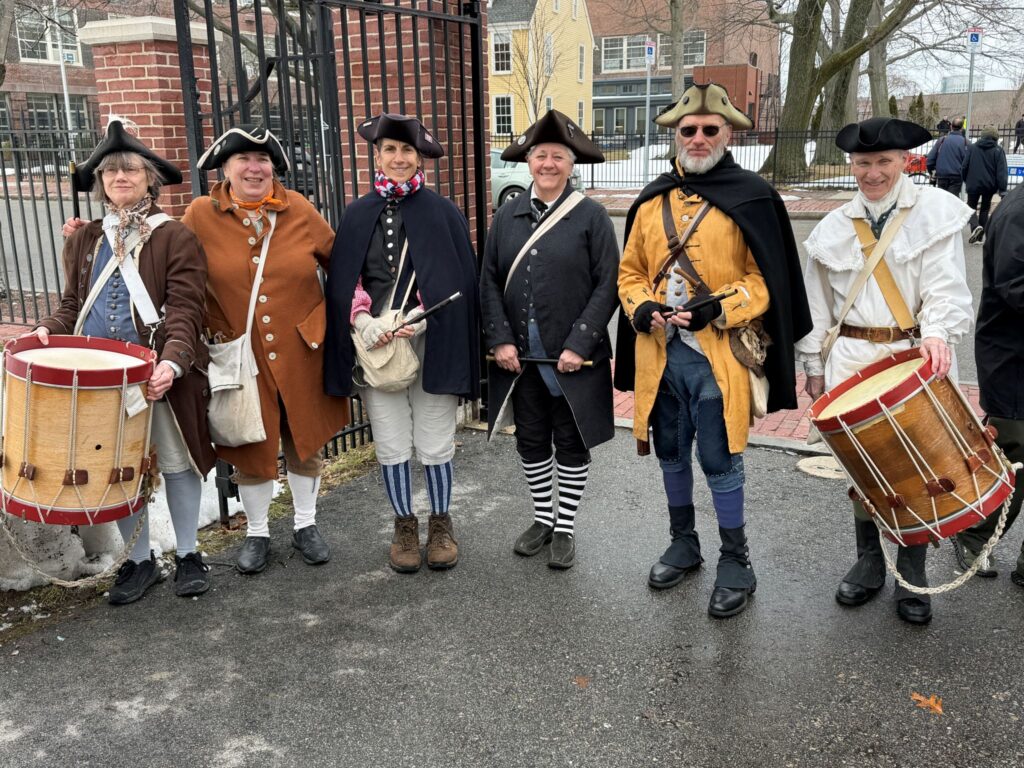
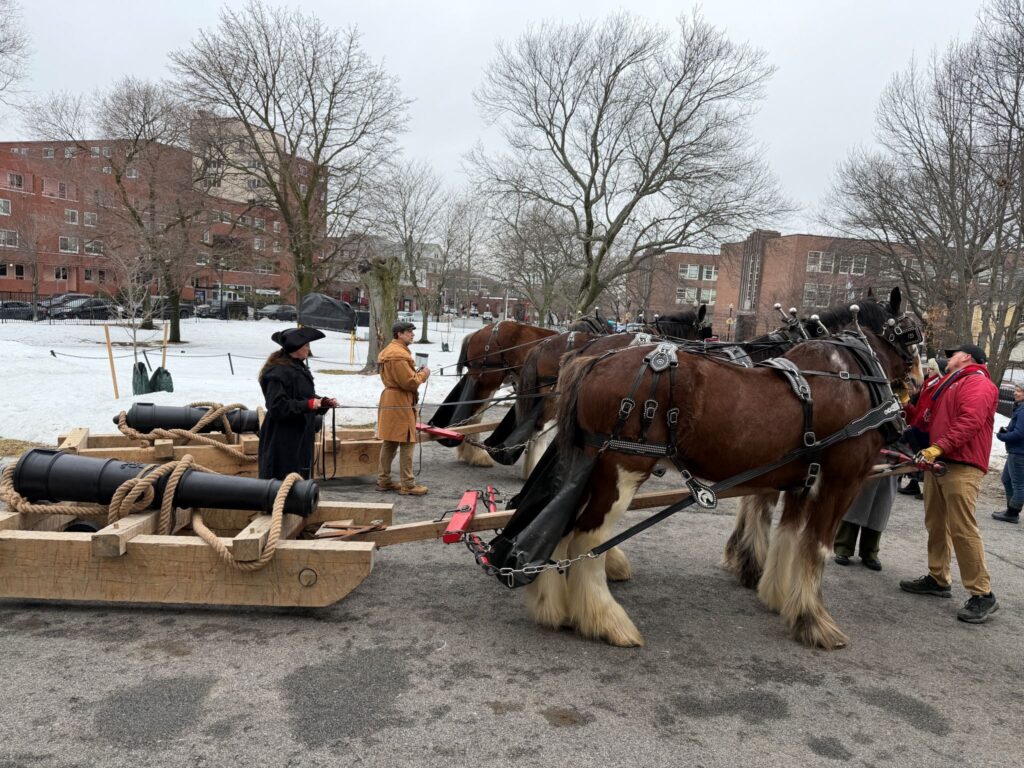
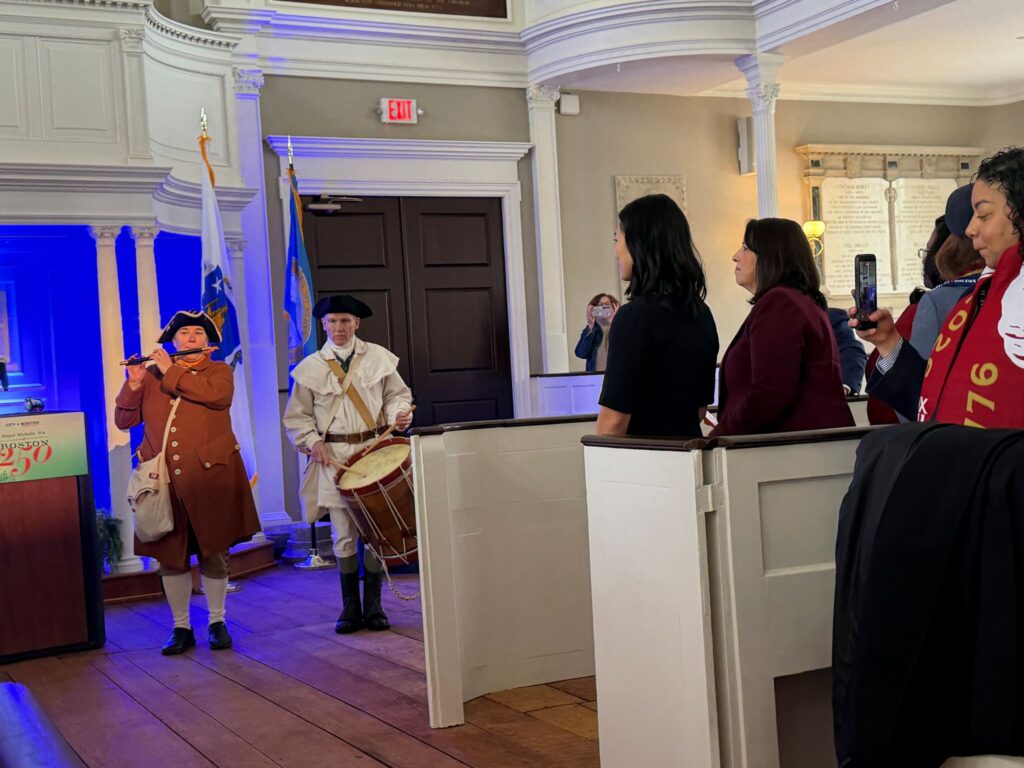
The Sudbury Ancient Fyfe and Drum Companie, including two members from Acton, Stephanie Smoot and Dale Wilson, joined the traditional horse and cannon procession from Fenway High School on Allegheny Street in Roxbury, meandering up the hill to First Church Roxbury at 8 John Eliot Square. Historians and dignitaries spoke, and poets, drummers, and dancers performed in an immersive spectacle that included a light show. Nubian Markets, a local cafe and grocery specializing in food of the African Diaspora, provided food.
Fifer Smoot said she is drawn to the musical side of re-enactment. “I am interested in enlivening the historic landscape with music. It’s a great experience, because you can see the architectural buildings, but it’s wonderful to have the music of the time to enhance it.” Sudbury Fyfe and Drum offers free fife and drum lessons every Wednesday night. Re-enactors from the Acton area, including Acton Minutemen, participate in Boston events a few times a year. “We usually do Harborfest, we did the Army 250, and we will do Evacuation Day on the 17th.”
The mayor said on her website, “[We] invite you to join us for a milestone in our Boston 250 celebration: the anniversary of Henry Knox’s Noble Train of Artillery…Two hundred and fifty years ago, Henry Knox and his diverse artillery corps transported 59 cannons from Fort Ticonderoga to Roxbury, a feat of engineering and endurance that changed the course of history. Today, Roxbury remains a vibrant beacon of thought and action in Boston. Join us for a celebration of Roxbury’s role in the American Revolution for an afternoon of history and storytelling.”
The presentation inside the First Church in Roxbury, which included honors and announcements from Mayor Michele Wu and Lieutenant Governor Kim Driscoll, began with Senior Pastor Reverend Willie Bodrick II from the historic 12th Baptist Church singing, “Lift Every Voice and Sing” (the Black national anthem).
Poet Amanda Shea emceed and read a poem she had written for the occasion, called “Boston Breathing Revolution”. It began: “Boston is a body that learned how to breathe rebellion. Two hundred and fifty years ago, its lungs filled with harbor wind and expelled insurrection…”
Shea introduced a lineup of historians to tell the story of Henry Knox and revolutionary Boston. “This is our story,” she said.
Dr. Noelle Trent, president and CEO of Boston’s Museum of African American History talked about what the British departure meant to Black Boston. “When Loyalist owners fled, they took their enslaved people with them, tearing apart families and scattering a community. Many never saw their loved ones again. At the war’s end, that dispersal continued, some to Canada, some re-enslaved in the Caribbean, and others eventually reaching Sierra Leone. You see, the American Revolution came at a cost, and some of that cost was borne by Black Boston. Today, as we commemorate the Knox Trail, I ask that we hold multiple truths at once, celebrating Henry Knox’s vision and the liberation of this city, while honoring the intellect, sacrifice, and profound losses that happened to the Black community.”
Local historian Dart Adams said that Black Bostonians feel the stories that are told often don’t include them. He mentioned Onesimus, an African man sold into slavery to the Boston Puritan minister Cotton Mather. Onesimus introduced the idea of smallpox inoculations. Inoculations were begun in 1721, changing history in Massachusetts and the future USA, and enslaved poet Phyllis Wheatley who is buried in an unmarked grave in Copps Hill Burial Ground.
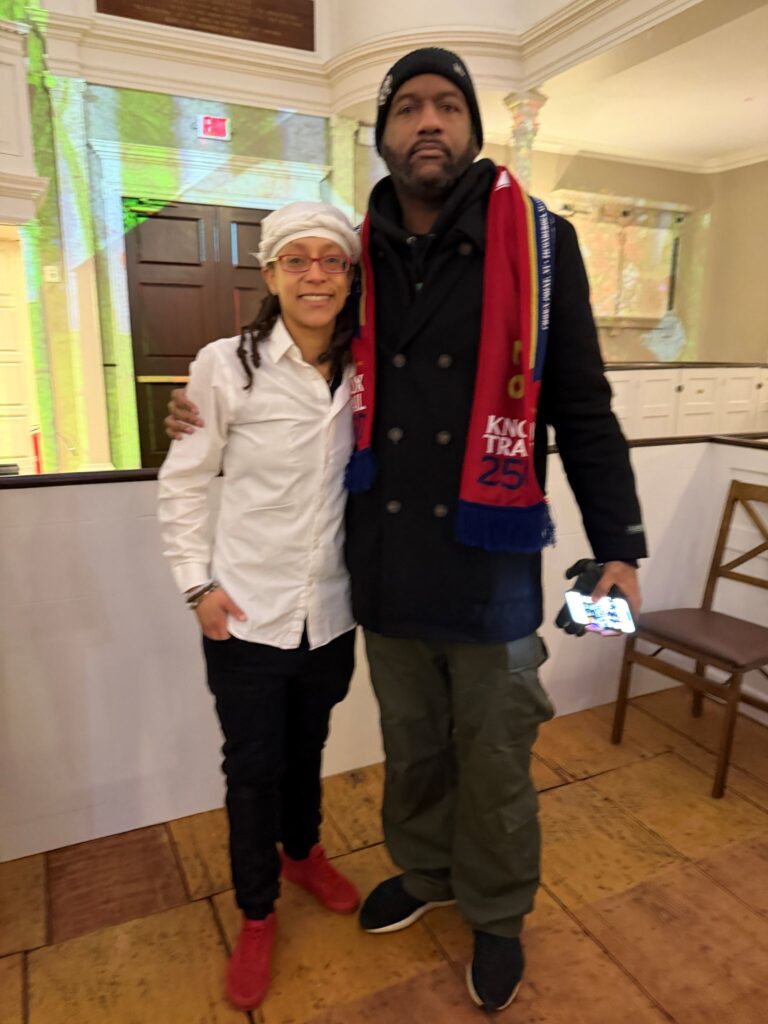
The Reverend Ray Shepard, who also spoke in Acton on Juneteenth 2025, has just written a book about Abel Benson, a 9-year old alarm rider — like Paul Revere, but unknown — who rode his horse from Framingham to Newton, warning farmers, “The Redcoats are out, the Regulars are about!” Shepard spoke at the Knox Commemoration and told Abel’s story.
Jonathan Lane of Revolution 250 said Saratoga 250 “were keen partners to make sure that Henry Knox’s story got all the way from Fort Ticonderoga to Dorchester Heights.” In turn, Lieutenant Governor Kim Driscoll told the story of Jonathan’s leadership. “I have to say, Jonathan had this idea for a concept — let’s recreate the Knox trail— two years ago. You pulled it off! This is amazing.”
Driscoll described Henry Knox’s noble train of artillery: “In the winter of 1775 and 1776 Knox and his team took massive cannons and ammunitions across rugged terrain from Fort Ticonderoga through towns and villages, over rivers and frozen roads, without paved highways, without engines, without trucks. They relied on … sheer labor, trust between neighbors, and a deep belief that what they were doing together mattered. That achievement was not made possible by one person or one place alone. It succeeded because the entire region, across towns, across state lines, chose cooperation over isolation, and collective effort over individual ease. It was a bold and unlikely mission.” She said that what happened in Boston was “not just a stop along the way, it was a moment of resolve, when communities understood what was at stake and chose to act.”
Executive Director of the Unitarian Universalist Urban Ministry Reverend Mary Margaret Earl, said that the Puritans gathered on this site in the 1630s and that archaeological finds show Native residents dating back thousands of years. She said that Knox and his team traveled through many tribal lands between Fort Ticonderoga and Boston. The day’s event was the first in the space since the recent culmination of ten years of renovations. “What a way to open back up!” Earl said.
A member of the Knox Artillery re-enactors offered the historical perspective. “We are up on the Roxbury Heights looking over Boston. The colonists would have been here since April 1775, when they chased the British back into Boston. This longterm staring contest is going on 10 months now. As of the 5th, we took some very large cannons and built a fort up on Dorchester Heights. The British were not very fond of that. Currently we are in the middle of a blizzard. 1776. We have an understanding that the British would like to make haste and leave for elsewhere. We have seen a lot of scurrying going around. They tried to send forces across to attack our new fortifications but the wind was so bad, start of the blizzard, we hope they should be leaving soon…within a week, I think! [laughs] –a week and a couple of days…There are about 120 ships in Boston and the British are looking to start to load them up.”
The re-enactor was not able to finish telling the history, as the troop was called to Roxbury Heritage Park for the shooting of the cannons. So, we’ll never know how it ends.
Franny Osman is the editor-in-chief of the Acton Exchange and writes on occasion.