On the cold dark evening of January 28, a capacity crowd filled the main gallery of the Umbrella Arts Center (the Umbrella) in Concord for the opening of the Ancient Light exhibit, featuring the work of Acton astroimager Marsha Wilcox.
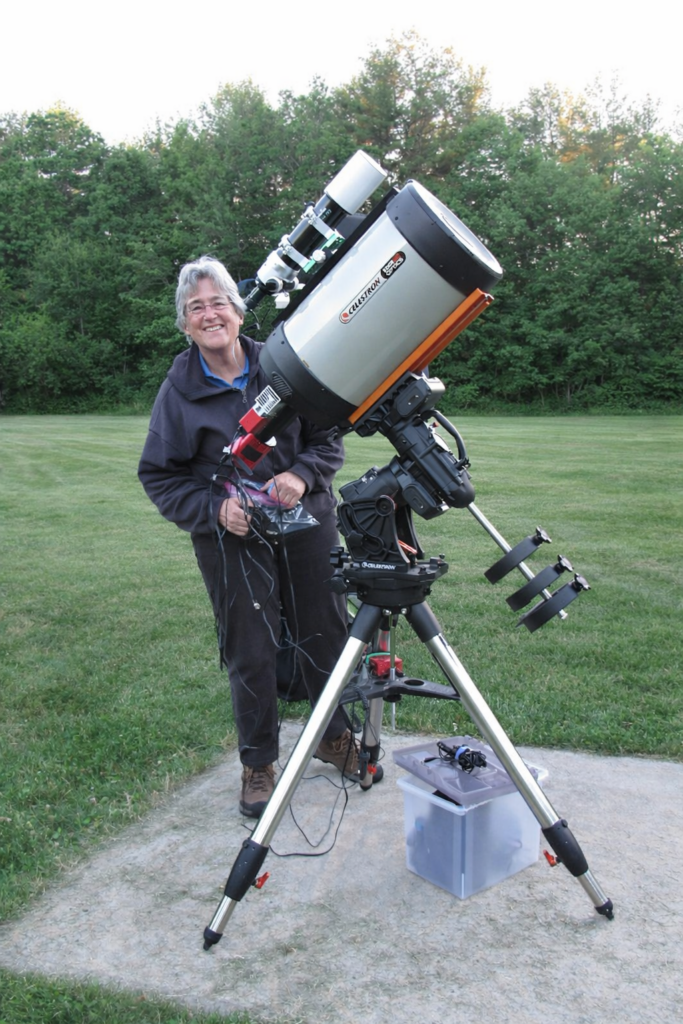
As readers may recall from Wilcox’s exhibit at the Acton Memorial Library, Wilcox uses her Celestron EdgeHD 11″ telescope to capture very long exposures of celestial objects such as galaxies and nebulae. She then combines different frequencies of light to create images that she describes as “a reminder that we are all connected to something infinitely larger than ourselves”. Wilcox demonstrates the workings of her telescope in this short video, filmed in her Acton driveway. Her website explains how she filters and processes the faint visual signals from her distant sources.
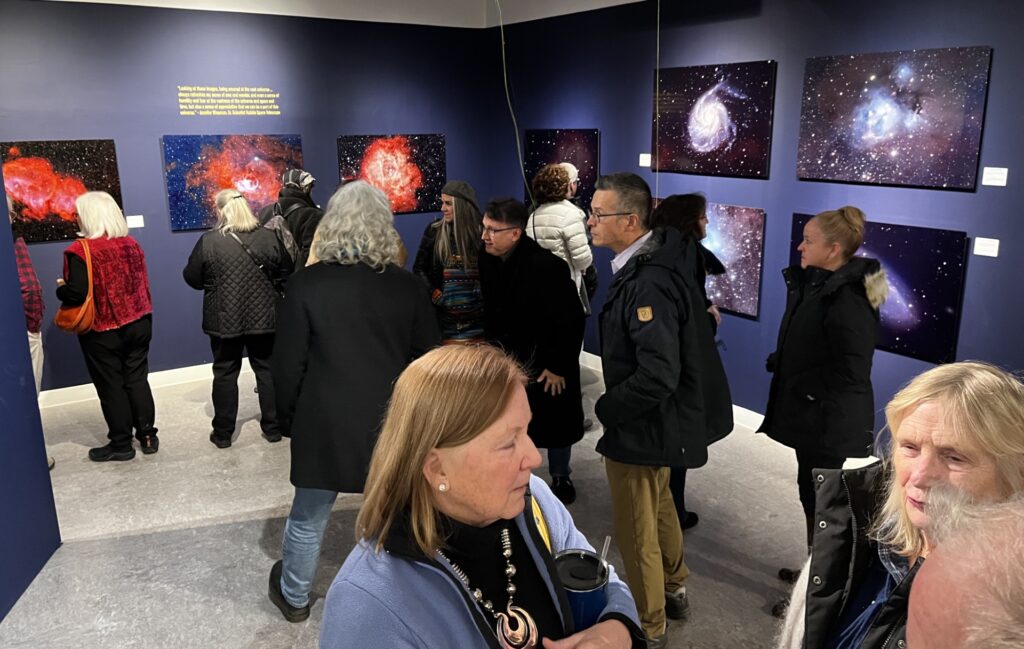
For this exhibit, the Umbrella had repainted the gallery walls in darkest blue to set off the black background and vivid colors of Wilcox’s art. The images were printed at a much larger scale than in any of her previous exhibits, filling the visual field of viewers standing in front of an image. Apt quotes from scientists, artists, and writers were posted in golden letters next to selected images, to bring forth the exhibit’s theme: “There is art in the science and science in the art.”
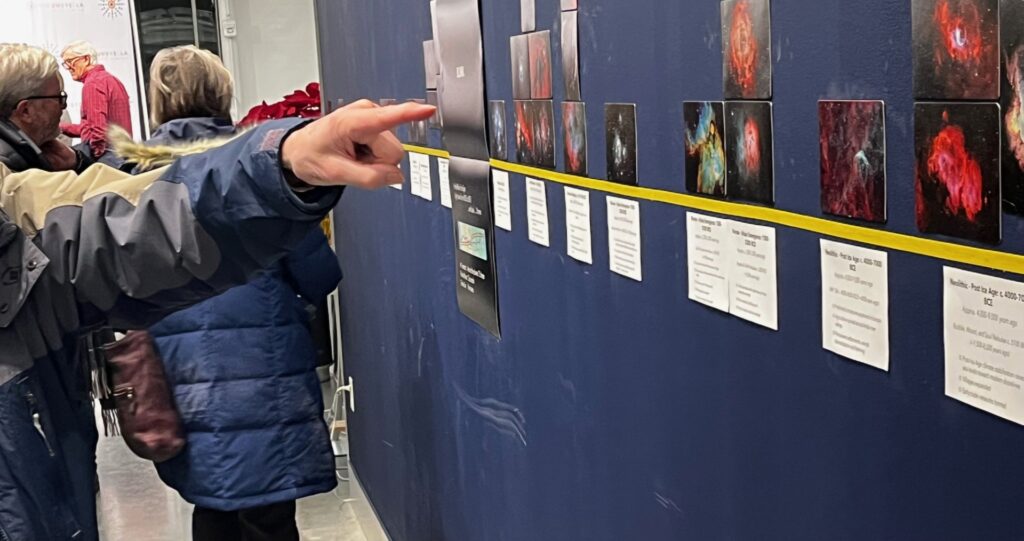
The largest wall of the gallery was given over to a timeline. The photons that formed Wilcox’s images travelled at the speed of light, taking hundreds or millions of years to reach Earth from their distant points of origin. In this display, small prints of each image are arrayed along the timeline, from the 400-million-year-old group of galaxies known as Hickson Compact Group 56 on the far left, to the 444-year-old Pleiades constellation on the far right. Labels beneath each image tell visitors what was happening on Earth when that image’s light was emitted from its source. When the light in Wilcox’s image left the distant Hickson Group, Earth was in the “Age of Fishes.” By the time the light left the “nearby” Pleiades, humans had evolved and the scientific revolution was in full swing.
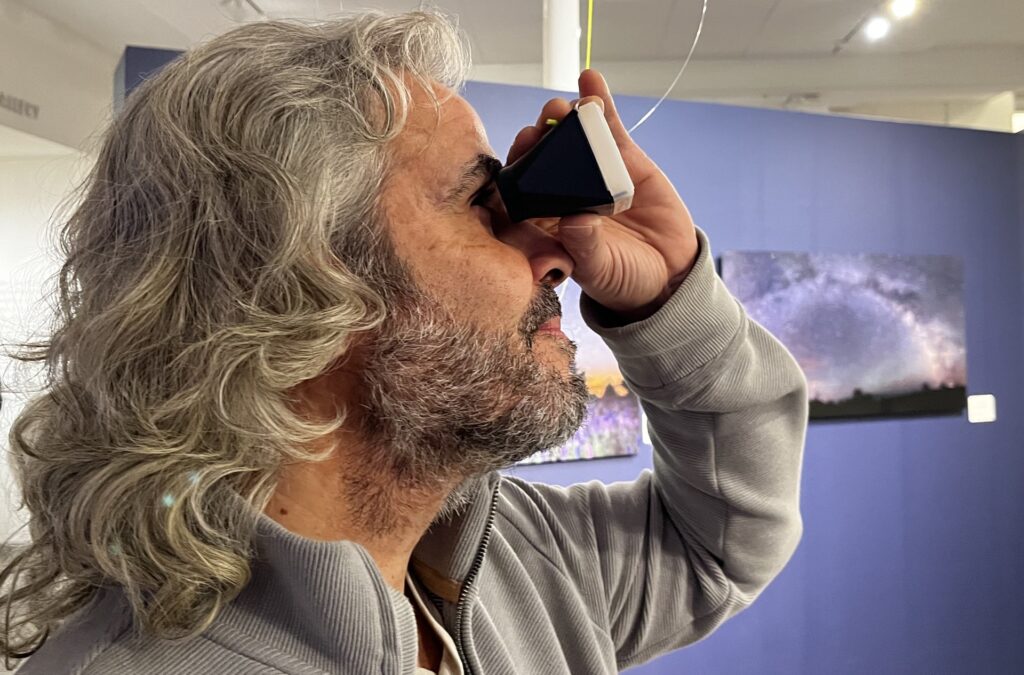
Hanging from the ceiling on cords, visitors were surprised to find hand-held slide viewers, of a type that older readers will remember from the days when 35mm slides provided the best available technology for displaying color photographs. When held up to the eye and pointed towards one of the ceiling lights, the slide viewers offer an immersive experience with the rest of the world blocked out and only the nebula or galaxy visible in glowing color.
From the opening moments of the event until the staff began to close up shop, Wilcox was surrounded by a circle of curious visitors of all ages asking endless questions spanning art, science and technology.

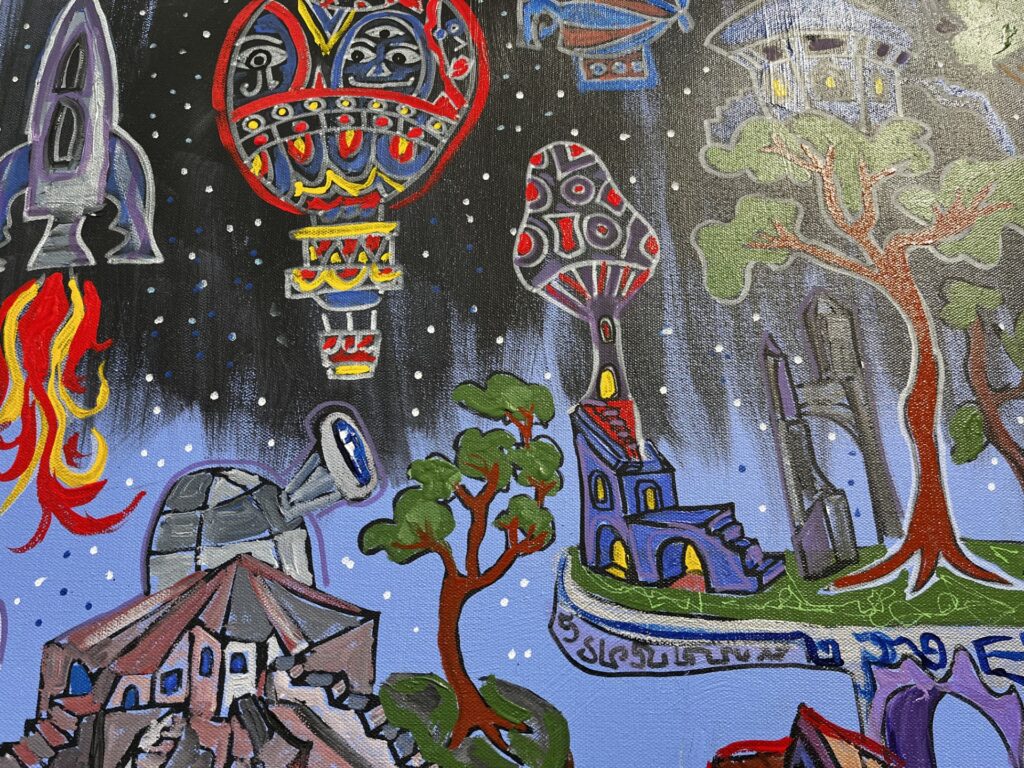
The Umbrella opening also showcased the work of another local artist, Carl Ristaino of Hopkinton, in a lively exhibit called Inspirational Jam. Ristaino’s vivid acrylic paintings are inspired by “the kinetic energy and soulful spontaneity of jazz music and culture.” A pair of sharp-eyed observers who visited Ristaino’s work upstairs and Wilcox’s work downstairs pointed out to this reporter a linkage between the two exhibits: Ristaino’s paintings include stars, the moon, planets, and a telescope.
Ancient Light will be on exhibit at the Umbrella Arts Center, 40 Stow Street in Concord seven days a week, 10 a.m.- 9 p.m., through March 22. The gallery is wheelchair accessible and admission is free. Gallery walks and an artist talk are scheduled throughout February and March; dates and times here. Or from home, you can view Wilcox’s work on the Glory of the Heavens page of her website.
Kim Kastens is an associate editor and board member for the Acton Exchange, and often walks in Acton conservation lands with Wilcox and her golden retrievers.