On January 12, Massachusetts Energy and Environmental Affairs (EEA) Secretary Rebecca Tepper declared that the Northeast Drought Management Region, which includes Acton, has worsened to a Level 2 – Significant Drought. “Continued snow and rainfall are needed to alleviate the drought that many regions in our state are experiencing this winter,” said Secretary Tepper. “Groundwater levels still need to recover, so as we get closer to the growing season, we encourage everyone to continue to follow state guidance and local water restrictions. This will help ensure we have enough water available for our essential needs.”
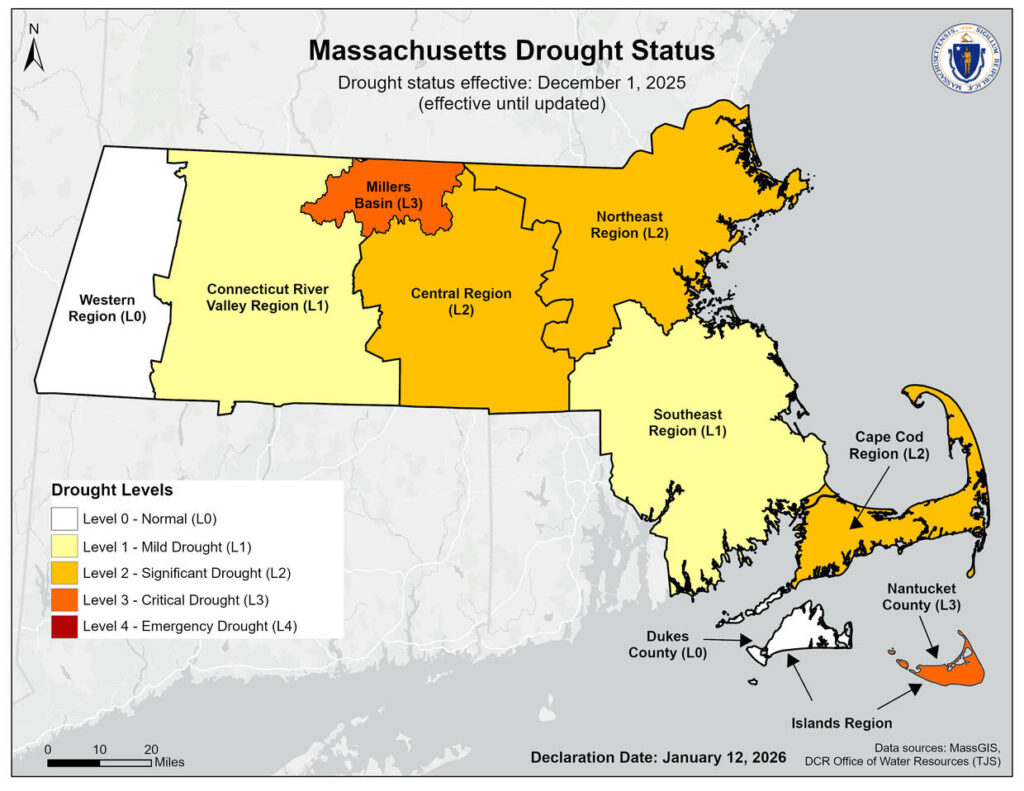
Drought is a look back at conditions over a period of time. In support of the recent drought status decisions, the Drought Management Task Force collected and analyzed data from August 2024 through December 2025, taking into account precipitation, groundwater level, streamflow, condition of lakes and impoundments, evapotranspiration, and fire danger. During December, Massachusetts received rainfall ranging from 3 to 4 inches; however, when looking back over the past 3 to 6 months, precipitation deficits persist.
Residents can report dry environmental conditions and submit photos to help monitor the situation on the Massachusetts Water Impact Reporter. Additionally, a FAQ is now available for questions regarding the current drought status and water conservation; and private well owners can go here for information on how the drought may impact them.
In a telephone interview with the Acton Exchange, Acton Water District (AWD) Manager Matthew Mostoller stated that the current drought is not causing any operational difficulties for the water district, partly because winter is a season of low water demand. However, Level 4 outdoor watering restrictions remain in effect, which means that no AWD water can be used outdoors, except for food and fiber production or to protect public health and safety.
Acton’s Level 4 water restriction is partly motivated by the drought, but even more so by the AWD’s need to temporarily stop distributing water from the South and Central Acton Water Treatment Plants while the new PFAS treatment systems at each of these plants is completed. Mostoller anticipates that the “start up inspection” of the South Acton Plant by the Massachusetts Department of Environmental Protection will happen the last week in January, with the Central Acton Plant following 2-4 weeks later. If all goes well, Mostoller projects that both plants could be producing and distributing ample quantities of water with negligible levels of PFAS by the end of February.
With the strain on water availability eased, the AWD will then reassess the drought situation, and likely relax the outdoor watering restrictions. However, Mostoller noted that the groundwater level is still very low and “is not rebounding as we would have hoped. The slow recovery of the groundwater could be a problem going into the spring.” The graph below illustrates Mostoller’s point.
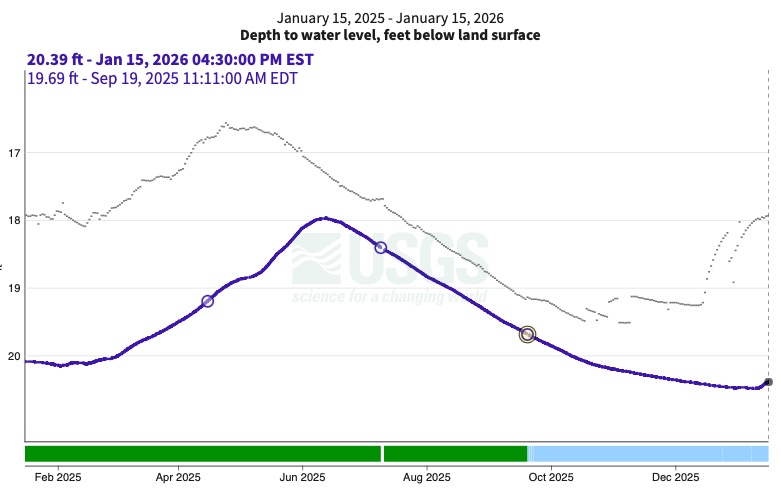
At the U.S. Geological Survey’s groundwater monitoring station on Wetherbee Street in Acton, the water table level at this time of year has historically averaged about 18 feet below the ground surface. This year, it is more than two feet deeper than that. Most years, the Wetherbee station’s groundwater level has been high in the spring, falls throughout summer and fall, and then rises in the winter. That upward trend typical of this time of year has not been happening.
Kim Kastens is an Associate Editor for the Acton Exchange and also chairs the Water Committee of Green Acton.