It’s been said that history is written by the victors, so it’s not surprising that the story of Loyalists to the Crown who lived in the American colonies is not as widely known as that of the Revolutionary War’s victors. Loyalists suffered not only their Patriot neighbors’ scorn; many also suffered the agony of fleeing their towns and homes for another country. A noted historian characterized the Revolutionary War as “America’s first Civil War.” Various historians estimated between 60,000 and 100,000 people fled the colonies by the time the war ended.
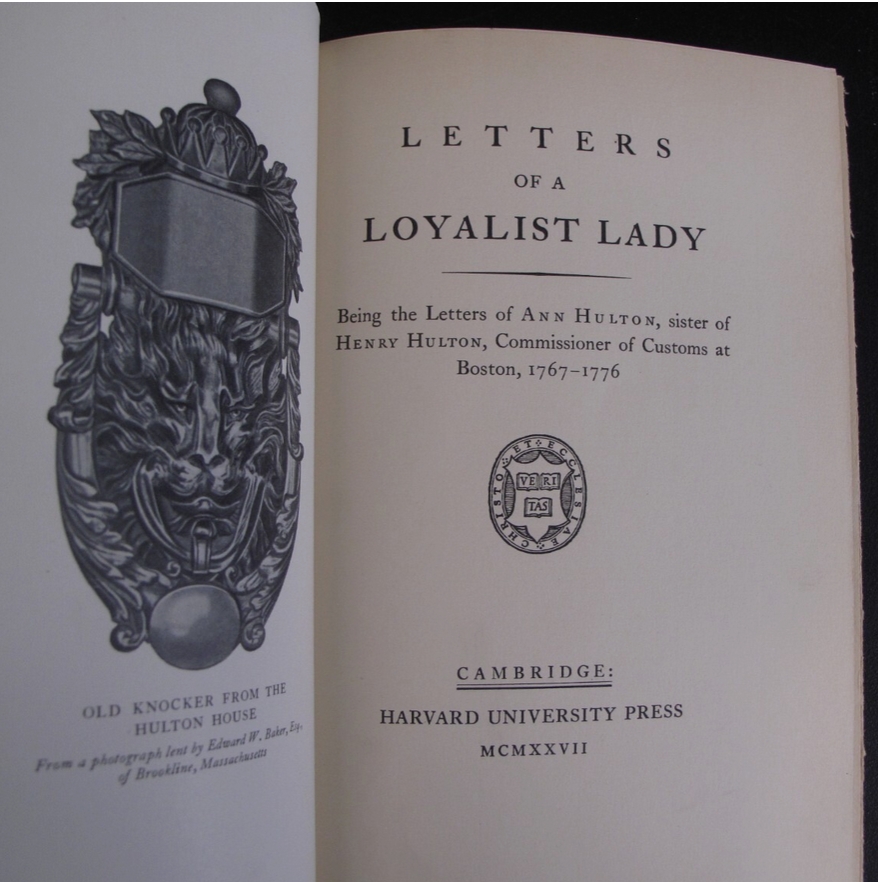
In letters Loyalist Anne Hulton wrote from Brookline, Massachusetts, to a friend in England between 1767 to 1776, she described the tarring, feathering, and whipping of a Loyalist customs officer and of a “Tory [Loyalist] woman” who was stripped by rebels of her and her children’s clothes. Her brother Henry described rebellious Massachusetts Patriots as “banditti of the country . . . a most rude, depraved, degenerate race.”
Attorney Daniel Bliss of Concord was an active Tory. After British army officers visited Bliss in Concord to assess the town’s preparations for rebellion, his neighbors threatened his life. Bliss fled, later sending his brother to spirit away his family and save what they could of his holdings (but to no avail). Bliss joined British General Burgoyne’s army, assuming an important position in the Niagara region and later settling in New Brunswick, Canada, where his legal work brought him prominence. Meanwhile, the 1778 Banishment Act of the State of Massachusetts — “An act to prevent the return to this state of certain persons therein named, and others, who have left this state or either of the United States, and joined the enemies thereof” — banned by name some 308 Massachusetts Loyalists, Bliss included, from returning upon penalty of death.
![A cartoon that shows two Boston patriots helding down a man who is on one knee and covered with feathers (and presumably, tar). One of the Bostonians is holding what looks like a large teapot. The text accompanying the cartoon says "A new method of MACARONY [sic] MAKING as practiced at BOSTIN in NORTH AMERICA.](https://www.actonexchange.org/wp-content/uploads/2026/03/2026_03_21_Loyalists_JohnMalcolmTarred.jpg)
Larry Kerpelman holds bachelor and doctorate degrees in psychology from, respectively, Johns Hopkins University and the University of Rochester. Since retiring after 30 years in 2002 as vice president and director of Corporate Communications of the Cambridge, Massachusetts consulting firm Abt Global, he has written and published articles on American history in general readership magazines. Mr. Kerpelman has been a member of the Acton Historical Society since the early 2000s and served as treasurer and a member of the Board of Directors for several years.
Editor’s Note:
Asked what inspired Mr. Kerpelman’s interest in history, he replied that he contributed a chapter to the 2016 book, “Chicken Soup for the Soul: The Spirit of America”, adding, “The chapter’s title is ‘The Town that Taught Me Patriotism’ and the town I wrote about is, of course, Acton.”
The Acton Exchange asked local historian Anne Forbes about Acton Loyalists. Ms. Forbes said there are several well-known stories of Loyalists in Concord, including one that split the town minister’s family. “I’ve always been surprised that I haven’t run into any in Acton. But, according toRobert Nylander in his Beacon article of June 28, 1973 ‘Upon Which His Descendants’,
‘ . . . the recollections (in the James T. Woodbury Historical Papers) of Charles Tuttle, who grew up during the Revolutionary period, state, quite unequivocally, that there was ‘not one Tory in Acton.’ ”
One member of the Acton Exchange editorial team commented, “My ancestor, Dr. Isaac Winslow, who saved Marshfield by inoculating them against the plague, was allowed to stay in Massachusetts, while the rest of the family had to emigrate to Nova Scotia, Canada (and then to Iowa, where my mom was born).”