The first public outreach workshop for removing the Bellows Farm Mill Dam and replacing the Carlisle Road bridge culvert was held virtually on Thursday, January 15, 2026, and attracted 34 participants. Nashoba Brook flows under Carlisle Road in North Acton, where the water is then impounded by the historic dam, forming Robbins Mill Pond. The structures, on opposite ends of the pond, were recently inspected, revealing the need for repairs or replacement. SLR, a sustainability consulting firm, conducted a feasibility study for the project, which was presented to those in attendance, along with time for questions and concerns.
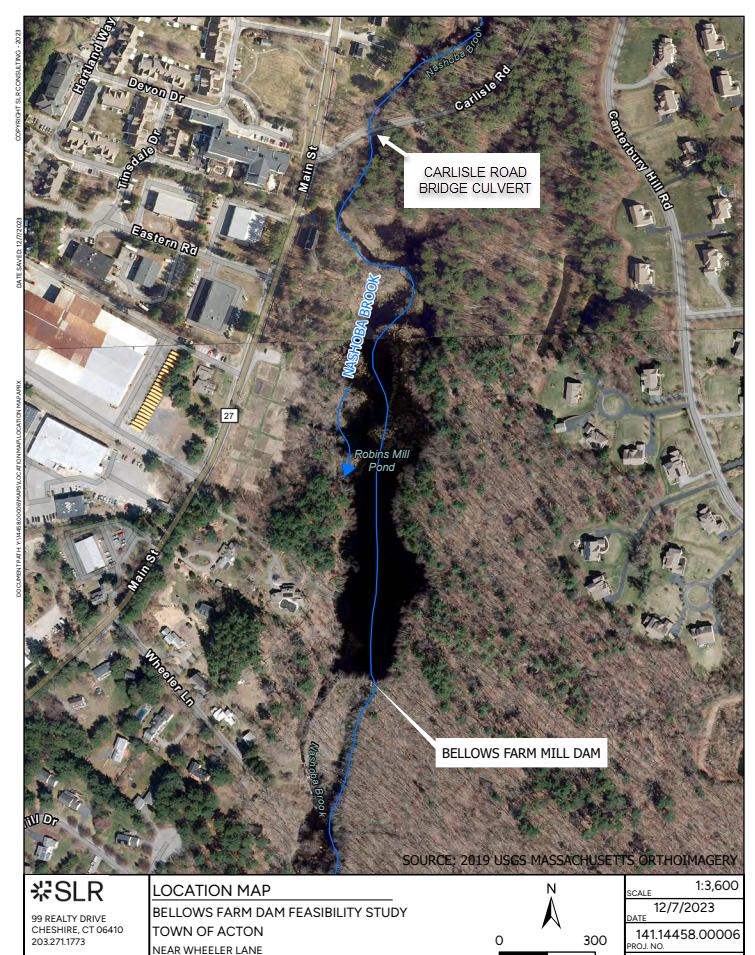
The Acton Trail Through Time historical information dates the dam back to 1732, when Thomas Wheeler Jr. built a mill complex along Nashoba Brook at the end of what is now called Wheeler Lane in Acton. He harnessed the water in the brook to power saws and grind grain. Remnants of the Wheeler homestead, the mill foundations and stone-lined canals are still visible today. A little further upstream is the earthen dam that stored the water of Nashoba Brook in a man-made pond, now called Robbins Mill Pond. When the sluice gates were opened, water would run down the canals to power the mill machinery.
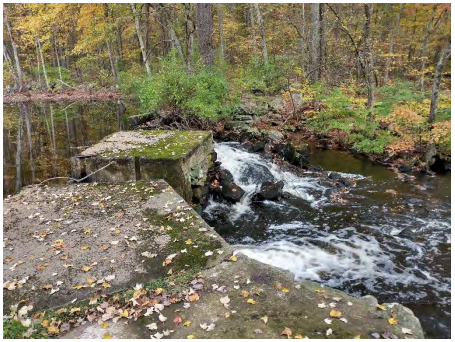
The dam, now called the Bellows Farm Mill Dam, has probably been reinforced over its nearly 300 years. One 18-foot spillway section is now concrete blocks of unknown age. A state inspection in 2020 stated, “The dam is in disrepair and will need to be removed or repaired to meet the safety standards of the Massachusetts Office of Dam Safety.” There is evidence of erosion and seepage around the concrete and stone spillway. If it has a major failure, it could cause serious damage downstream.
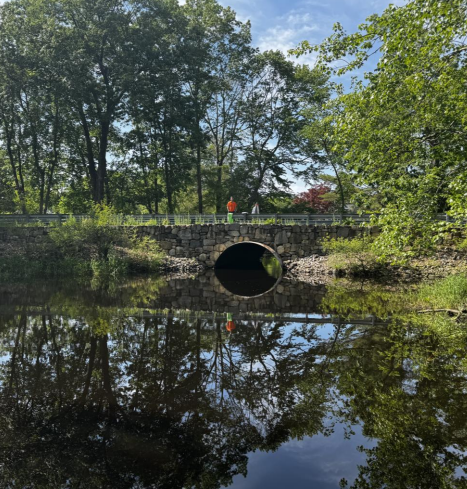
On the northern side of Robbins Mill Pond, another problem is churning —- literally. The culvert that directs Nashoba Brook under Carlisle Road is too small at just 13.5 feet wide. The water pressure builds through this culvert and carves a scour hole as it exits the other side. The culvert itself is a corrugated steel pipe that has rusted out in spots, creating a potential hazard for the roadway above it.
SLR consultants were given a few objectives when considering the feasibility and options for this project.
- Safety – Protect the town from failing infrastructure
- Cost
- Restoration of natural river processes
- Protecting wetlands
- Protecting recreational and historical sites along Nashoba Brook.
Restoring natural stream flow requires a lot of soil and water testing and permitting. Combining the dam and culvert into one project makes the testing and permitting more efficient, since it does not need to be repeated for each project. The consultants from SLR probed and sampled the stream bed at several places to measure soil composition and test for hazardous chemicals in the sediment. Some trace amounts of 2-butanone and ethylbenzene, two chemical solvents, were found. Further testing will be done, but the consultants did not think the low concentration would warrant concern.
Part of the dam removal feasibility study included reviewing several alternatives. A partial dam breach was recommended to balance the cost while still meeting the safety and ecological goals of the project. The estimated cost of the partial dam breach is $1.9 million. This is significantly less than a full dam removal ($3.1 million) or repairing the dam ($2.0 – $2.7 million). The town has received funding to pursue partial dam removal through a Massachusetts Energy and Environmental Affairs (EEA) Dam and Seawall Repair or Removal program.
The Bellows Farm Mill Dam will be partially breached to lower the water level behind the dam to a point where the dam no longer has to meet state regulations and monitoring – and no longer poses a downstream threat of an uncontrolled breach. The 18-foot concrete spillway will be removed and that section will be widened to approximately 70 feet, forming a new stream channel. This will change the wide, still-water habitat of Robbins Mill Pond back into a narrow, flowing brook habitat like it was nearly 300 years ago before the dam was built. A large section of the original earthen dam and the historic canalways will remain but will no longer impound water.
Some abutters to the project location who were at the meeting expressed concern about losing the pond and the wildlife that lives there. The SLR consultants acknowledged the change to the ecosystem, but also pointed out the fish and other animals that will occupy the new flowing stream habitat. They presented before and after pictures of a similar project in Connecticut that showed a wide man-made pond turned into a meandering stream among marsh grasses and a few wetland trees.
Another concern was how the newly exposed pond bed will re-vegetate, and if invasive plants will take over. The expectation is that native seed stock will grow in, possibly with a few planted native trees and shrubs. Invasive plants are a problem in all Acton conservation lands and will need to be monitored and controlled. A more detailed vegetation plan will come in a later phase of the project.
Some heavy machinery will be needed to remove a section of the dam. It is not clear yet how these machines will access the site. The access path will likely require some restoration after the machines are removed from the site.
SLR recommends that the Carlisle Road bridge culvert, on the north side of Robbins Mill pond, be replaced with a prefabricated concrete bridge with a 34-foot span. This wide span would allow Nashoba Brook to pass underneath the road unimpeded and to have a natural stream bed. The wider span would leave some dry stream bank on both sides, allowing animals to cross under the road. Extra space on the stream banks would also accommodate the high water volume when the stream swells in heavy rain and snow melt.
Using a prefabricated bridge is expected to minimize the duration of road closure along Carlisle Road during construction. Traffic would still likely need to detour for a few months.
No specific dates were presented at the meeting. There is still a lot of testing, permitting and designing to do before the project commences. This was the first public outreach presentation for this project. There will be more details released and more public presentations made as the project progresses. See the project website to follow progress.
Tom Wolf is the Acton Land Steward for the Nashoba Brook Conservation Land, which includes the Bellows Farm Mill Dam. He writes for the Acton Exchange on various topics, usually related to nature and environment.