The League of Women Voters Acton Area (LWVAA) hosted a forum on Saturday, Feb. 28 at Acton Town Hall entitled, “Restoring the Promise: Immigration Policy and the Path Forward.” The event was the first one made possible by the Margaret Kennedy Social Justice Initiative Fund, established with a bequest from long-time LWVAA member Margaret Kennedy, known to family and friends as Marge. As previously reported, the bequest supports a multi-year initiative to advance Marge’s legacy of social justice work through public forums, speaker series, and other community building programs.
More than 50 attendees gathered in person, with another 40 online, and even more viewing on Acton TV. Lori Cooney, executive committee member of the LWVAA, welcomed the audience and described some of the League’s activities, such as candidate forums and “Vote Tuesday” lawn sign placement.
Marge’s son, Steve Long, spoke of the initiative’s work, noting, “My mom would have found this event perfect, so you all hit the nail on the head.” He shared three words that come to mind when he remembers his mom — caring, community, and curiosity. “She was involved in so many things. Whether it was health, housing, or social justice, she really invested herself into this community.”

This author introduced Attorney Antonio Massa Viana, a Brazilian American who founded Massa Viana Law in 2015 after becoming licensed. He was the first known undocumented immigrant attorney in Massachusetts. Viana’s firm handles cases on immigration matters, including family and employment-based petitions, removal defense, and humanitarian relief.
Viana began the discussion with questions to get a sense of attendee viewpoints. Many indicated agreement that there was chaos at the southern border during the previous administration, and most agreed that the US is a nation of immigrants and that US immigration policy is in need of some fixes. All hands rose when he asked if people who commit crimes, even violent crimes, deserve due process. Viana asked the audience to listen to his talk with important questions in mind: “How is this going to impact us as a country, and how is this going to impact [us] as citizens?”
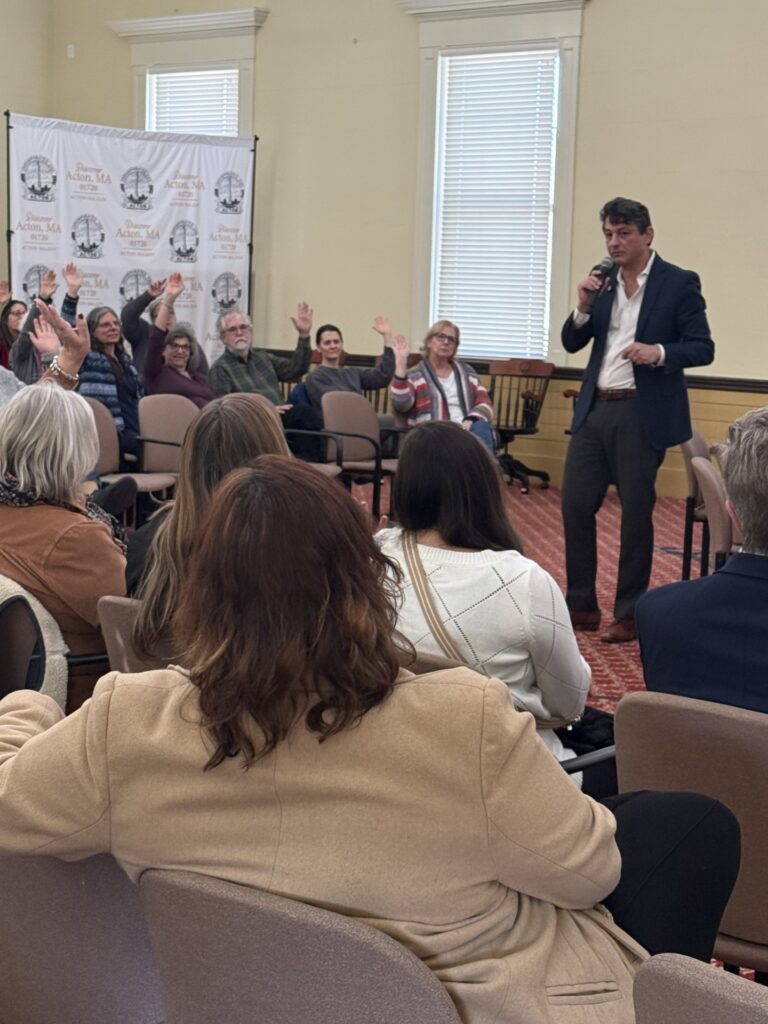
Viana’s presentation focused first on important moments in the evolution of immigration policy in the country. He noted that one of the grievances in the Declaration of Independence was the limitation on immigration to the colonies imposed by the king. Other milestones included a 1790 statute restricting citizenship to “free white persons” living in the country for at least two years, the Fourteenth Amendment that allowed people of other races born within the country’s borders to be entitled to citizenship, the Chinese Exclusion Act, and the adoption of quotas to limit immigration, that were first racially based, but are now based on national origin.
Next, he detailed the types of immigration status that exist, including citizenship conveyed by naturalization, legal permanent residency, Deferred Action for Childhood Arrivals (DACA) Temporary Protected Status (TPS), status granted to migrants from countries that have experienced war or natural disaster, parole programs, and many types of visas, a “salad” of them as Viana put it: H1B (skilled workers), F1 (student), O1 (special abilities), R1 (religious minister), and family sponsorships. A point Viana said is critical relates to the length of time it takes to process cases — 10, 20, 30 years, or even longer.
A number of statistics, provided by the Department of Homeland Security (DHS) and the Economic Policy Institute, painted a picture of the undocumented population, a term that could be considered a misnomer as these immigrants are not without documents. More accurately, they are without legal status, Viana pointed out. Between 11 and 14 million undocumented immigrants reside in the US today, 8 out of 10 have lived here 14+ years, and are 1 in 20 of the country’s workers. In 2022 they paid $96.7 billion in local, state and federal taxes and $25.7 billion into social security, a program from which they cannot receive benefits. Immigrants with work authorization receive a tax ID number, but not a Social Security number.
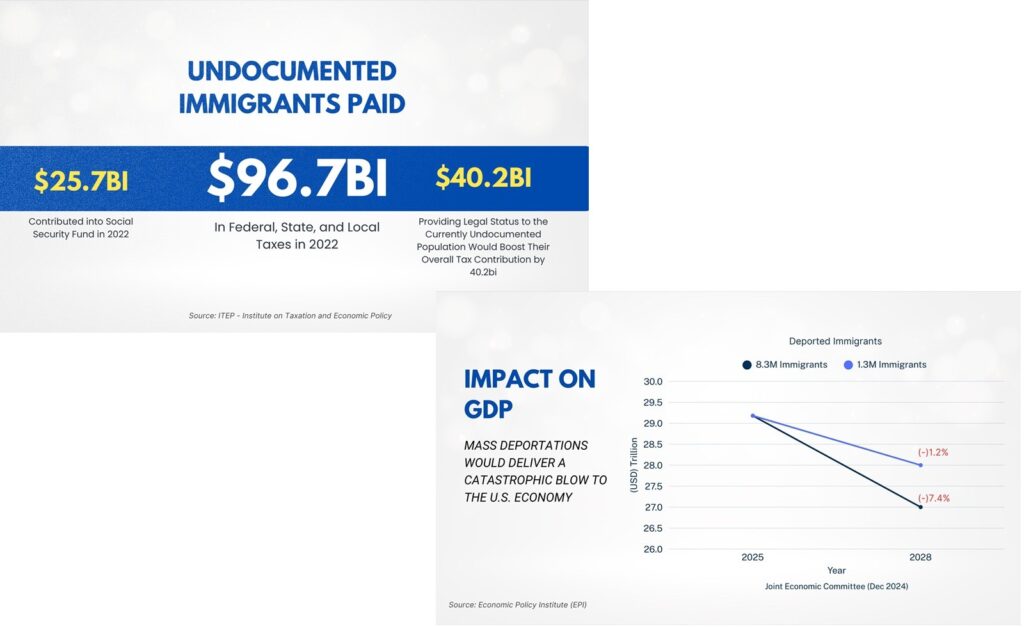
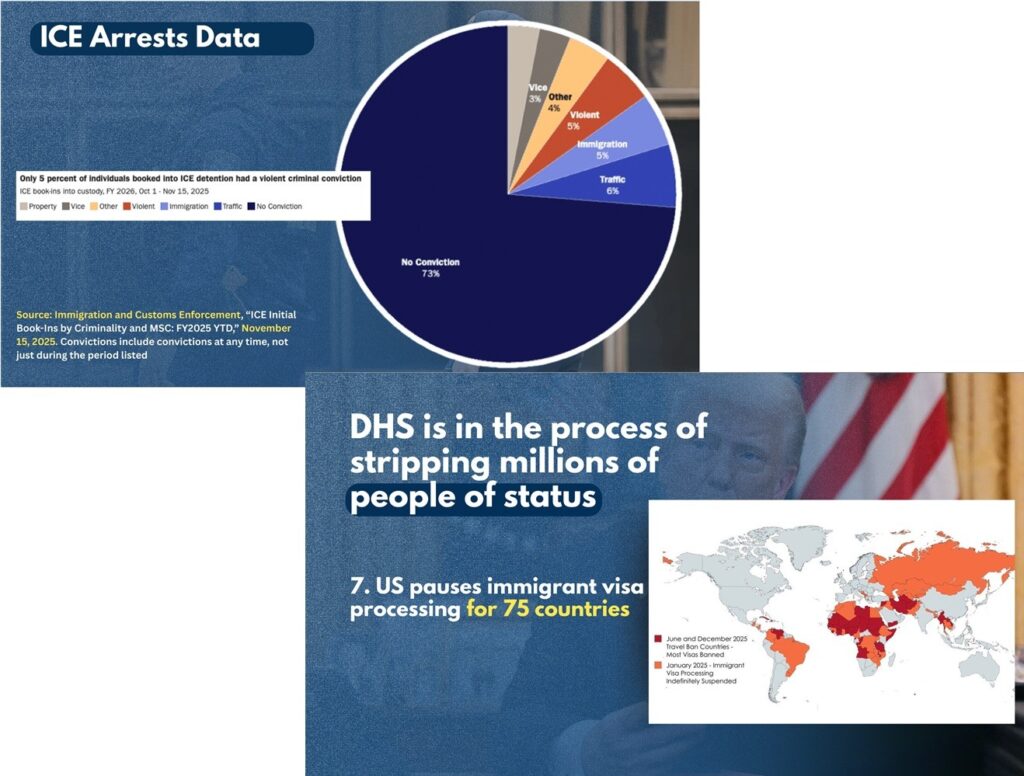
Viana then explained how mass deportation contracts the US economy and that we see this playing out now. The country lost 98,000 hospitality workers last year, and the tourism industry lost $1.2 billion. Moreover, the spending power of immigrants without status is lost when detention and deportation occurs. Explaining that immigration violations are civil and not criminal, unless a person crosses the border illegally a second time, he also shared that in the past year, the percentage of detainees with no criminal conviction rose from 6% in January to 40% by the end of November. He urged the audience to keep in mind an important distinction: only 5% of detainees with criminal convictions had violent convictions, and that more people are being detained now only because of quotas set by DHS. There has also been a sharp increase in the percentage of people being detained in the interior instead of at the border, and an increase in the number of people dying in detention centers.
Viana’s mother was in the audience, her first for one of these community discussions he has conducted around the state since last October. Viana shared a touching story of her move to the U.S. at the age of 16, his birth outside the country after a couple of his siblings had been born in the U.S., and his attempt to fill out a form at the age of 12 in order to gain legal status after moving into the country with his family, his 3 siblings and his mom, a single mother.
He shared another story of a client endeavoring to bring her father, the sole caretaker of her disabled adult brother, to the U.S. after her mother died, but no pathway existed in the family sponsorship system due to its complex and sometimes nonsensical rules. Viana could work to bring her father, a parent, but not her sibling, because he was an adult. “The big question is,” Viana said, “does it really have to be that hard?”
“Let me tell you what I’m dealing with day to day,” he continued, stating that 1.6 million people have had their previously legal status rescinded by the Trump administration. “The largest creator of undocumented immigrants in America today is actually the United States government.” Termination of status is happening to people with TPS and various visas, and they are being detained outside the courtroom after their cases are dismissed by judges, under pressure from the Department of Justice (DOJ) to do so. Video embedded in Viana’s slide deck showed people in immigration courts being thrown to the ground and grabbed by the neck. Judges working in immigration courts, appointed by several of the previous administrations, both Republican and Democrat, are resigning, or are being reassigned.
The DOJ issued a memo in June of last year, recommending the prioritization of denaturalization proceedings with a goal of 200 per month in 2026. Moreover, an executive order was issued to end birthright citizenship, as directed by the Supreme Court to the lower courts, but it is making its way back to SCOTUS ( Supreme Court of the United States).
“So much has happened, it’s hard to keep track,” Viana said. “I think it was two weeks ago, the U.S. government paused immigrant visa processing for 75 countries. This is not about unauthorized migration. When this happened, our phones were non-stop. All of these people have been waiting many years, outside the country, and now they have no recourse.”
Viana also stated that “The government has been detaining people illegally. A Minnesota judge reported that ICE ignored 96 court orders in January alone. A judge said that ICE has ignored more orders in one month than other federal agencies in their entire existence. If the government can ignore a judicial order towards immigrants, it can also ignore a judicial order for you.” Viana pointed out that more than 170 U.S. citizens were detained by ICE last year.
Viana allowed attendees to interrupt him with questions and comments. Many asked for clarification on statistics or legal immigration terms and programs, but some participants offered corrections or criticisms. David Chang suggested, “In this whole discussion, there’s nothing about Angel Island, about the imprisonment of Chinese immigrants, and about the Chinese fighting the system.” Viana responded, “Do you want to tell us more about that?” When Chang declined, Viana shared a few details about systemic abuse that occurred during the turn of the century, as well as Japanese internment during WWII, and noted that a seminal case law will factor in the upcoming SCOTUS hearing on the birthright citizenship issue.
Viana explained, “This is part of our history. Do we just say, ‘There is nothing new, and this is the identity of our country, and we’re just going to settle for that?’ It seems a lot of people are at that place right now, [feeling like] there’s nothing we can do. I don’t know that there have been many moments in our history when we have blatantly ignored the law like we are doing today. This country that I’m assuming all of us here love, for decades has engaged in practices that horrify us, but again, I don’t remember a time when they were trying to purchase 20+ warehouses to hold 90,000 people.”
In response to a question about what we should be doing, Viana encouraged the audience to get informed, get connected to people, hold legislators accountable, to support immigrants serving the community and immigrant-owned businesses, and to support organizations such as LUCE and BIJAN that help immigrants by documenting enforcement activity, providing legal assistance, or raising funds to pay bond or buy groceries.
Just before the discussion closed, Viana showed a composite of video clips depicting violent detentions of people on the streets around the country, saying the subjects were “people who came here because we tell everybody out there that America is different. People have come here for decades to seek a better life for themselves and their families, and in that process they help us create a better country.”
Readers can view the discussion on Acton TV’s YouTube channel. The second Marge Kennedy Social Justice Initiative event will be a webinar on Barriers to Town Meeting Participation, 7 p.m., March 19; register here.
Alissa Nicol is a member of the Acton Select Board and writes about community events for the Acton Exchange. She is a member of the League of Women Voters – Acton Area.