In the face of oppression, choosing joy is a radical act. Letting your light shine, even when forces around you conspire to block it out, is an act of resistance. Sharing and spreading that joy is even more powerful still because of its ability to inspire change. This is what Najee A. Brown leaned into as the director and choreographer of The Umbrella Stage Company’s recent production of “Hairspray, the Broadway Musical.” (Book by Mark O’Donnell and Thomas Meehan; music by Marc Shaiman and Scott Wittman; based on the film by John Waters.)
Change is a-coming
Set in Baltimore, a city known for systemic segregation in 1962 as the civil rights movement was heating up, the play addresses themes of racism, cultural appropriation, classism, body shaming, bullying, and belonging. Yet it does so through humor and warm-hearted, energetic song and dance.
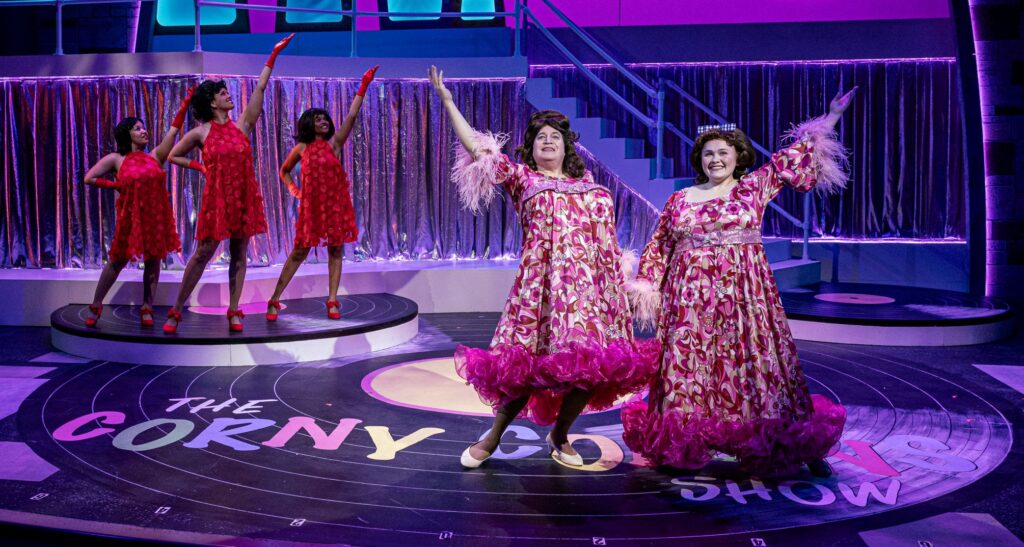
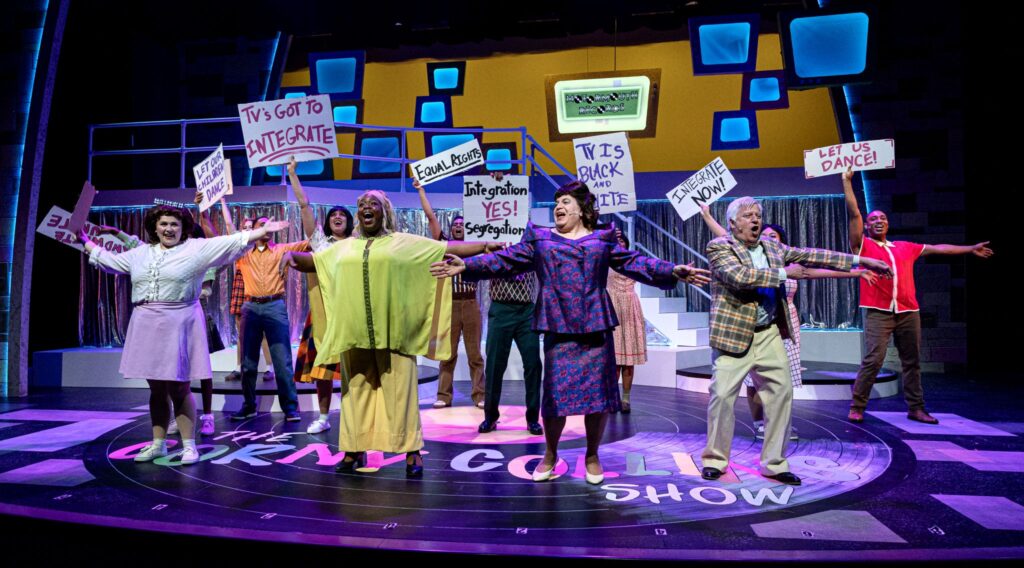
The story is about Tracy Turnblad (Nora Sullivan), a full-figured teenager with bouffant hair who dreams of dancing on The Corny Collins Show and has the chops to do so. Tracy auditions and is at first rejected, and teased, because of her size. She later befriends and learns exciting new dance moves from Black teens while in detention for her big hair. Emboldened, she earns a spot on the show. With increasing indignation toward social injustices, she sets out on a mission to do away with “Negro Day” (a recurring monthly segment on The Corny Collins Show where Black teenagers are allowed to dance on television) and integrate the show.
The set, designed by Cameron McEachern with lighting by SeifAllah Salotto-Cristobal, was evocative of a 1960s TV studio set. Stylized television monitors, reminiscent of the Jetsons, hung in the background and changed color and saturation to add visual interest and set the tone depending on the scene. A long, curved staircase led to an upper walkway, which was used effectively for certain dramatic entrances and exits. The Turnblad’s home scene, stage right, was a smart use of the space with a TV, armchair, and Edna Turnblad’s (Robert Saoud) laundry and ironing board. Motormouth Maybelle’s record shop on stage left was more minimalist.
More than mere decoration, the TV screens served as a reminder of the power broadcast television was beginning to have on America — displaying images of racial unrest, but also of young people dancing together and variety shows featuring British boy bands and glamorous Motown singers. It was the social media of its time.
One flaw with the set was that, because of its size and installation, there was no moving it, which meant all the major song and dance numbers had the same backdrop, whether they took place on the Corny Collins Show or in a jail. This got a little monotonous.
From dancing like a chicken to powerhouse vocals
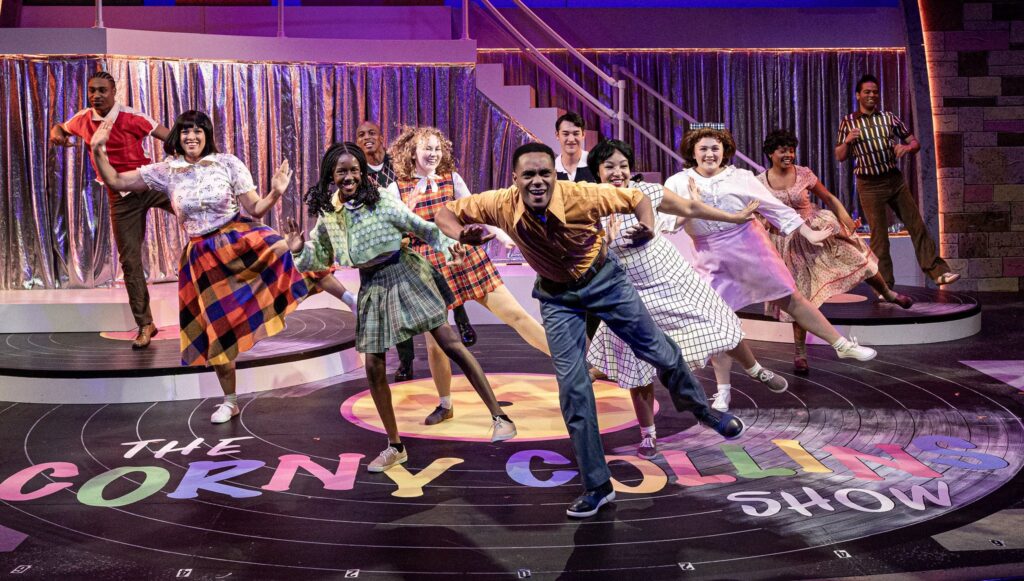
The dance numbers were all high energy, fun, and contagious. The choreography incorporated moves from the ‘60s that you would expect to see — the twist, the hitch hike, and the mashed potato — plus the exaggerated and comedic stricken chicken made up just for this musical. All the dancers were skilled and precise. The choreography looked good on them.
Sullivan and Amber Von Tussle (Lisa Kate Joyce) were especially captivating dancers. In the ensemble, Sydney Peterson (great turnout and port de bras), Pearl Scott (impressive backward pop-up), and MacKenzie LeTorré (most versatile) stood out. There were few amazing or spectacular big moves, though, which I found myself missing.
Sullivan was a terrific Tracy Turnblad. She was effervescent, with the right combination of innocence and chutzpah. Her playful growls, mixed in with her happy, sweet voice in songs like “I Can Hear the Bells”, captured the essence of the character. Her eye makeup was unexpectedly striking, but it worked. Saoud, in drag as is tradition for the role of Tracy’s plus-size mother, was tender and funny, with a dash of camp — enough to make the cross-dressing and ample proportions work. His performance of “(You’re) Timeless to Me” with Wilbur Turnblad (Chip Phillips) was endearing and timeless.
Joyce is a magnetic performer and was a convincing spoiled brat, with exaggerated grimaces and sour puss mugs. Velma Von Tussle (Aimee Doherty), Amber’s mean and scheming show-business mom, managed to be both menacing and humorous as she became increasingly unhinged. Her rendition of “(The Legend of) Miss Baltimore Crabs” was pure entertainment. The two of them made a nice pair.
Corny Collins (Joshua Lapierre) was excellent as a smarmy and slick television host. He nailed the schtick. Unfortunately, Link Larkin’s (Nick Corsi) microphone was staticky at times, which was a distraction. He gave a solid performance but could have used a little more swagger. Seaweed J. Stubbs (Christian David) despite being cool and smooth, especially as a dancer, sometimes looked like he had a worried expression on his face, which was incongruous with the character. He also could have delivered some of his lines more convincingly.
In terms of plot, it wasn’t clear enough that Motormouth Maybelle (Barbara Pierre) was the guest DJ for “Negro Day” on the Corny Collins Show. However, Pierre stood out as a powerful matriarch and an even more powerful singer. In “Big, Blonde and Beautiful” she came on the scene with incredible force. In “I Know Where I’ve Been” she blew the doors off the place.
I also must mention The Dynamites, the R&B girl group (Simone Alyse, Nikita DaRosa, and Pearl Scott). All three were agile, soulful singers in their own right. Together they created rich, warm harmonies. And their bright red dresses made them pop on stage.
The sleeper in the cast was Penny Pingleton, Tracy’s skittish sidekick, played by Maggie Cavanaugh. As Penny slowly comes out of her shell and listens to her heart, Cavanaugh’s performance gains steam until she’s belting out lyrics and dancing with verve.
Other than Corny Collins and Seaweed’s green suit at the end, the men’s costumes weren’t that interesting. The lead female characters, however, had colorful and dramatic ensembles. The matching pink dresses worn by Tracy and Edna in “Welcome to the ‘60s” were quintessential of that era. What really knocked me out was the glitter and flash of Tracy’s and Motormouth Maybelle’s outfits in the closing number. They sparkled like the stars that they were.
A Compelling Message
The one theme that isn’t brought out in this musical, but that jumped out to me, is the role of the parent/child relationship. There are four mothers in this play, each with their own backstory and distinct personalities that shape the lives of their children, for better or worse. Since this is a performance review, not a literary analysis, I won’t delve into each relationship. What I will say is that the children (Tracy and Seaweed) with mothers (Edna and Motormouth Maybelle) who accept, support, and evolve with their offspring are the ones with the courage and confidence to be the change they want to see in the world and to express their joy openly. What a blessing.
Brown states in the show notes that he set out to create a production that celebrates the power of love, hope, acceptance of self and others, community, liberation, and the freedom to take up space despite daunting odds. He succeeded in letting that light shine through.
Dana Lissy is a member of the Board of Directors of the Acton Exchange, an occasional writer, and a patron of the arts.