On a cold December morning at the Senior Center, Acton Town Manager John Mangiaratti did what he has been doing since 2018: shared coffee, invited questions, and offered residents a candid look at how their town is being run. The December 12 edition of Java with John featured a wide-ranging discussion of budgets, construction projects, housing, traffic, energy, and public safety, grounded, not in abstractions, but in the practical realities of municipal governance.
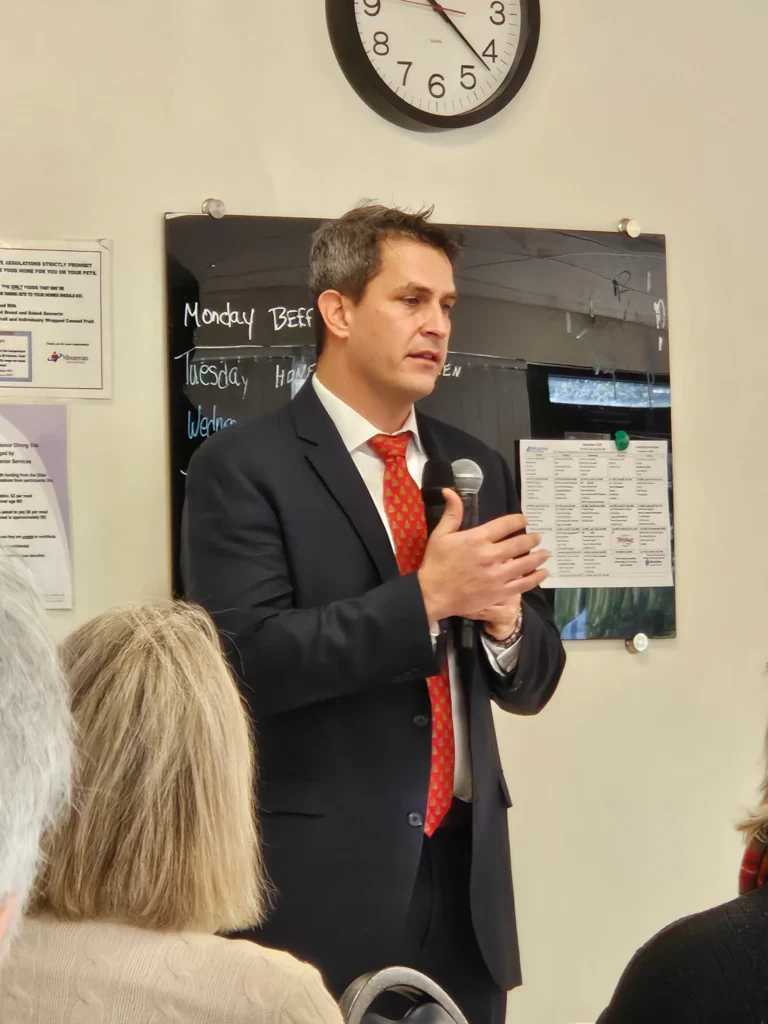
Mangiaratti opened with a reminder that while most residents are thinking about the end of calendar year 2025, town officials are already halfway through Fiscal Year 2026. That distinction matters, especially as Acton prepares to publish its annual budget for Fiscal Year 2027 later this month and present it to the Select Board in early January.
The headline news: For the coming year, projected revenues appear sufficient to cover town operations, something, Mangiaratti noted, “you can’t always say.” While challenges remain, particularly within the school district as it completes a major reorganization review, the town’s overall fiscal outlook is stable.
Grants doing the heavy lifting
A recurring theme was how aggressively Acton has pursued state and federal grants to reduce pressure on local taxpayers. Over the past five and a half years, the town has secured roughly $24 million in grant funding, supporting everything from roadwork and public buildings to library programs and cemetery improvements.
One example resonated strongly with the audience: the historic chapel at Woodlawn Cemetery, which is being made fully accessible thanks to a $250,000 grant combined with cemetery trust funds. For Mangiaratti, these projects illustrate how outside funding helps preserve Acton’s character while expanding access and services.
Residents have also noticed the visible results of grant-funded construction. A new dog park — fully grant-funded — is taking shape under the management of the Recreation Department, and major projects such as McManus Manor and the Asa Parlin House are nearing completion.
“We’ve been a town under construction,” Mangiaratti acknowledged, thanking residents for their patience.
Behind the Scenes: Facilities and buildings
Facilities Manager Dan Ouellette, who joined the town in July, offered a behind-the-scenes look at what it takes to maintain Acton’s municipal buildings — between 15 and 17 of them — with a small custodial staff. His remarks highlighted a lesser-known aspect of town operations: maintaining historic buildings while keeping them functional, safe, and accessible.

Two upcoming projects stood out. First, the electrification of Town Hall, which will replace fossil-fuel heating systems with electric heat pumps as part of Acton’s net-zero emissions goals. Second, a proposed restoration of the Town Hall bell tower, where structural deterioration has silenced the bell. A Community Preservation Committee (CPC) proposal has been submitted and, if it is approved, work could start this summer.
Ouellette’s enthusiasm for Acton’s historic structures, particularly the original section of the library, with its Revolutionary War artifacts, underscored how preservation and modernization often go hand in hand.
Housing, permits, and ADUs
Building Commissioner and Zoning Enforcement Officer Ed Mullen brought data and perspective to ongoing conversations about growth and housing. His department will issue approximately 3,500 permits this year, generating revenue that supports not only inspections but also other town services.
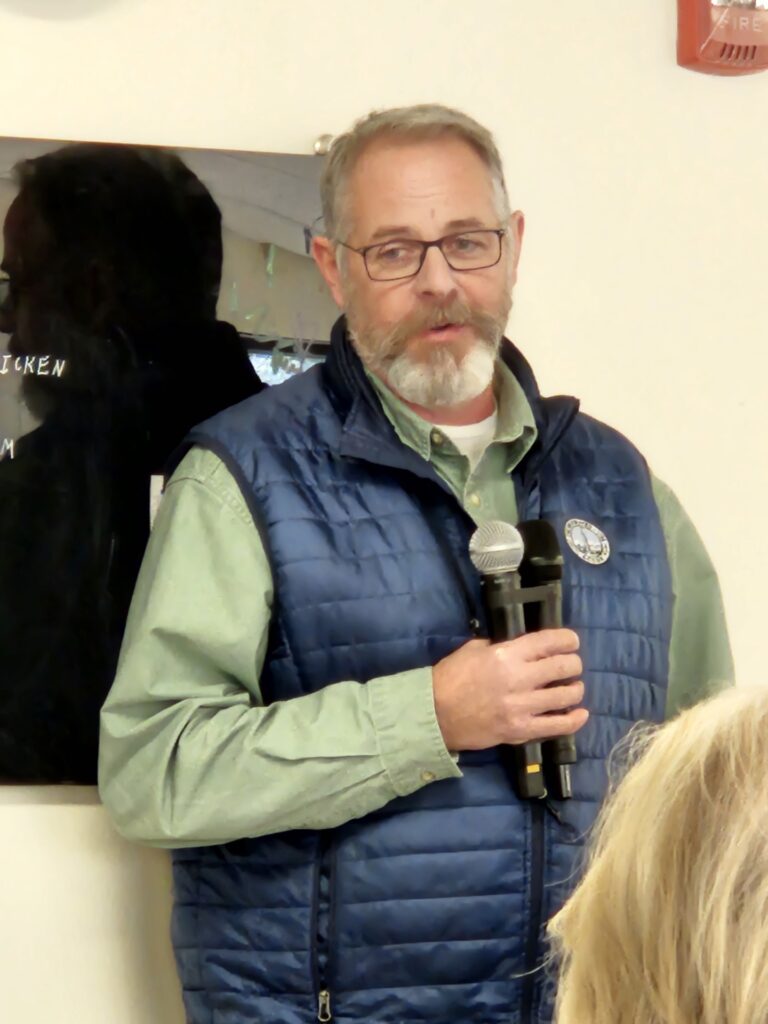
One area seeing notable growth is Accessory Dwelling Units (ADUs). Since changes in state law, Acton has been receiving roughly one ADU application per week, a pace Mullen described as both encouraging and manageable. ADUs are now allowed by right up to 900 square feet, with some flexibility for pre-2019 detached structures. The biggest obstacle, he noted, is often septic system capacity rather than zoning.
Mullen also offered practical advice to homeowners hiring contractors, emphasizing the importance of licensed professionals and Home Improvement Contractor (HIC) registration, protections that can make the difference when projects go wrong.
Traffic, patience, and Kelley’s Corner
No Java with John would be complete without traffic questions, and this session was no exception. Residents raised concerns about Prospect Street, Kelley’s Corner, and the Taylor Road–Route 2 intersection. Mangiaratti acknowledged the frustration but emphasized that many of these projects reflect designs vetted over years of public process and approved at Town Meeting.
Kelley’s Corner, he stressed, is still under construction. Signal timing, lane markings, pedestrian features, landscaping, benches, trees, and decorative lighting are all still to come. When finished, the area will look and function very differently than it does today.
On safety, Mangiaratti was blunt: Enforcement helps, but defensive driving is essential. The town is coordinating with state police on Route 2 enforcement and participating in initiatives like the “pace car” program to promote safer driving behavior.
Energy costs and what Acton can – and can’t – control
Residents also asked about electricity costs and why Acton’s rates differ from neighboring towns like Concord. Mangiaratti explained that unlike communities with municipal light plants, Acton relies on Eversource for distribution. While that limits local control, the town uses community aggregation to secure competitive supply rates and offer greener energy options.
A town that shows up
As the meeting closed, Mangiaratti reflected on what makes Acton distinctive: engagement. From packed Senior Center rooms to volunteer boards, committees, and public hearings, residents consistently show up, sometimes with praise, sometimes with complaints, but always with investment in their community.
That engagement, on full display during this one-hour conversation, is what gives programs like Java with John their staying power. They are less about announcements than about accountability, and about reminding everyone in the room that local government is not an abstract institution, but a shared, ongoing project.
To watch the entire one-hour long meeting on ActonTV, click on “Java with John – December 12th, 2025.”
Greg Jarboe is the Acton Exchange beat reporter for the Council on Aging and Senior Center.