The historic park at 53 River Street, along Fort Pond Brook, will open this year. The decade-long story of its creation involves a number of monkey wrenches.
At a special town meeting in October 2016, the Town of Acton acquired the 7-acre site at 53 River Street. To figure out the best use for the site, the Town held input sessions, where residents could hear about alternatives from housing to recreation, and express their preferences. The Select Board created the 53 River Street Master Plan Special Committee (Committee) to review the feedback. In the fall of 2018, with recommendations from the Committee, the Select Board decided to move forward with the creation of an historic park. Around the same time, the project encountered the first monkey wrench. The state Office of Dam Safety determined that the dam was structurally unsafe and would need to be mitigated through repair or removal.
Conceptual planning for the historic park began in late 2019 with Town Meeting approving a grant recommended by Acton’s Community Preservation Committee. Very quickly the second monkey wrench appeared. There was disagreement about the nature of the historic park.
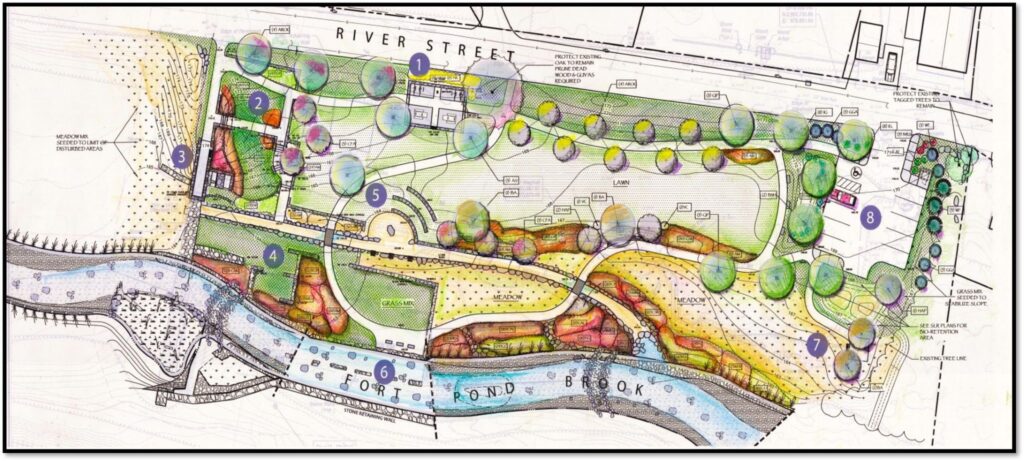
In the drawing above, you can see the following elements:
- Old mill building location.
- Rehabilitated wheelhouse.
- Lookout on a portion of the old dam.
- Stone outline location of old mill race.
- Stone amphitheater.
- Foundation of an old mill building.
- Aquatic meadow.
- Parking lot.
Some wanted to keep the dam and mill race (the channel that diverted the water to power the mill) in place and functional. Repairing the dam would be many times more expensive than breaching it. Because dam modifications required Army Corps of Engineers approval, it also required a Section 106 historical review by the Massachusetts Historical Commission (MHC). The Acton Historical Commission was the agent of the MHC on the project.
Discussions, planning, and design continued through 2020. A breakthrough of sorts happened when Tom Tidman, then Acton’s conservation agent, produced sketches of the dam breached, but with a line of stones remaining, where breached sections of the dam had been. This concept of “echo walls” marking where historic elements had been ended up being used many times in the park design. In response to the order from the Office of Dam Safety, the Select Board voted to breach, rather than rebuild, the dam.
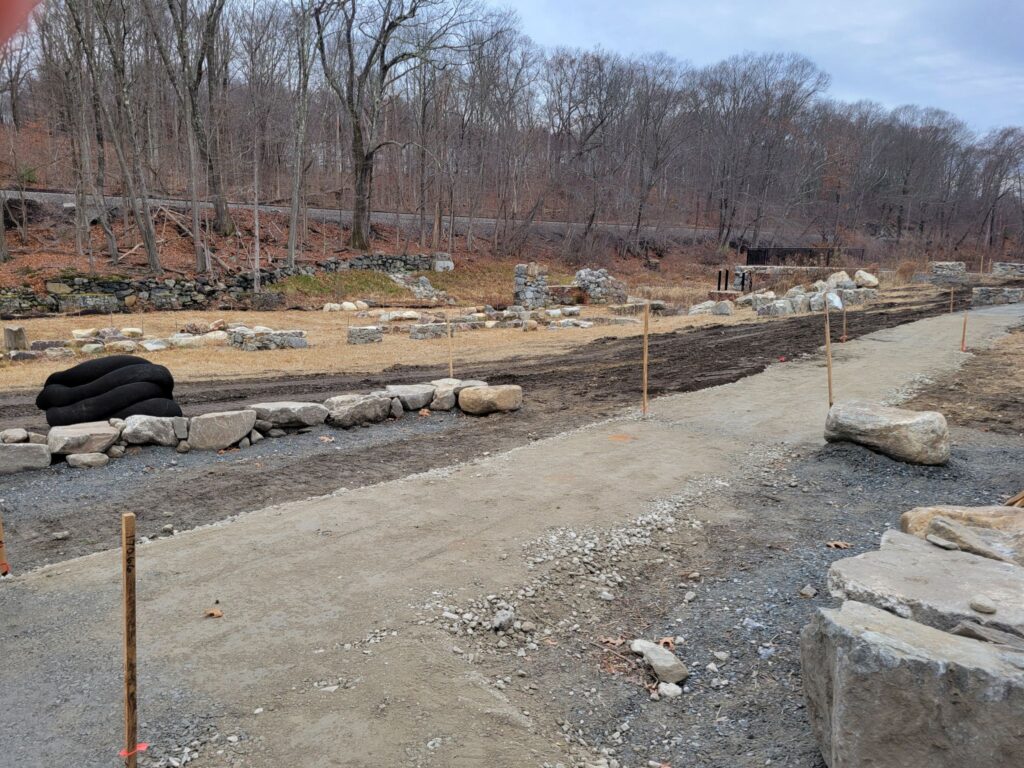
By 2021, outlines for an agreement on historic elements was coming into focus:
- Echo walls would outline where historic mill buildings had been.
- Structural supports for the dam and other historic foundations in the brook would be retained.
- Two non-historic buildings on the property would be demolished.
- The outside of the brick wheelhouse (sometimes referred to as the chimney) where the dam’s sluice gates were controlled, would be rehabilitated.
- To make sure that any artifacts were preserved, an archaeological monitor would be on site whenever there was digging during construction.
- To preserve any underlying artifacts, the mill race would be lined with geotextile, filled in, and outlined with echo walls. It would not carry any water, after the dam was breached.
The spring and summer of 2021 saw significant rainfall, throwing another monkey wrench into the mix. Water was flowing over the top of the dam, where it was designed to spill, but was also threatening to over-top earthen portions of the dam, which could be catastrophic, forcing the Town to sandbag those sections. The situation was monitored closely by the Town and its consultants.
A Memorandum of Agreement (MOU) was signed with the Army Corps. Since 53 River Street is in the South Acton historic district, Acton’s Historic District Commission needed to approve any structures being removed, including the dam itself, or added, including most of the echo walls.
The buildings were demolished and the dam was breached in 2023. That’s the good news. The bad news was another monkey wrench: contaminants. First, a significant quantity of asphalt was found to have been discarded on the site. Then, asbestos, lead, and arsenic were discovered in the soil — some of it concentrated in the area of the burnt-down former mill building.
The question was how to handle it. Some of the contaminants could have been buried on the site, but the Town decided to dispose of the contaminated soil. A Licensed Site Professional was hired to oversee the removal and further testing. By the end of summer 2024, the contaminated soil had been removed, but that led to the next monkey wrench: money. Town meeting approved borrowing as the base funding for the project, but most of the project was funded with numerous grants:
- State Dam and Seawall grants, including design and supplemental grants, funded most of the dam breaching and related work.
- American Rescue Plan Act of 2021 (ARPA) money was provided, but was largely eaten up by removing the contaminants.
- The State added a Municipal Vulnerability Preparedness grant.
- Acton’s Community Preservation Committee provided several CPA grants for park design and historic preservation.
Each time monkey wrenches were encountered, time was needed for work-arounds. Any additional funding caused delays waiting for the funding cycle. Removing the soil contaminants cost hundreds of thousands of dollars. Fortunately, Acton’s Community Preservation Committee recommended a couple of supplemental grants in 2024 and 2025, which were approved at Town Meeting.
In the end, the compact park, with its historic orientation, will be unique among the parks of Acton. Besides the echo walls, features of the park include:
- Access to the river, even fishing, if you have a license.
- Accessible walkways.
- Lower parts of the park are designed to be a flood plain during high water.
- An overlook to view upstream to where the impoundment (the mill pond created by the dam) was.
- Signage identifying historic elements.
- Small stone amphitheater.
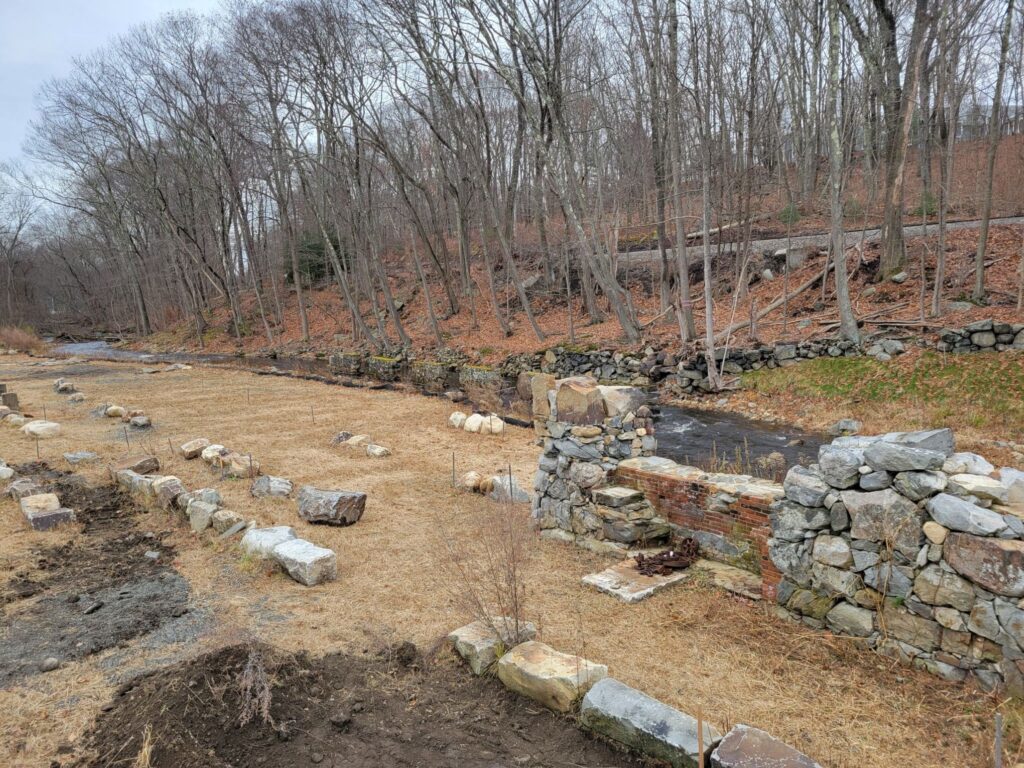
Early snow interrupted the final work last fall. Landscaping and walkway paving should be completed this spring. Expect a ribbon-cutting in early summer.
David Martin is a Select Board member and a former chair of the 53 River Street Master Plan Special Committee.