If you walked the Guggins Brook conservation area in 2025, prior to October, you probably did not get far before being turned back by flooded trails. Boardwalks and bridges that used to keep your feet above the wettest and muddiest sections of trail had been submerged by rising water levels due to beaver activity along the multiple brooks that cross this conservation area.
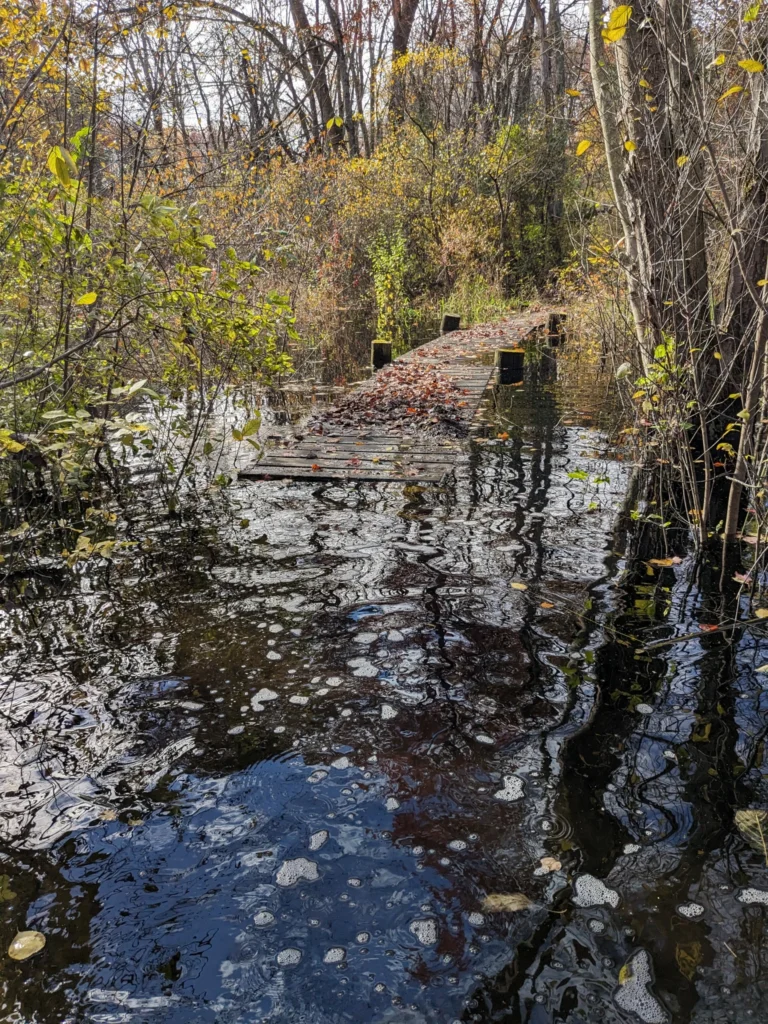
Jon Campbell, the land steward for the Guggins Brook conservation area, described the challenge of keeping the trails above the rising water levels. He said, “In late spring 2025, I was finding that two volunteers working 2-3 hours clearing branches from a culvert was undone overnight by the beavers, and then reinforced over the next few nights. It’s pretty humbling to work hard and be defeated by a swimming rodent!”
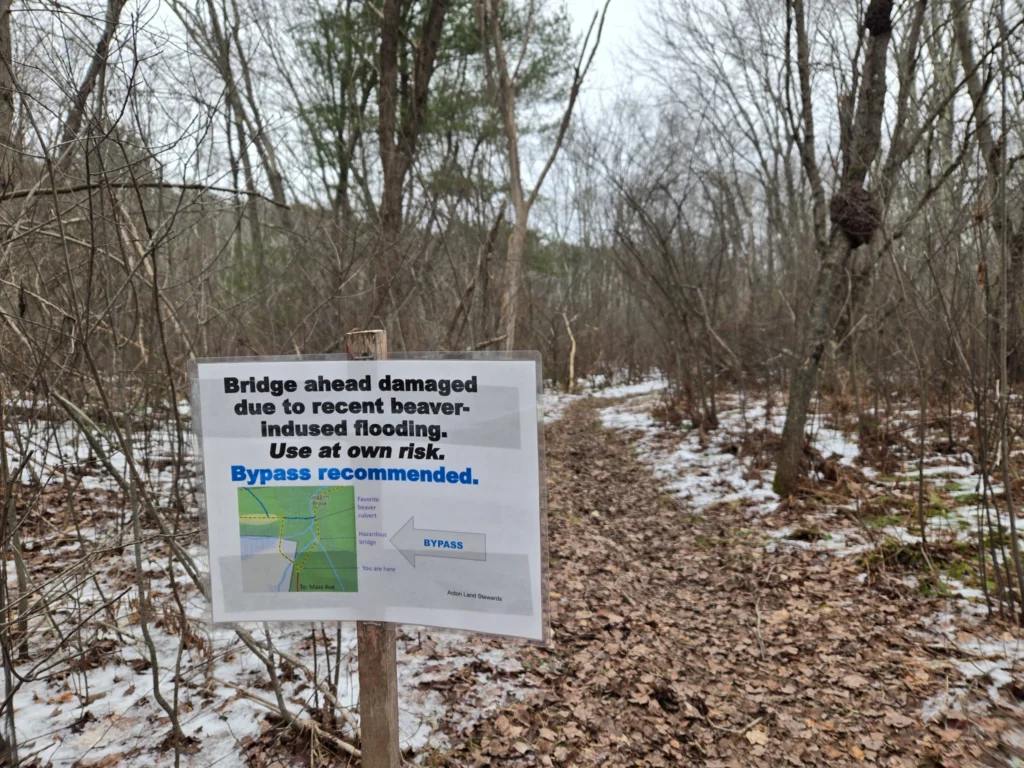
If you walk Guggins Brook today, you will find that your feet stay (mostly) dry. The Town recently contracted with Beaver Solutions to help mitigate the flooding problems caused by beavers that had dammed the brooks.
Before we demonize these aquatic mammals for the problems they cause, let’s review some of their more admirable qualities. “Busy as a beaver” is a common saying that praises their industrious nature. The Massachusetts Institute of Technology has adopted the beaver, often referred to as “nature’s engineer”, as their mascot. Beavers devise clever solutions and dam building techniques to expand their habitat.
Most importantly, beavers accelerate the expansion of wetlands, an important ecosystem for many species of plants and animals. Ian Bergemann, the Community Conservation Specialist for the Town of Acton, explained in an interview: “Beavers can take a habitat that is a wetland or a budding wetland and accelerate that wetland to being a full wetland, providing all those ecosystem services: flood absorption, carbon storage, biodiversity hotspots. We know that birds, fish, and invertebrates all find an area like this home.”
But in the process of building their dams, the beavers cut down tree canopy. By raising water levels, they also flood the roots of surrounding trees, causing them to suffocate and die. Beaver dams create more standing water, which is a breeding ground for mosquitoes, and could be a factor in the spread of mosquito-born diseases. Beavers can block culverts under roads, leading to storm water issues. Higher water levels also create expensive home repairs for those living near the newly formed wetlands.
Olivia Barksdale, the conservation agent for Acton, described the balancing act of coexisting with beavers, in an interview: “From our standpoint in conservation, we want beavers. They are a keystone species and create great habitat and biodiversity, but then they cause a problem when they have the human interface, such as flooding leaching fields, which may cause septic systems to fail.”
In the past, beavers were trapped for their prized pelts. By the early 1900s they became an endangered species. Currently, there are many state regulations about what you can and cannot do when beavers create a problem. Barksdale described the permit review process for seeking mitigation for beaver related issues:
“If the beaver dam is impacting human health and safety, then the homeowner can work with the Board of Health, and the beaver dam has to meet one of nine criteria to trigger a 10-day emergency permit to allow the homeowner to immediately breach the dam, trap the beaver, or install a flow device.”
When there is no immediate health or safety concern, there is a longer permitting process that requires more detailed plans to be presented to the Conservation Commission.
In the case of Guggins Brook and Heath Hen Meadow conservation areas, the flooding caused by beavers was threatening the trail bridges and culverts and making the conservation land inaccessible to citizens who visit these pockets of nature. The town had recently used $40,000 in Community Preservation grant funds to construct a new boardwalk across the brook at Heath Hen Meadow. It was designed using composite materials that should last decades, but the rising water levels were threatening this investment. Barksdale explained, “We received grants for the amazing trail bridges. And so this year we decided to prioritize saving those bridges.”
One method used to control water levels is commonly called a “beaver deceiver.” Beavers, when they hear the sound of running water, will work quickly to repair their dams, often overnight. By piercing the dam with a long plastic pipe submerged underwater, the beaver deceiver allows water to flow through the dam and restores more reasonable water levels. By placing the ends of the pipe far from the dam, the beavers will (hopefully) not find the source of the leak. For further deterrence, steel rebar grates are placed over the ends of the pipe making it harder to block the flow.
Another method to prevent damming involves placing steel rebar fences around culverts. The fence makes it harder for the beavers to block the water flowing through the culvert.
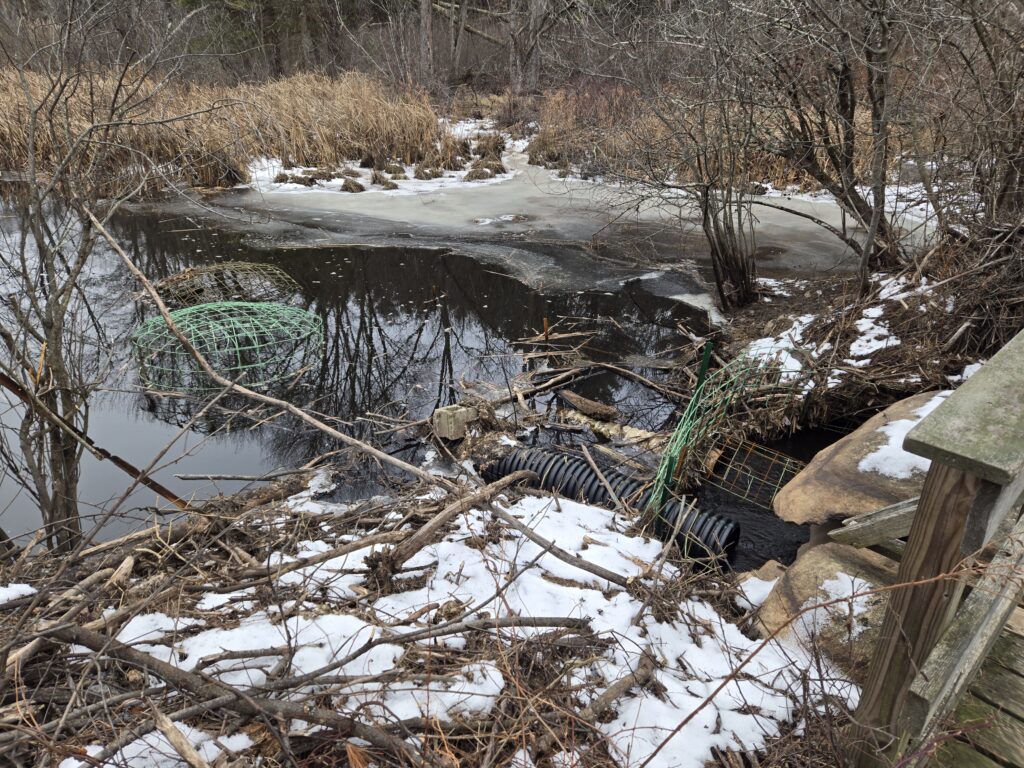
Similar flow devices have been deployed at Guggins Brook in the past, but they are old, require regular maintenance, and have not been sufficient. The Acton Conservation Division sought help from a company called Beaver Solutions based in Southampton, Massachusetts. After doing a site review to assess the problem areas, and obtaining the required permits, the company installed new water level control devices in October. Heath Hen Meadow had two 10-inch flow pipes installed, and Guggins Brook had a flow pipe and a culvert fence installed. The results were dramatic. In just a few days, the water that was blocking trails at Guggins Brook had receded. Beaver Solutions is also contracted to monitor and maintain these new water level control devices with annual cleanouts. The total project cost about $10,000 and is guaranteed for 10 years. Additional sites in Acton are being evaluated and prioritized for similar water level control devices in the future.
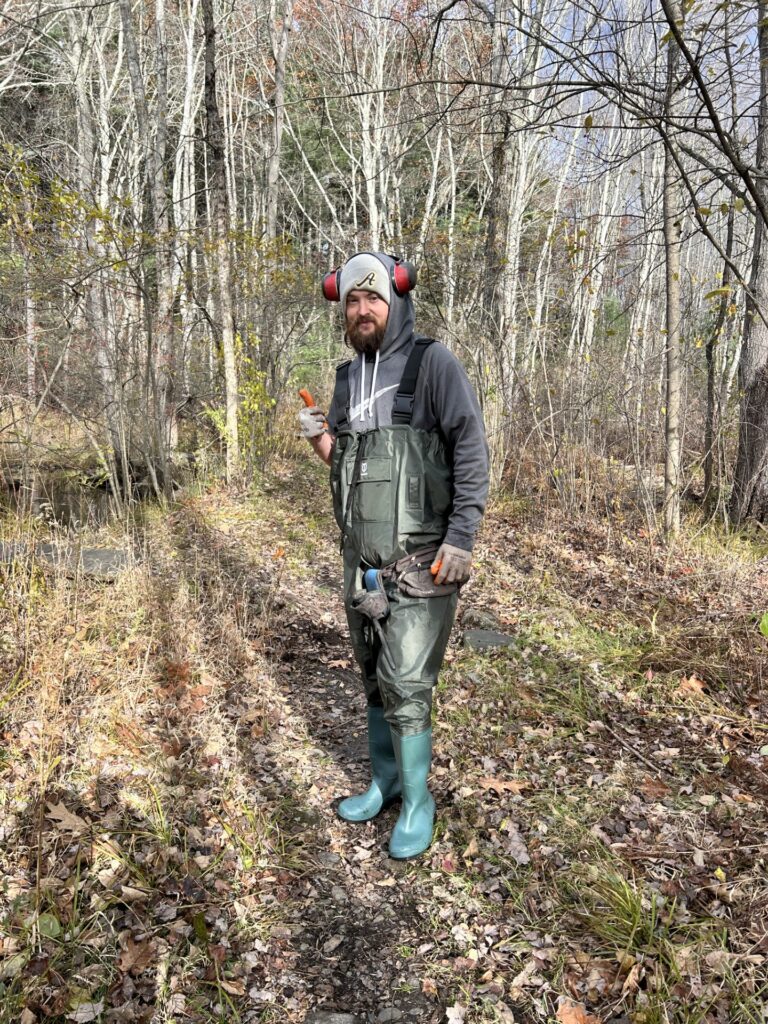
Another positive development in problem-solving high water levels across town is the AB STEAM Acton Flood Solutions Hackathon. Launched in August, it challenges students to find creative solutions to flooding in town, including flooding caused by beavers. Hackathon presentations will be made on February 5, 5-7 p.m. at Danny’s Place.
After the water levels at Guggins Brook receded, Campbell evaluated the situation left behind on the trails, stating, “We have a lot of repairs we need to do in the previously flooded areas. Many other bridges were damaged, floated off their supports, collapsed, etc. Hopefully, we can continue to coexist with these amazing aquatic engineers.”
More information about beavers is available from a Massachusetts Division of Fish and Wildlife factsheet, on the World Wildlife Fund website, and on the website of Southampton-based Beaver Solutions LLC..
Tom Wolf has been a resident of Acton since 2001 and is a volunteer on the Land Steward Committee.