November
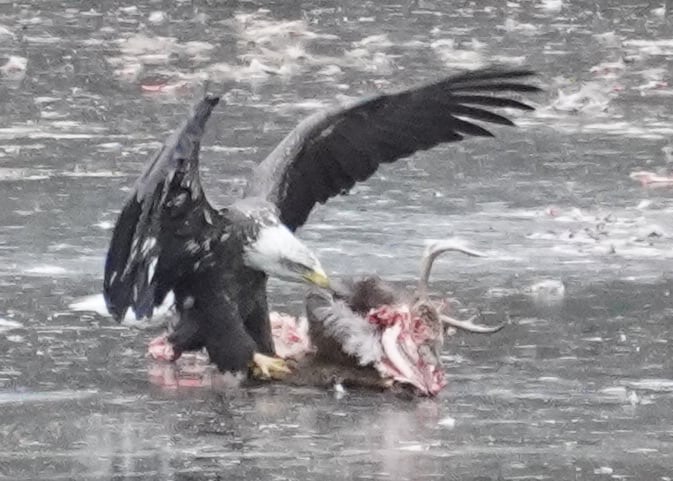
Nov. 30: A COYOTE family yips, whines, and howls in N. Acton woods (thanks for this and all trail cam videos monitored by Rebecca Harvey). We don’t have wolves in Acton anymore, but our healthy population of coyotes has moved up the food chain to the top. See the deer kill photo with a scavenging bald eagle for December 22 to see possible evidence of their taking large game.
December
Dec. 5: Over several December nights, a parade of mammals traverses a frozen section of Nashoba Brook, including an OTTER, at least one BOBCAT, a MINK, a FISHER, RACCOONS, and a COYOTE.
Dec. 19: Two BALD EAGLES fly together over the Assabet River near Acton Ford…a hunting FISHER trots beside a N. Acton stream; then, just off-camera, an unidentified OWL swoops low after it, but the photographer finds no evidence of a kill.
Dec. 21: BRACKET FUNGI the size of tea saucers with colors spanning shades of white, tan, red, and brown encircle a red maple stump near Mass. Ave. in W. Acton.
Dec. 22: A young BALD EAGLE perches in a deciduous tree near Robbins Mill Pond in N. Acton, then descends onto the ice to scavenge the carcass of a WHITE-TAILED DEER, possibly a coyote kill. =
Dec. 27: Three AMERICAN ROBINS crowd onto a small area of open grass in a W. Acton back yard, vigorously pecking among the greenery. Snow covers the rest of the yard, restricting the birds’ area for ground feeding.
Dec. 28: Mass Audubon’s annual Christmas Bird Count (the Count) tallies all the species and estimates individuals in each town in the state. Like last year, Andy Magee led Acton’s count and writes about his sector (which includes several neighboring towns), “We had 56 species, which is good for us, but our total numbers were low — 3,625 birds. That was consistent with the Count in general. Most attributed the low numbers to the very cold weather throughout December, saying it was more like mid-winter birding than early winter birding.”
Notably Acton hosts the region’s only TURKEY VULTURES (13). The top ten birds Andy counted in town were DARK-EYED JUNCO (458 individuals), HOUSE SPARROW (365), EUROPEAN STARLING (321), MOURNING DOVE (261), BLACK-CAPPED CHICKADEE (224), CANADA GOOSE (221), TUFTED TITMOUSE (172), BLUE JAY (165), NORTHERN CARDINAL (134), and MALLARD (121).
January
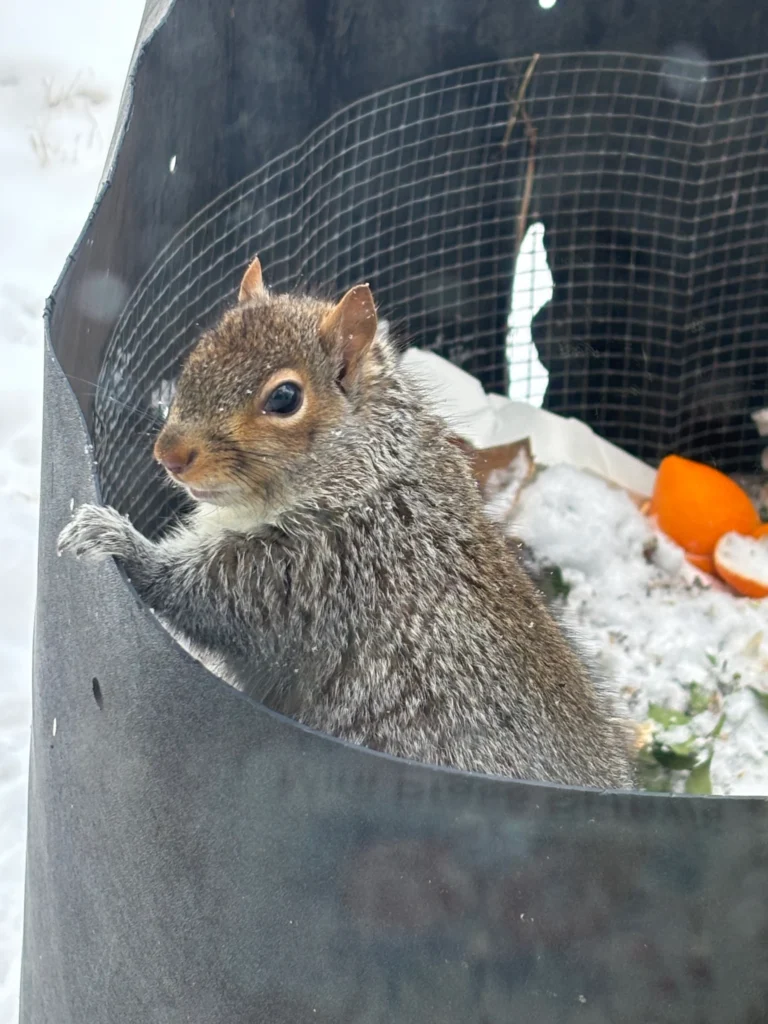
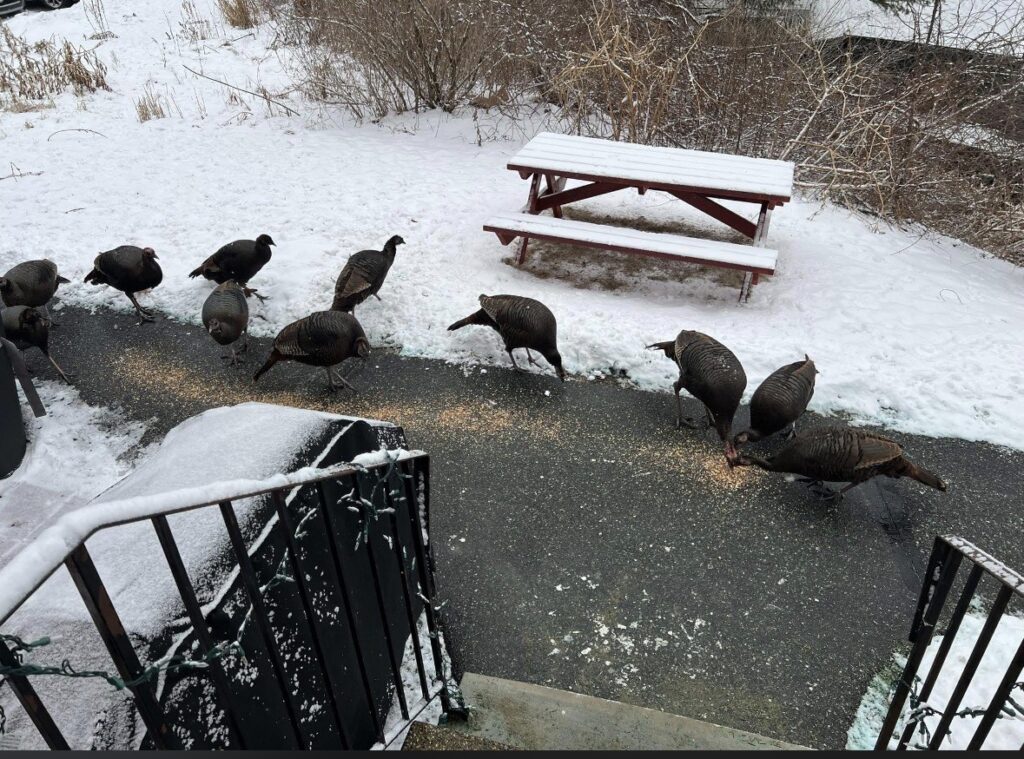
Jan. 1: A GRAY SQUIRREL turns to face the photographer as it forages in a W. Acton back yard compost bin…a dozen WILD TURKEYS peck at cracked corn, meant for other avian guests, behind a Great Road residence. (Editor’s note: check out state’s advice against feeding wild turkeys here.)
Jan. 3: A BOBCAT sprints across Flint Road in W. Acton on a bright late afternoon.
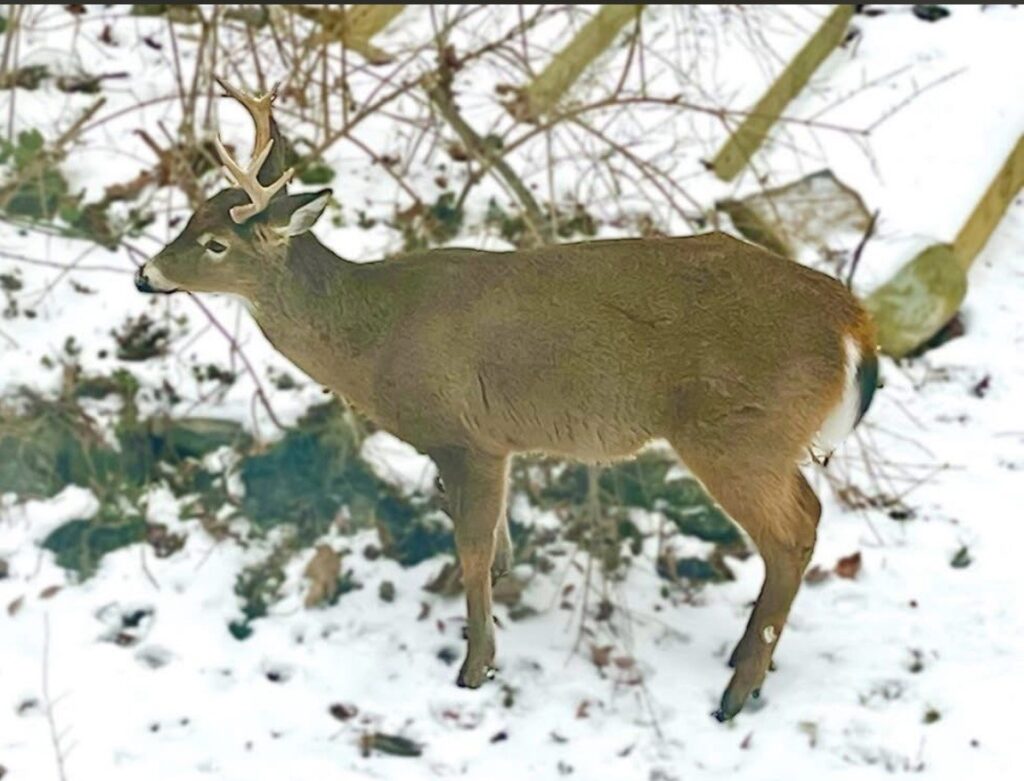
Jan. 5: Browsing in a snowy Acton Center back yard, a male WHITE-TAILED DEER pauses to take a look out.
Jan. 6: A SWEETBAY MAGNOLIA tree on Martin Street in S. Acton keeps its green leathery leaves when nearly all other deciduous trees stand bare.
Jan. 9: Two COYOTES stop in a HEMLOCK grove in N. Acton, scanning the woods while nervous GRAY SQUIRRELS chatter.
Jan. 12: RED MAPLE trees drip sap from branch tips on a warm morning after a frosty night.
THANKS to Acton Nature Watchers Frann Addison, Jon Chase, John Goreham, Christopher Robert Hardy, Rebecca Harvey, Andy Magee, Peter Mosbach, and Dan Praetorius.
GOT MICE? Learn how to exclude them before any more move in! The Massachusetts Department of Public Health toolkit shows building managers and homeowners how to implement Integrated Pest Management (IPM). IPM practice favors sealing up and excluding rodents from entry points around your house. See this 1-minute YouTube video for how to do this. For more information about making Acton less friendly to pests but safer for our raptors, attend Green Acton’s Biodiversity Committee meeting the third Thursday of every month at 8 p.m. The committee is now focusing on how to reduce or prevent the use of SGARs (Second-Generation Anticoagulant Rodenticides) and other rodenticides in Acton. For agenda and how to connect, email biodiversity-contact@greenacton.org.
In the coming month, watch for breeding mammals denning up; skunks actively claim territory with their distinctive scents around Valentine’s Day…snowdrops and crocus usually emerge in sunny thawed patches…watch for returning red-winged blackbirds. The earliest return we have seen was on February 9 in 2024…Submit your observations and photos to actonnaturewatch@gmail.com.
Rob Gogan is a West Acton resident and compiles the Acton Nature Watch feature. He is one of the organizers of Green Acton’s Biodiversity Committee.