About 70 people filled the meeting room at Acton Memorial Library on the evening of May 14 for a talk that did something local history rarely does: it revised the record rather than just retelling it.
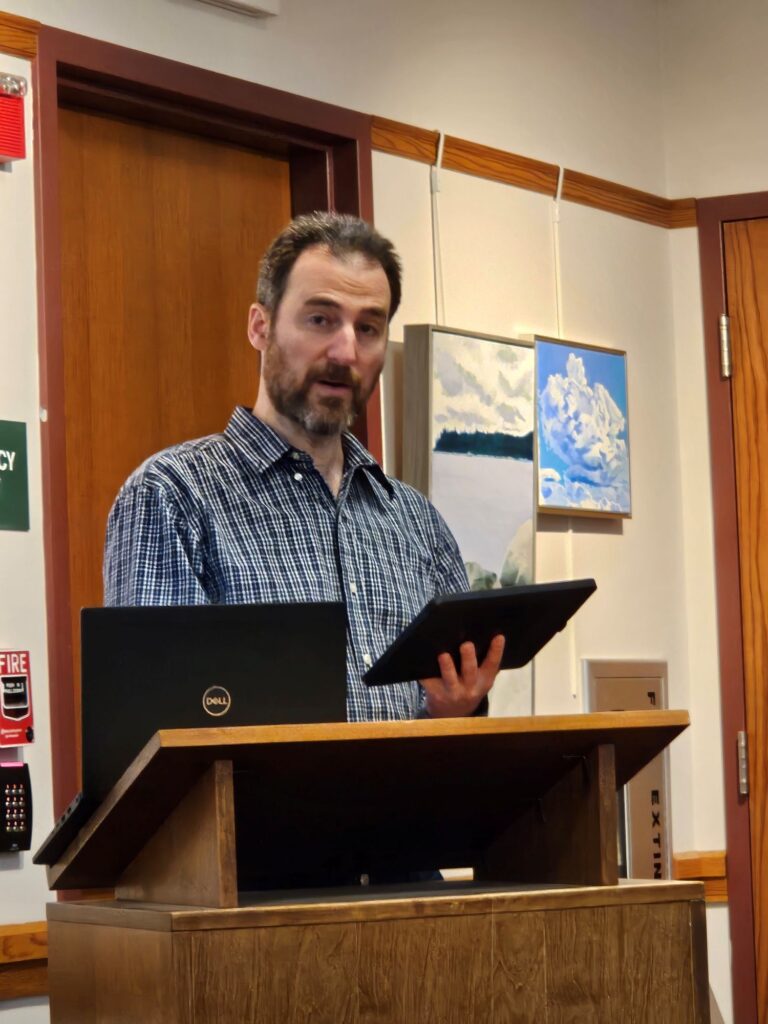
Brent Ranalli, a local historian completing a book titled, “Tahattawan’s World”, spent two hours sharing findings from a fresh, close reading of seventeenth-century primary sources – the kind of painstaking archival work that occasionally turns up surprises and sometimes proves that a mistake made 180 years ago has been quietly misleading everyone ever since. The talk was presented in partnership with the Friends of Pine Hawk.
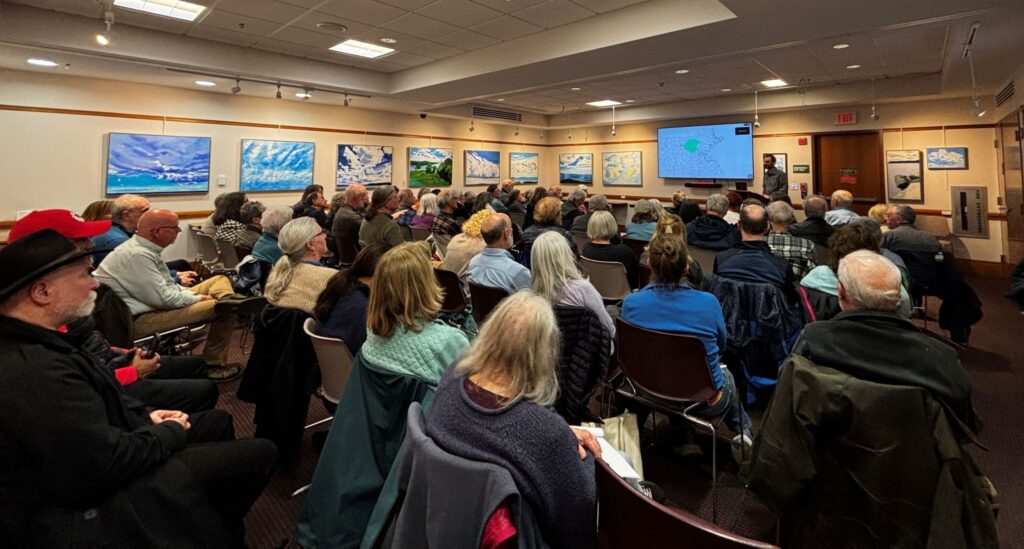
The subject was Tahattawan’s band, the Algonquian people who inhabited this part of Middlesex County in the 1600s and the people on whose land Acton and a dozen other towns now stand. Their story, Ranalli explained, runs from about the 1630s, when the band and its leader first appear in English records, to the end of the century, when the community dispersed into the wider population of Christian Indians in the Massachusetts Bay Colony. Most residents know at least some version of that story. What the evening offered was a sharper and more honest one.
A Devastating Prelude
When Tahattawan’s people enter the written record in the 1630s, there are only around 50 of them, roughly 10 families. That figure is not a starting point; it’s the aftermath of two catastrophic epidemics, one in 1616 and one in 1633. Native American communities encountering European diseases for the first time sometimes lost nine in ten people. If that was the case here, the band that enters the historical record was the remnant of a pre-contact population of around 500.
“We need to picture a band of 500 persons living in this area,” Ranalli told the audience, “that went through the terrible trauma of these epidemics, and was reduced to a small remnant of 50.”
Like other Southern New England Algonquians, Tahattawan’s people combined agriculture, hunting, and gathering, moving through their territory seasonally to make the most of its resources. They had two main village sites: Musketaquid, in what is now Concord, and Nashobah, in what is now Littleton. Those place names gave rise to their two most common designations in the historical record: the Musketaquid Indians and the Nashobah Indians.
One of the new contributions of Ranalli’s research is a map of how much territory the band actually controlled. By assembling deeds signed by Tahattawan, his son John Tahattawan, and later descendants identified as heirs, Ranalli reconstructed a domain of roughly 200 square miles. It was centered on modern Carlisle and included all or parts of Lincoln, Concord, Acton, Boxborough, Littleton, Westford, Chelmsford, Tewksbury, Wilmington, Billerica, Bedford, and Lexington.
“This seems like a very natural question to ask,” he said of the territory’s extent, “but I haven’t seen it addressed before.”
A Calculated Bet on the English
In the mid-1630s, Tahattawan made a decision that might seem counterintuitive: he invited the English to settle at Musketaquid. Ranalli argues this was not accommodation but strategy. Tahattawan had watched English coastal communities for decades and concluded that the future of his diminished band lay in embracing English ways of life. He converted to Christianity, and his entire band followed. He was, Ranalli notes, the first hereditary Indian leader in the Massachusetts Bay Colony to do so, and his example opened the door for other bands in the region to convert.
A praying town called Nashobah, founded in 1654 in what is now Littleton, was established specifically for Tahattawan’s band. The colony (Massachusetts Bay) recognized the township as legally belonging to its Indian inhabitants, a meaningful protection against English neighbors who were always looking for land. Tahattawan died during the Nashobah years, as did his son John. The band entered the next, more dangerous chapter of its history without a hereditary leader.
Setting the Historical Record Straight
In regional power terms, where did Tahattawan’s band fit? The primary sources are clear, Ranalli says: they were part of the Massachusett confederation, the dominant Indian political grouping in Massachusetts Bay, centered on the village of Mystic (now Medford). The evidence is pinned to a single definitive fact. When Tahattawan arranged for the English to settle at Musketaquid, the deal required the blessing of Squaw Sachem of Mystic, leader of the Massachusett, who took a share of the payment.
But if you look up Squaw Sachem in many standard references, you’ll be told she was not Massachusett but Pawtucket. The Pawtucket, also known as the Pennacook, were a separate nation living along the middle reaches of the Merrimack River in northern Massachusetts and New Hampshire. The village of Pawtucket itself was at the falls of the Merrimack River in modern Lowell. The erroneous claim that Squaw Sachem of Mystic was Pawtucket, Ranalli traced, goes back to a single sloppy book: a history of Lynn written in 1844 by one Alonzo Lewis. Lewis’s error was repeated, absorbed into authoritative sources, and generated decades of downstream confusion, including the false notion that the Pennacook nation once exercised dominion over Massachusetts Bay.
Credit for first identifying Lewis as the culprit belongs to Ellen Knight, a Winchester town historian, Ranalli says. Ranalli’s book goes further, offering a plausible account of how Lewis fell into the mistake in the first place.
Deer Island: A Trauma That Deserves Precision
The part of the evening that seemed to grip the audience most was Ranalli’s reexamination of what happened to the Praying Indians during King Philip’s War of 1675–76.
The war pitted Wampanoag, Nipmuck, and Narraganset forces, fighting under the Wampanoag leader Metacom (King Philip to the English), against the English colonial government and its Indian allies, including the Praying Indians and the Mohegans. The Praying Indians, who had lived among, traded with, and worshipped alongside the English for half a century, naturally took the English side. But wartime anxiety brought out virulent anti-Indian prejudice in many of the English. “They couldn’t, or wouldn’t, distinguish between Indian friend and foe,” said Ranalli There were several incidents of anti-Indian violence.
In part for their own protection, restrictions were placed on the movement of Praying Indians. The Nashobah band, now numbering around 60, was first moved to Concord in November 1675 and housed under the care of lawyer John Hoar. Then, without any legal authority, a military company led by a former privateer named Samuel Mosely marched in, robbed the band of their belongings, and force-marched them to Boston. The colonial government was unhappy with Mosely, but didn’t punish him. Rather than return the Nashobah band to Concord, the government shipped them to Deer Island, where Praying Indians from Natick and Ponkapoag were already imprisoned.
Popular and scholarly accounts have long claimed that up to half the island’s captives died, many from starvation. Ranalli’s reading of the primary sources doesn’t support either assertion.
Working through the available population counts – arrivals, mid-winter estimates from multiple sources, and a postwar census – Ranalli estimates a mortality rate of around 5 percent. He was careful to call that conjecture. “The actual number might have been lower or higher,” he told the audience.
He was equally careful about what that finding does not mean. “I don’t want the takeaway from this talk to be that everything was fine on Deer Island,” he said. “Everything was not fine, definitively.”
The harm was not only, or even primarily, a matter of physical conditions. The Praying Indians had accepted a place in English colonial society in good faith, but were treated as enemies when it mattered. And the Praying Indians had several near misses with disaster: At one point the colonial government narrowly stopped a mob from launching a flotilla to lynch the Indians. And then the colonial government itself debated a motion to sell the Praying Indians into slavery. “Deer Island was a terrible trauma that reverberates to this day,” Ranalli said, “and a stain of shame in Massachusetts history.”
After the war, most of the Nashobah Indians resettled in Natick, the central praying town, where their descendants maintain roots today.
A Story Still Being Told
Throughout the evening, Ranalli was candid about what his research can and cannot do. The primary documents he works with are English, written from English perspectives, offering a view of Native history from the outside. For those who want the inside view, he directed the audience to the living descendants of these same communities –Massachusett, Nipmuck, and Wampanoag people who maintain their own traditions and carry their own accounts of this history.
“If you find this history interesting,” Ranalli told the audience, “don’t stop with what I have to say.”
Brent Ranalli’s book, “Tahattawan’s World”, is forthcoming.
Greg Jarboe is the Acton Exchange Senior Center beat reporter but writes on a variety of topics.