Standing before an audience at the Acton Senior Center on April 30, Meredith Bergmann spoke with the quiet authority of someone who has spent decades listening to the dead. Not in any mystical sense, but through letters, biographies, photographs, and the painstaking labor of pressing clay into the likeness of women history almost forgot.
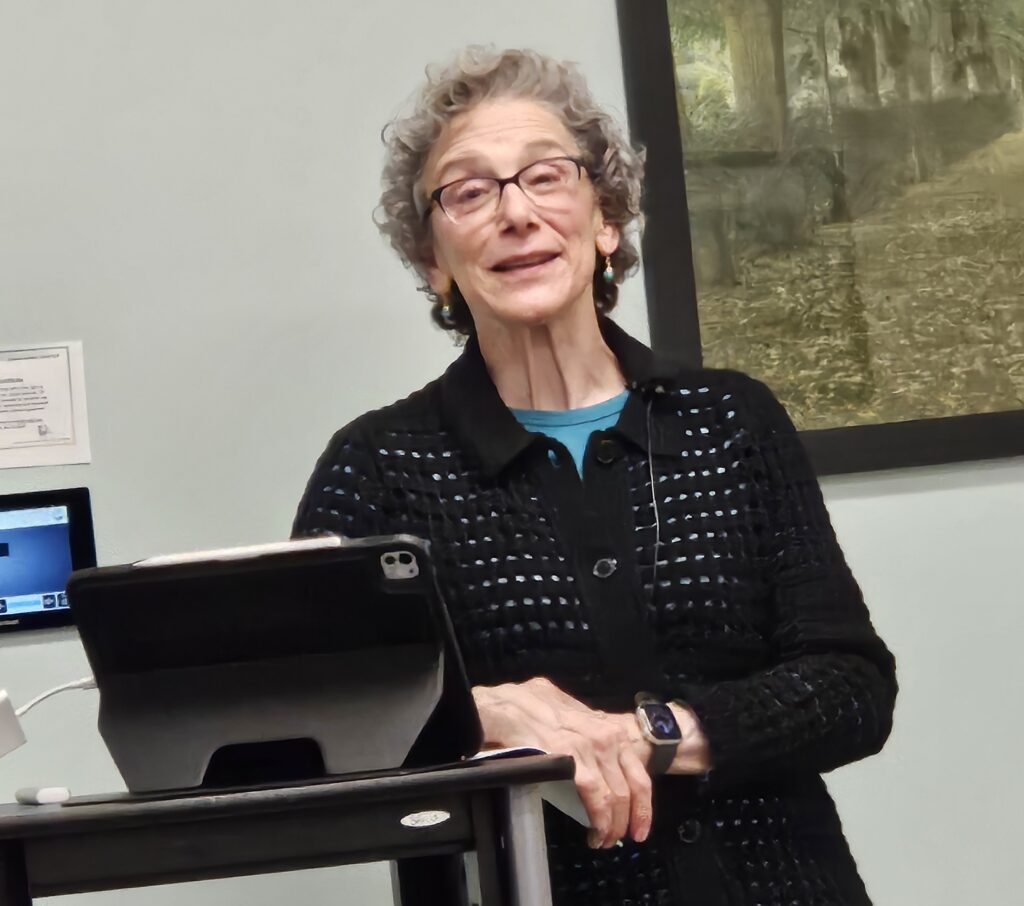
Bergmann, who lives in Acton, is one of America’s foremost public sculptors. Her talk, “History Made by Hand,” was sponsored by the Friends of the Council on Aging as part of its Honoring Excellence program. Over the course of 45 minutes, she walked her audience through five major public commissions, revealing the research, the choices, the occasional YouTube tutorial, and the genuine love of history that go into every monument she creates.
“More important to me than making beautiful sculptures is to make places and to tell stories,” she told the room. “Places where people can stop and think, feel safe enough to spend the time necessary to be moved and inspired.”
The Commission That Started It All: Boston’s Commonwealth Avenue
In 1998, Bergmann won her first major commission: the Boston Women’s Memorial on Commonwealth Avenue at Fairfield Street, honoring Abigail Adams, Phillis Wheatley, and Lucy Stone — three women chosen for their impact on society through writing. At the time, figurative statues were considered passé, and the committee challenged artists to design something contemporary yet harmonious with the Mall’s 19th-century character.
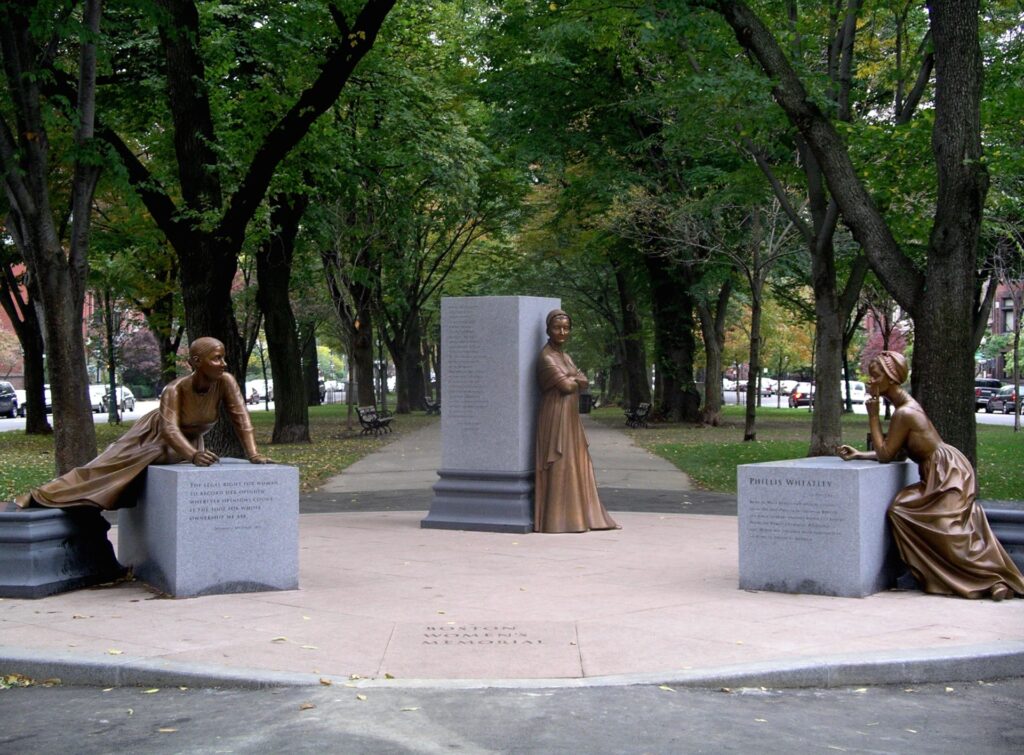
Bergmann’s solution was elegant. She studied the existing monuments along the Mall, all of men, and observed their shared vocabulary: large bronze figure, granite pedestal, inscribed quotation. Then she upended it.
“I realized I could bring the women literally down from their pedestals,” she said, “making a cliché come powerfully alive.”
Each of the three women would be portrayed at a different age, representing different stages of a woman’s life. Each would also embody a different creative temperament: Contemplative, Imaginative, and Active.
Abigail Adams, posed gazing back toward Boston Common, carries on her pedestal the famous line “Remember the Ladies” — her appeal to her husband, John, and the Continental Congress — as well as a passage from an 1807 letter reflecting on the velocity of history.
Phillis Wheatley’s story gave Bergmann particular pause. Kidnapped from West Africa and brought to Boston in 1761, enslaved by the Wheatley family who named her after the slave ship she arrived on, “knowing how she got her name always makes me shiver,” Bergmann said, Wheatley nevertheless mastered English, Latin, and Greek, and became famous as a poet. The only image of her is an engraving from the frontispiece of her book, which had to be published in England because no Boston printer would take it. Bergmann used nine different women as models to sculpt Wheatley’s full-round portrait, and drew inspiration for her twisting pose from Michelangelo’s Libyan Sibyl in the Sistine Chapel.
Lucy Stone, whose existence Bergmann said she hadn’t known before the commission, was a Massachusetts-born activist for abolition and women’s rights. “I realized it’s thanks to Lucy Stone that I could even sign my name, not my husband’s, to the contract for the commission,” Bergmann said. Stone is depicted having climbed atop her own pedestal to edit her Woman’s Journal. After the 2016 election, visitors placed “I VOTED” stickers on the statues, and someone left a handwritten note of apology in Lucy Stone’s hand. The inscription on Stone’s pedestal reads, “Let woman’s sphere be bounded only by her capacity.”
A Portrait of Justice: Ruth Bader Ginsburg
In 2010, Bergmann did something unusual for an artist: she wrote a fan letter. The recipient was Supreme Court Justice Ruth Bader Ginsburg.
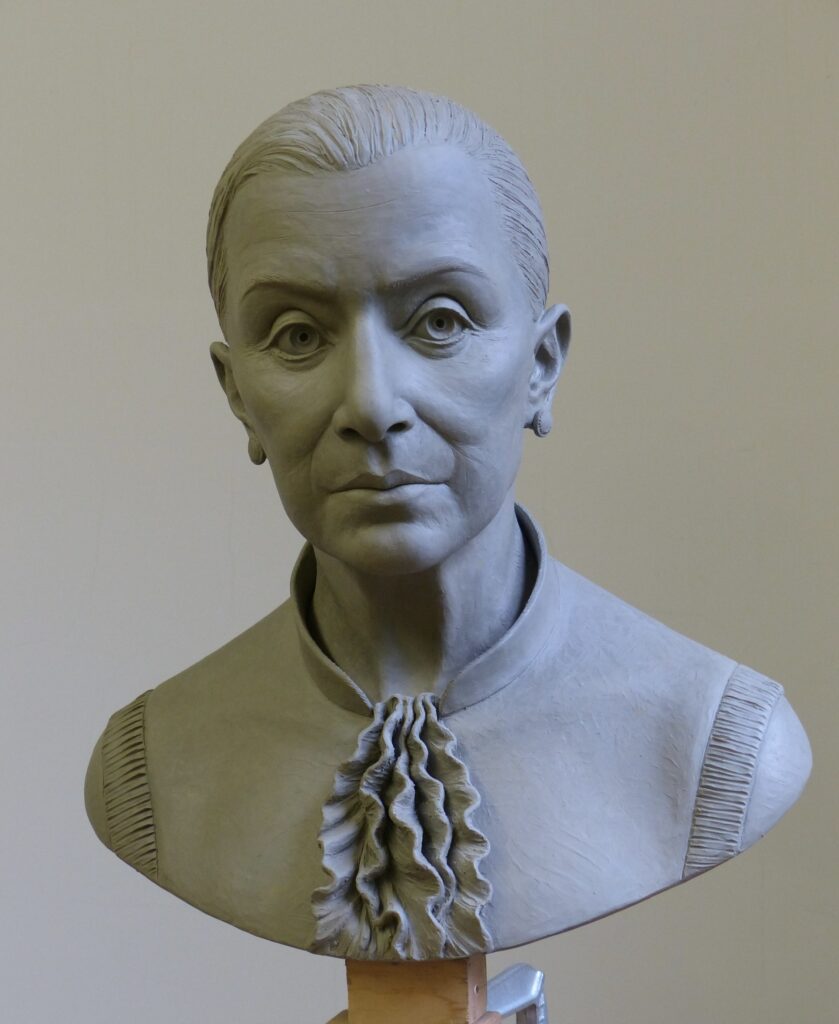
“I asked her to sit for a portrait, for just two sittings,” Bergmann recalled. Ginsburg agreed, received Bergmann and her family in her chambers, cleared a desk for the sculptor to work on, and showed her various robes and collars. She also signed a pocket Constitution for Bergmann’s son. Ginsburg didn’t exactly sit still, “she just kept working”, but Bergmann’s husband took 84 photographs, from which the portrait was completed months later.
Bergmann wanted the bust to evoke the great 18th-century portraits of the Founding Fathers sculpted by the French artist Houdon. The finished work is now in the collection of the Smithsonian’s National Portrait Gallery.
A decade later, in 2020, Bergmann was commissioned to sculpt a new portrait of Ginsburg for the New York State House in Albany, to be carved in sandstone and installed in the ornate 1883 “Million Dollar Staircase,” a space Bergmann likened to the art of M.C. Escher. The staircase was full of portraits of famous men; women were relegated to the very bottom. Bergmann’s Ginsburg, unveiled in August 2023 in a ceremony with Governor Hochul, depicts the justice in her prime, wearing the collar she reserved for special occasions.
Frances Perkins and the List That Changed America
In 2024, Bergmann unveiled a sculpture of Frances Perkins in Ithaca, New York. Perkins, a young social worker from Worcester, witnessed the 1911 Triangle Shirtwaist Factory fire in Manhattan, in which 146 workers, mostly women, died after jumping from a building whose owners had locked the exit doors. The experience transformed her.
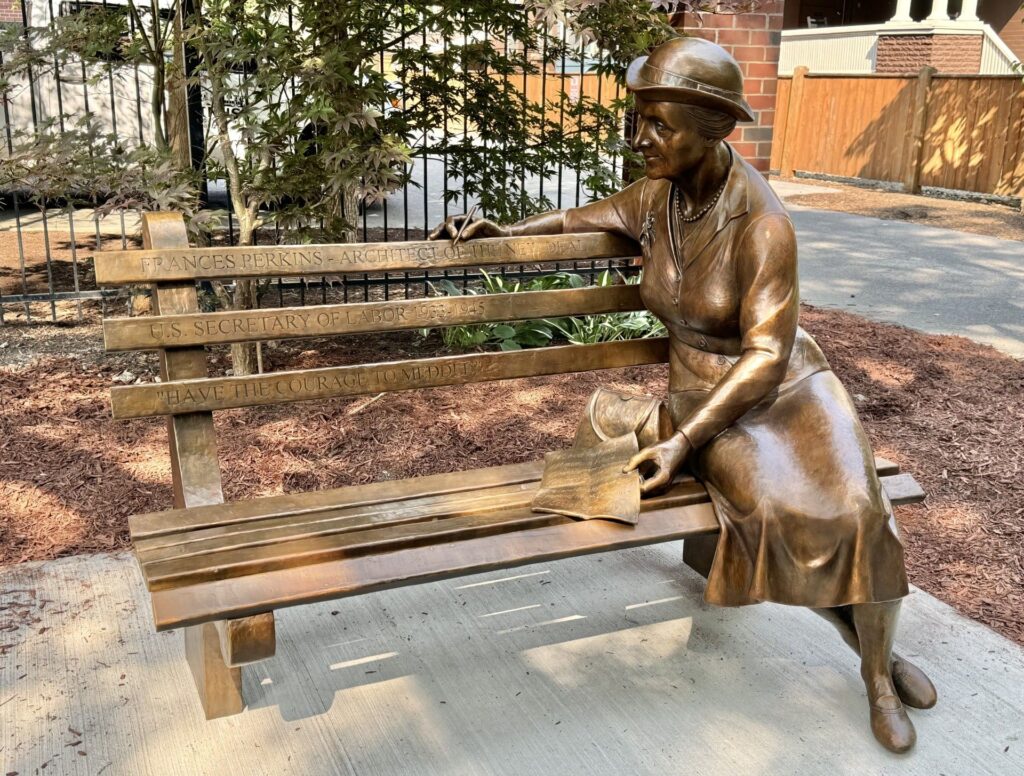
Twenty-two years later, when President Franklin Roosevelt asked her to become his Secretary of Labor, Perkins arrived with a list. Bergmann’s statue captures that moment: Perkins is seated on a bench, showing you the document.
“She’s showing you that list,” Bergmann said. The items on it were audacious for 1933: a 40-hour workweek, a federal minimum wage, unemployment insurance, workers’ compensation, an end to child labor, federal employment insurance, and Social Security. Only national health insurance failed to become law. “She is famous for being the architect of the New Deal, creating the social safety net on which we all, to some extent, rely,” Bergmann noted, adding pointedly that it “is now being undermined by the current administration.”
Perkins’s grandson attended the unveiling. He said he recognized her. Bergmann admitted she was “enormously relieved.”
Central Park at Last: Anthony, Stanton, and Truth
Twenty years after the Boston Women’s Memorial, New York City began to catch up to Boston, Bergmann observed with a certain satisfaction. Central Park had statues of many great men, and of Alice in Wonderland and Mother Goose, but not a single monument to a historical woman. A volunteer group called Monumental Women set out to change that, fighting city agencies who suggested they might prefer “a nice garden. How about in Queens?” After four years, they secured a site on the Literary Walk.

The three women chosen were Susan B. Anthony, Elizabeth Cady Stanton, and Sojourner Truth. Unlike the subjects of the Boston memorial, these women had actually met and worked together,which meant, for the first time, Bergmann could sculpt them truly interacting.
Stanton, she explained, was the radical philosophical engine of the movement, a mother of seven who wrote furiously at home while Anthony traveled and spoke. Anthony, in turn, regularly wrote to Stanton in a panic before legislative appearances: “I’m going before the legislature — you have to help me with a speech!” Stanton would reply: “If you’ll hold the baby and make the puddings, I’ll write you a speech.”
Sojourner Truth had walked away from slavery in upstate New York and made herself, in Bergmann’s phrase, “an icon of self-ownership and self-definition.” She sold portrait cards of herself dressed as a proper middle-class woman, often displaying her knitting — not a hobby, Bergmann explained, but a skill and patriotic duty during the Civil War, one that enslaved people were not taught.
Bergmann packed the sculpture with historical details. Anthony’s brooch bears the image of Minerva. Her alligator bag, famous enough to appear in a children’s jump-rope rhyme, overflows with pamphlets and petitions. Stanton’s dress features sunflowers, the emblem she adopted as a girl when she wrote a newspaper column under the pseudonym “Sunflower.” At her feet are books by Mary Wollstonecraft, Sarah Grimké, and Margaret Fuller.
The monument was unveiled on August 26, 2020, the anniversary of the ratification of the 19th Amendment, with Hillary Clinton speaking. Within weeks it had become a spontaneous memorial to Ruth Bader Ginsburg, draped in photographs and flowers. Before a subsequent election, someone attached a banner reading: “Put on your Big Girl panties and Vote” and “Grab your Future by the Ballots.” The banner lasted about three hours before the Parks Department removed it.
Coming Home: “Something Is Being Done” in Lexington
Of all Bergmann’s commissions, the most recent, and in some ways the most personal, is the one closest to Acton.
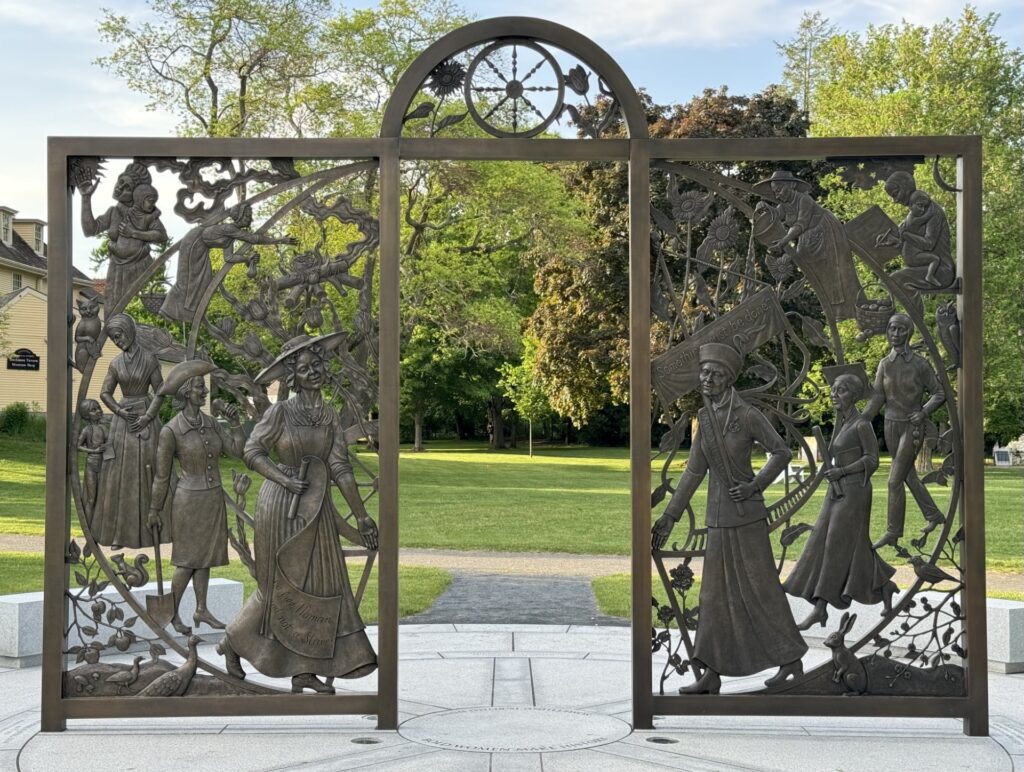
The Lexington Battle Green already had prominent monuments to the men who fought and died on April 19, 1775. A group called LexSeeHer wanted to add a permanent monument honoring women in an equally prominent location. They fought for their idea through town meetings, select board hearings, and presentations to multiple committees. They prevailed.
When they issued their call for proposals, the images they used to illustrate their vision were Bergmann’s own Boston and Central Park monuments. She was flattered, but felt strongly that she needed to bring a new idea. She proposed a freestanding bas-relief gateway: two monumental panels that include the silhouettes of powder horns (taken from the monuments to the Minutemen already on the Green), through which visitors could walk and reach out to touch the hands of women from across Lexington’s history.
The sculpture ultimately includes 24 figures plus symbolic plants and animals. Among them: an aviator, a college graduate, a newspaper editor, a suffragist, a woman burning tea (in Lexington’s own pre-Boston Tea Party protest), an enslaved mother whose child is being taken from her, and a mother urging her son toward the British. There is a famous astrophysicist, an architect, and the first female Town Selectperson, back-to-back with the first female Town Moderator.
One figure required special care. Margaret Tulip was enslaved in Lexington in the 1700s, freed by law when she came of age, then illegally re-enslaved by the nephew of her former owner. She sued and won her freedom in 1770. Late in the project, LexSeeHer located her living descendants. The sculptor couldn’t use one as a model — the clay was already finished — but she did something else: she resculpted Margaret’s extended hand to match the hand of Tulip’s descendant, Carol Goldsbury Tucker’s daughter Sidney, copying even the lifelines on her palm.
“When you reach out to take her hand,” Bergmann said, “you’re touching the bloodline of Margaret Tulip.”
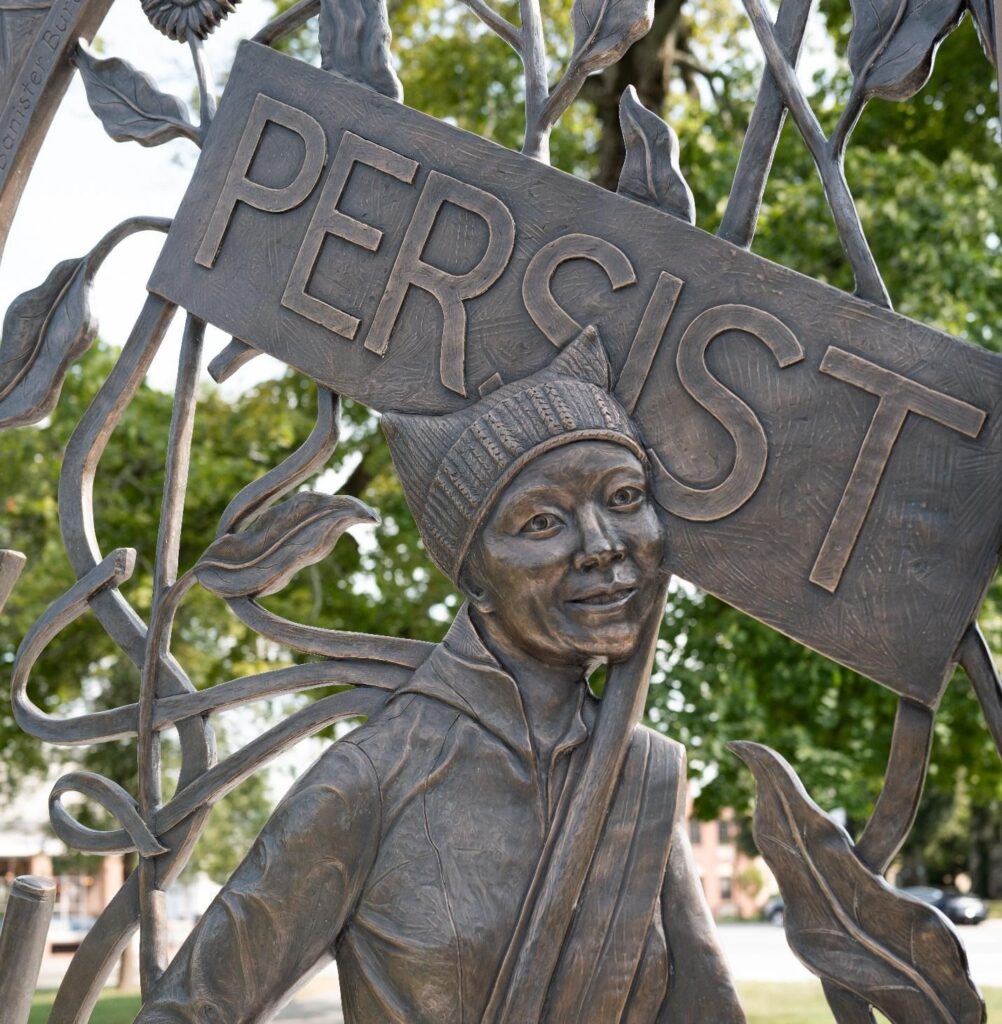
Threaded through the monument is a single strand of history that runs from 1775 to the present. Abigail Harrington, waking her teenage son before dawn on April 19 to tell him the British were coming, cried out: “Something must be done!” Those words were stitched onto a banner by Lexington women in 1887 to raise money for women’s suffrage. That banner was carried in the first large, organized march on Washington in 1913. On the opposite side of the gateway, back-to-back with the woman who sewed it, a young protester in a “Pussy Hat” holds a “Persist” sign.
A Family Film Worth Seeing
Bergmann closed her talk with news of a different kind of project: a feature-length fiction film, written by and starring people with non-speaking autism. Her son Dan wrote the screenplay, her husband Michael produced and directed, and she contributed production design and cinematography. Called Pointing Fingers, it follows a couple with non-speaking autism as they set out to live together independently — a love story, a crime drama, and a comedy.
The film will be screened on Saturday, May 9, 2026, at 12:45 p.m. at the Maynard Fine Arts Theatre, sponsored by the Autism National Committee. For an artist who has spent her career making visible those whom history overlooked, it may be her most personal work yet.
More images of Bergmann’s sculptures can be viewed at www.meredithbergmann.com. The Acton Exchange has reported previously on Bergmann’s work: an event honoring the Boston Women’s Memorial on its 20th anniversary, the unveiling of “Something is being Done,” her talk in the Acton 250 lecture series, and the premiere of “Talking Statues.”
Greg Jarboe is the Acton Exchange beat reporter for the Council on Aging and the Senior Center.