If last week you had a lot of icicles hanging from the eaves of your house or building, chances are you have a significant insulation or heat loss problem that needs fixing. It also means you are likely paying a higher heating bill than you need to and are at risk of ice dams occurring on your roof that can lead to water damage inside your home.
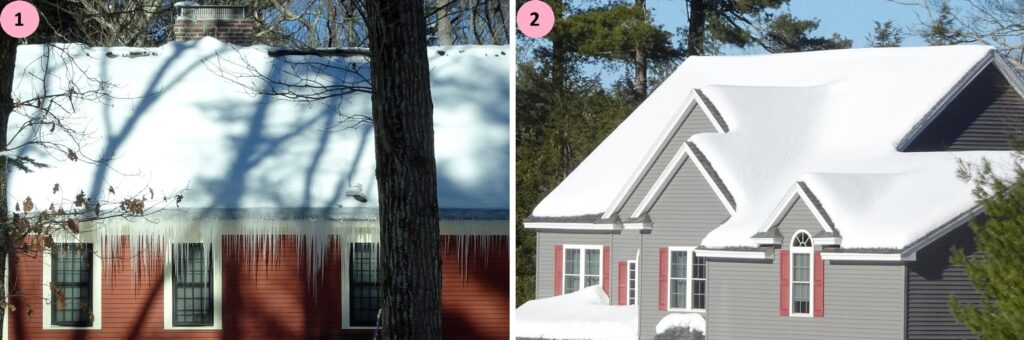
A few icicles normally occur on most roofs during the winter because of freeze-thaw cycles during the day, but you should be concerned if they look like what is shown in Photo 1,below. At this house there are icicles a couple of feet in length along the entire roof edge, even though the neighbor’s roof has none, and neither does the house up the street, Photo 2, located in bright sunlight!
Recognizing you may have a problem is, as always, the first step to making things better. A problem in the attic or attic crawlspace is likely because of one of three things: 1) insufficient insulation 2) air leaks from the conditioned living space below, or 3) not enough ventilation (in unconditioned space). The net effect of these problems is that heat is escaping the house through the roof and melting the overlying snow.
The good news is that there are people who can advise you — for free. Home owners, renters, and landlords can contact Mass Save to get a free Home Energy Assessment. During an assessment, an energy specialist will inspect your home and identify energy-saving opportunities, recommend upgrades, and describe available financial incentives. Mass Save will even pay 75% or more of the cost to better insulate your house!
You can also get local free advice and support from the Acton Sustainability’s Office’s Clean Energy Coaches. The coaches are trained residents of Acton who can answer all your energy-related questions about the insulation and weatherization process, heat pump technologies for home heating and cooling, installing solar, electric vehicles, and many other climate-friendly actions. You can request a free consultation with a coach through EnergizeActon or directly using this form.
Can you really determine whether your home needs more insulation or air sealing just by looking at your roof? Yes, but only when the circumstances are right — as they were last week. Unfortunately, by the time you read this article, the weather may have warmed up too much to definitively diagnose if you have a problem, but have a look anyway and compare your roof to your neighbors’ roofs to see if you can tell who has better insulation.
So let’s get you ready to do an evaluation in the future. Ideally you want a situation where snow falls in subfreezing conditions onto a bare roof and then have it stay well below freezing afterwards for several days. For example, after the big snow storm on Jan 25 it stayed bitterly cold (7˚ to 25˚ F) for six days when all these photos were taken. The cold temperatures and thick snow mean that the sunshine could not melt the snow nor reach the surface of the roof to heat it up. That means if icicles are present, it is because heat from the house melted the snow from below and the melt water flowed down to the overhanging edge of the roof where it freezes again on the roof (potentially causing ice dams) or drips off to form icicles.
In Photo 3, below, the roof is likely uninsulated. Not only do you see icicles, but also a kind of ridge and trough pattern in the snow on the roof. In this case, in the spaces/bays between the rafters the heat can readily conduct through the thin wood sheathing to melt the overlying snow and create the troughs/areas where the snow is now thin. The heat has a somewhat harder time conducting through the thicker rafters and so melts relatively less snow and so this is where you see the ridges/lines of thicker snow.
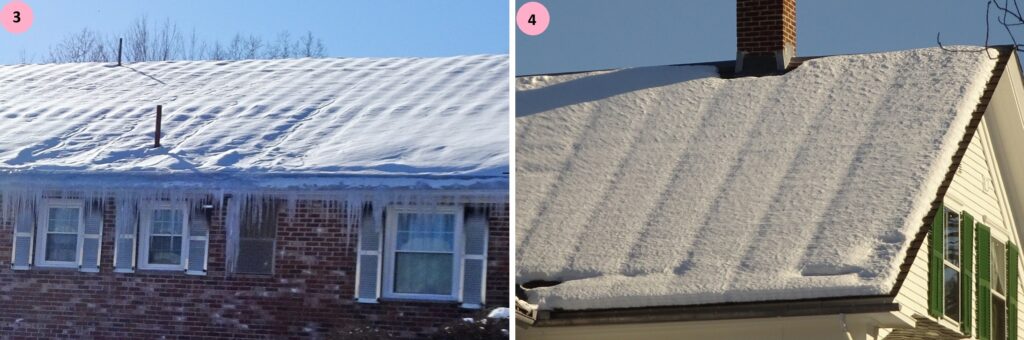
Beware, not all alternating linear patterns of snow melt on roofs indicate a big problem. In Photo 4, the roof is very well insulated with closed cell foam in the bays between the rafters. So here the rafters are actually better at conducting the heat than the insulation is. So the pattern is reversed,compared to Photo 3, with slight troughs at the rafters but thick snow everywhere and no icicles.
Of course you don’t have to wait until the next snow storm to figure out if you have a problem because you can get a Home Energy Assessment or consult a Clean Energy Coach any time.
Dr. Brewster Conant Jr. is a member of EnergizeActon and the Green Acton Water Committee and has used heat as a tracer in his hydrogeological research.